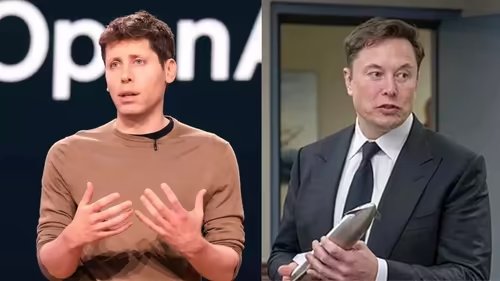
The tech world is on edge as a legal battle of epic proportions unfolds. At its center: a former founder, a world-changing AI company, and a staggering demand for $134 billion. This isn’t just a lawsuit; it’s a fundamental clash over the very soul of artificial intelligence.
Elon Musk, the CEO of Tesla and SpaceX, has filed a lawsuit against OpenAI and its primary backer, Microsoft, accusing them of a massive betrayal. His claim? That they defrauded him by abandoning the non-profit, pro-humanity mission he helped fund and build, all while enriching themselves. OpenAI and Microsoft have dismissed the suit as nothing more than “baseless harassment” . But what’s the real story here?
Table of Contents
- The $134 Billion Claim: What Is Musk Actually Suing For?
- The Heart of the Dispute: The Founding Agreement
- Microsoft’s Role in the Elon Musk vs OpenAI Feud
- OpenAI and Microsoft’s Defense
- Why This Lawsuit Matters for the Future of AI
- Conclusion: A Battle for AI’s Soul
- Sources
The $134 Billion Claim: What Is Musk Actually Suing For?
Musk’s lawsuit, filed in August 2024, is a multi-pronged attack. He alleges fraud, unjust enrichment, and breach of fiduciary duty against OpenAI and its leadership, including CEO Sam Altman . The core of his financial demand is based on two key arguments:
- Recovery of Seed Investment: Musk claims he was defrauded of his initial $38 million seed investment in the non-profit OpenAI.
- Share of Profits/Value: More significantly, he argues that because OpenAI abandoned its founding principles, he is entitled to a substantial share of the value it has created since its pivot to a for-profit model. His legal team estimates this value at between $79 billion and $134 billion .
This isn’t just about money; it’s a direct challenge to OpenAI’s current business model and its relationship with Microsoft.
The Heart of the Dispute: The Founding Agreement
The entire case hinges on a single, contentious document: the alleged 2015 founding agreement. Musk asserts that this agreement legally bound OpenAI to develop artificial general intelligence (AGI) “for the benefit of humanity” and to keep its technology open and accessible .
According to Musk, OpenAI’s shift to a for-profit structure in 2019 and its subsequent exclusive partnership with Microsoft constituted a direct violation of this sacred pact. He believes this move transformed OpenAI from a public good into a private, profit-driven entity under Microsoft’s control—a stark betrayal of its original vision .
However, this is where the story gets murky. OpenAI has publicly stated in legal filings that there was never a formal “founding agreement” that locked them into a purely non-profit, open-source future . They argue that the evolution of their business model was a necessary step to secure the massive funding required to compete in the AI race and that their mission to benefit humanity remains intact, even if their methods have changed.
Microsoft’s Role in the Elon Musk vs OpenAI Feud
Microsoft is not just a bystander in this drama; it’s a central player. The company’s deep involvement with OpenAI began with a landmark $1 billion investment in 2019, followed by another significant investment in 2021, and a reported $10 billion infusion in 2023 [[17], [20]].
In exchange for this capital, Microsoft secured an exclusive partnership, making Azure its primary cloud provider and giving it a significant stake in OpenAI’s future profits. From Musk’s perspective, this deal is the smoking gun. He sees it as the moment OpenAI sold its soul, trading its open, humanitarian mission for a cozy, lucrative relationship with a tech giant .
For Microsoft, this partnership is a strategic masterstroke, positioning it at the forefront of the AI revolution through its integration of OpenAI’s models like GPT into its own products, from Windows to Office. But Musk’s lawsuit directly threatens this arrangement, painting Microsoft as a co-conspirator in the alleged fraud.
OpenAI and Microsoft’s Defense
Both OpenAI and Microsoft have issued strong, unified statements dismissing Musk’s claims. Their defense rests on several key points:
- No Binding Agreement: As mentioned, OpenAI denies the existence of a binding founding agreement that would prevent its current structure .
- Evolution, Not Betrayal: They argue that the shift to a for-profit model was a pragmatic necessity to attract the billions in investment needed to build cutting-edge AI, which ultimately serves their mission better.
- Baseless Harassment: They characterize the lawsuit as a strategic move by Musk, who is now a direct competitor in the AI space with his own company, xAI, and its Grok chatbot . They see it as an attempt to disrupt a rival rather than a legitimate legal grievance.
Why This Lawsuit Matters for the Future of AI
The stakes of this legal battle extend far beyond the $134 billion price tag. It forces a critical conversation about the governance and direction of powerful AI technologies.
On one side is the ideal of open, decentralized AI development, championed by Musk, which aims to prevent any single corporation or government from monopolizing this transformative power. On the other is the reality of the immense resources required to build AGI, which often necessitates deep partnerships with large, well-funded corporations like Microsoft.
This case could set a precedent for how AI companies are founded, funded, and held accountable to their original missions. It also highlights the intense competitive pressures in the AI industry, where former allies can quickly become bitter rivals. For readers interested in the broader implications, our deep dive into [INTERNAL_LINK:ai-ethics-and-governance] explores these themes further.
Conclusion: A Battle for AI’s Soul
The Elon Musk vs OpenAI lawsuit is more than a billionaire’s legal fight; it’s a proxy war for the future of artificial intelligence. Musk is fighting to hold OpenAI to what he believes was its original promise—a promise of AI for all. OpenAI and Microsoft, meanwhile, are defending their right to evolve and secure the resources needed to build that future, even if it means operating within a corporate framework.
Whether Musk’s claims of fraud will hold up in court remains to be seen. However, the mere fact that this lawsuit exists has already sparked a vital global debate about who should control the most powerful technology of our time and to what end. The outcome could reshape the AI landscape for decades to come.
Sources
- Times of India: Elon Musk wants OpenAI and Microsoft to pay $100 billion plus for defrauding him
- Bloomberg: Elon Musk Sues OpenAI and Microsoft for Up to $134 Billion
- The Verge: OpenAI denies Musk lawsuit claim that there was founding agreement over nonprofit status
- Microsoft Blog: Microsoft invests in and partners with OpenAI