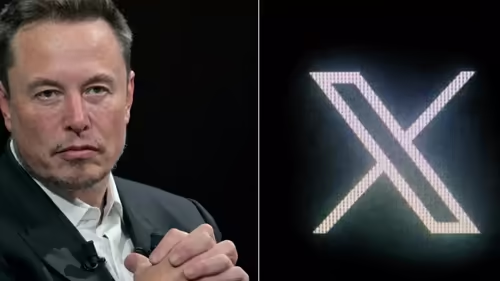
When X (formerly Twitter) went down briefly this week, most users grumbled and refreshed their feeds. But not Ryanair. The famously cheeky budget airline seized the moment to throw shade at none other than Elon Musk—and what followed was a rapid-fire, headline-grabbing exchange that laid bare a deeper rift over one of Musk’s most ambitious ventures: Starlink.
Their public spat isn’t just corporate banter—it’s a high-stakes clash over the future of in-flight connectivity, ego, and who really controls the skies (and the internet). Let’s unpack how a simple outage spiraled into one of the most viral CEO showdowns of 2026.
Table of Contents
- The Outage and Ryanair’s Opening Jab
- Elon Musk’s Scathing Counterattack
- The Real Issue: Why Ryanair Hates Starlink
- Clash of Titans: Musk vs. O’Leary
- What This Feud Means for In-Flight Wi-Fi
- Conclusion: More Than Just Tweets
The Outage and Ryanair’s Opening Jab
On January 15, 2026, X experienced a brief but noticeable global outage—a rare hiccup for the platform since Musk’s $44 billion acquisition . Within minutes, Ryanair’s official account posted a now-viral quip: “Perhaps you need Wi-Fi?” accompanied by a meme mocking the downtime .
It was classic Ryanair: sarcastic, on-brand, and designed to go viral. But they weren’t just trolling a social network—they were taking aim at Elon Musk personally, reigniting a simmering conflict over his satellite internet service, Starlink.
Elon Musk’s Scathing Counterattack
Musk didn’t let the jab slide. Within hours, he responded directly on X: “Should I buy Ryanair and appoint someone named ‘Ryan’ as CEO?” The dig was layered: it mocked Ryanair’s branding while implying its current leadership—CEO Michael O’Leary—was expendable.
But Musk didn’t stop there. He doubled down, calling O’Leary an “utter idiot” and accusing him of rejecting cutting-edge technology out of sheer stubbornness. The exchange quickly went viral, with millions of views and thousands of memes dissecting every word.
The Real Issue: Why Ryanair Hates Starlink
This wasn’t spontaneous drama. The tension has been brewing since late 2025, when Ryanair publicly dismissed Starlink as a viable option for its fleet. In a press briefing, O’Leary bluntly stated, “We don’t need Starlink… Elon Musk is an idiot” . His reasoning? Cost and practicality.
Ryanair operates on razor-thin margins, flying short-haul routes across Europe where passengers spend under two hours in the air. O’Leary argues that expensive satellite-based Wi-Fi like Starlink offers little value for such brief journeys—and would force fare hikes that contradict Ryanair’s ultra-low-cost model.
Meanwhile, Starlink has already partnered with major carriers like JSX, Hawaiian Airlines, and even some international flag carriers to offer high-speed, low-latency internet—even over oceans . For them, it’s a premium differentiator. For Ryanair? A luxury they refuse to afford.
Clash of Titans: Musk vs. O’Leary
At its core, this feud is a collision of two of the most combative CEOs in modern business:
- Elon Musk: The tech visionary who thrives on disruption, moonshots, and social media warfare. He sees Starlink as essential infrastructure for the future—including aviation.
- Michael O’Leary: The no-nonsense airline boss famous for his abrasive style, cost-cutting ruthlessness, and disdain for “unnecessary frills”—including, apparently, high-speed internet.
Both men relish provocation. Both have built empires by defying convention. And now, they’re using X—the very platform Musk owns—as their dueling ground.
What This Feud Means for In-Flight Wi-Fi
Beyond the insults, this clash highlights a real divide in the aviation industry:
- The Premium Camp: Airlines investing in Starlink to attract business travelers and justify higher fares. Early data shows passengers are willing to pay for reliable, fast internet mid-flight .
- The Budget Camp: Carriers like Ryanair prioritizing rock-bottom prices over amenities. Their stance: if you want Wi-Fi, fly someone else—or wait until you land.
According to the International Air Transport Association (IATA), in-flight connectivity is now a top-three passenger expectation on long-haul flights . But for short hops? The jury’s still out. Ryanair’s bet is that most of its customers care more about a €9.99 fare than streaming Netflix at 35,000 feet.
Still, as Starlink’s hardware costs decrease and installation becomes simpler, even budget airlines may face pressure to adopt it—especially if competitors do.
Conclusion: More Than Just Tweets
The Elon Musk-Ryanair feud might seem like billionaire banter, but it’s actually a proxy war over the future of air travel. On one side: innovation, connectivity, and premium experience. On the other: austerity, efficiency, and the relentless pursuit of the lowest possible price.
While Musk won’t be buying Ryanair anytime soon (despite his joke), the underlying question remains: as the world gets more connected, can any airline truly afford to stay offline? For now, Ryanair says yes. But in an era where even remote villages get Starlink, flying blind might become a harder sell.
Sources
- [1] Times of India: “Perhaps you need Wi-Fi?” Ryanair mocks X outage
- [2] Reuters: Ryanair CEO calls Elon Musk ‘idiot,’ dismisses Starlink
- [3] Downdetector: X (Twitter) Outage History
- [4] SpaceX Starlink Aviation Page: Starlink for Aviation
- [5] IATA Passenger Survey 2025: In-Flight Connectivity Trends