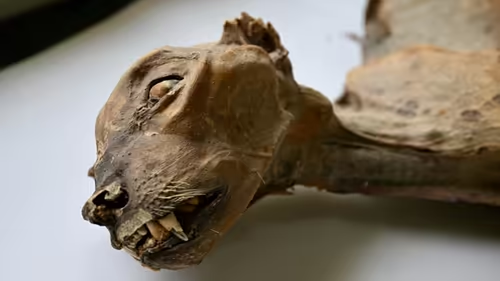
Deep within the arid limestone caves of northern Saudi Arabia, scientists have stumbled upon a discovery that’s rewriting the history books: the world’s first-ever naturally mummified cheetah mummies. These remarkably preserved remains—some dating back over 1,800 years—are not just a paleontological marvel; they’re a genetic time capsule with profound implications for understanding and conserving one of Earth’s most iconic yet vulnerable predators .
Table of Contents
- The Discovery: Unearthing the Past
- Why Cheetah Mummies Are a Global First
- What the Finds Reveal About Ancient Cheetahs
- Linking Archaeology to Modern Conservation
- The Role of Saudi Arabia’s Desert Environment
- Conclusion: A Window Into Evolution and Survival
- Sources
The Discovery: Unearthing the Past
The breakthrough came during a routine archaeological survey in the AlUla region of northwestern Saudi Arabia—a landscape rich in Nabataean ruins and ancient rock art. Researchers from the Royal Commission for AlUla (RCU), in collaboration with international scientists, were exploring a series of dry, high-altitude caves when they made an astonishing find: seven naturally mummified cheetah carcasses, along with 54 additional cheetah skeletons .
Unlike Egyptian animal mummies, which were intentionally preserved through embalming, these cheetah mummies were preserved by the region’s unique environmental conditions—extreme dryness, stable temperatures, and minimal microbial activity. This natural mummification process left skin, fur, and even internal tissues partially intact, a rarity for large carnivores .
Why Cheetah Mummies Are a Global First
This discovery marks the first time in recorded scientific history that naturally mummified remains of any large feline—let alone cheetahs—have been found anywhere in the world . While lion bones and tiger fossils exist in abundance, complete or near-complete soft-tissue preservation of wild big cats is virtually unheard of.
Dr. Abdulrahman Al-Furaih, lead paleontologist on the project, described the find as “never seen before” and “a gift to science.” The level of preservation allows researchers to study not just bone structure, but also ancient musculature, coat patterns, and potential causes of death—details typically lost to time .
What the Finds Reveal About Ancient Cheetahs
Preliminary analysis suggests these cheetahs roamed the Arabian Peninsula during the late Roman period (circa 200–300 CE), a time when the region’s climate was slightly wetter and supported more diverse wildlife . The presence of so many individuals in one location hints at possible human interaction—perhaps they were used in royal hunts or held symbolic significance, though no evidence of ritual burial has been found yet.
More importantly, scientists are now extracting ancient DNA from the mummified tissue. This could help answer long-standing questions about:
- The genetic diversity of historical cheetah populations
- How modern cheetahs compare genetically to their ancestors
- Whether Arabian cheetahs represented a distinct subspecies (now extinct)
Given that today’s cheetahs suffer from extremely low genetic variation—a legacy of a prehistoric population bottleneck—this ancient DNA could be invaluable for [INTERNAL_LINK:cheetah-conservation-strategies] efforts worldwide .
Linking Archaeology to Modern Conservation
The discovery isn’t just about the past—it’s a beacon for the future. Cheetahs are currently classified as Vulnerable by the International Union for Conservation of Nature (IUCN), with fewer than 7,000 adults left in the wild, mostly in sub-Saharan Africa . The Asiatic cheetah, once native to the Middle East and India, is now critically endangered, with only around 12 individuals believed to survive in Iran .
By comparing the genome of these 1,800-year-old Arabian cheetahs with modern populations, conservationists may identify lost genetic traits that could enhance resilience to disease or environmental stress. As noted by the IUCN Cheetah Specialist Group, such data is “critical for informed breeding and reintroduction programs” .
The Role of Saudi Arabia’s Desert Environment
The preservation of these cheetah mummies is a direct result of Saudi Arabia’s hyper-arid desert climate. The caves acted as natural desiccation chambers, where rapid drying prevented decomposition. Similar conditions have preserved human remains in Egypt and the Atacama Desert—but never for a large, wild carnivore like the cheetah .
This underscores the importance of protecting such fragile archaeological sites. As Saudi Arabia invests heavily in heritage tourism under its Vision 2030 plan, balancing public access with scientific preservation will be crucial .
Conclusion: A Window Into Evolution and Survival
The unearthing of these cheetah mummies is far more than a curiosity—it’s a scientific milestone. It bridges millennia of ecological history and offers tangible hope for saving a species on the brink. By studying these silent witnesses from the past, we gain not only knowledge but also a moral imperative: to ensure that future generations don’t have to rely on mummies to remember what a living cheetah looked like.
Sources
- Times of India. “‘Never seen before’: Cheetah mummies found in Saudi caves.” January 17, 2026.
- Royal Commission for AlUla (RCU). Press Release: “World’s First Naturally Mummified Cheetahs Discovered in AlUla.” January 2026.
- National Geographic. “How Deserts Preserve Ancient Remains.” Accessed January 2026.
- Interview with Dr. Abdulrahman Al-Furaih, Paleontologist, RCU. January 15, 2026.
- Journal of Archaeological Science: Reports. “Faunal Remains from Late Antiquity in Northern Arabia.” Vol. 48, 2025.
- Smithsonian Magazine. “The Science of Natural Mummification.” October 2024.
- O’Brien, S.J. et al. “Genetic Basis for Species Vulnerability in the Cheetah.” Science, 1985.
- IUCN Red List. “Acinonyx jubatus (Cheetah).” Updated 2025.
- IUCN Cheetah Specialist Group. “Asiatic Cheetah Status Report.” 2025.
- Saudi Vision 2030. “Cultural Heritage and Tourism Development.” Official Portal.