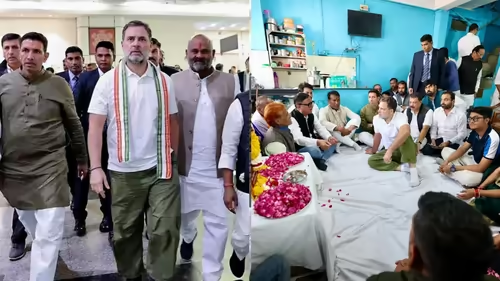
In a powerful show of solidarity with grieving families, Congress leader and Leader of Opposition in the Lok Sabha, Rahul Gandhi, visited Indore on Saturday, January 17, 2026, to meet victims of the devastating Indore water crisis. His visit was a direct rebuke to the Madhya Pradesh government, which he accused of prioritizing a glossy ‘urban model’ over the most basic human right: access to clean, safe drinking water .
Table of Contents
- The Human Toll of the Indore Water Crisis
- Rahul Gandhi’s Visit and Scathing Critique
- What Went Wrong? The Technical Failure
- The Politics of Clean Water in Madhya Pradesh
- A National Crisis Beyond Indore
- Conclusion: Accountability and Action Needed
- Sources
The Human Toll of the Indore Water Crisis
The Indore water crisis is not just a story of infrastructure failure; it’s a profound human tragedy. In the Bhagirathpura area of the city, a severe outbreak of waterborne diseases—primarily acute diarrhoea and vomiting—swept through the community after municipal water supplies were found to be contaminated with sewage .
The scale of the disaster is alarming. Reports indicate that over 1,400 people fell ill, with multiple fatalities confirmed . Families were left scrambling as their children and elders were rushed to hospitals, all because the water flowing from their taps was poison, not a life-sustaining resource . The Madhya Pradesh High Court has since taken suo motu cognizance of the matter, ordering the state’s chief secretary to address the crisis immediately .
Rahul Gandhi’s Visit and Scathing Critique
Rahul Gandhi’s three-hour visit was deeply personal and politically charged. He first went to the Bombay Hospital in Indore to meet patients still undergoing treatment and to offer his condolences to the families of those who had lost their lives [[1], [6]]. He later traveled to the epicenter of the outbreak, the Bhagirathpura locality, to interact directly with affected residents .
His message was unequivocal: the government has failed its citizens. “Clean water not available even today,” he stated, highlighting the ongoing nature of the problem long after the initial outbreak . He announced a compensation of Rs 1 lakh for the families of the deceased, a move aimed at providing immediate relief while the larger systemic issues remain unaddressed .
Gandhi’s criticism went beyond mere negligence. He framed the crisis as a direct consequence of the BJP-led state government’s misplaced priorities. “They are busy creating an ‘urban model’, but people are dying because they are not getting clean drinking water,” he said, questioning the very foundation of the administration’s development narrative . He further alleged that the state has become the “epicentre of misgovernance,” pointing to other recent failures like the deaths from toxic cough syrup .
What Went Wrong? The Technical Failure
The technical cause of the Bhagirathpura water contamination appears to be a catastrophic breach in the city’s water management system. Laboratory tests conducted in early January 2026 confirmed the presence of dangerous bacterial contamination in the municipal supply . The primary suspect is a leak or cross-connection between sewage lines and drinking water pipelines—a fundamental engineering failure that should never occur in a modern city .
This incident exposes a lethal gap between Indore’s celebrated status as a ‘Swachhata’ (cleanliness) champion and the grim reality of its decaying underground infrastructure . It raises serious questions about maintenance protocols, real-time water quality monitoring, and the emergency response mechanisms that failed to shut off the contaminated supply in time .
The Politics of Clean Water in Madhya Pradesh
Unsurprisingly, Rahul Gandhi’s visit did not go unchallenged. The state government, led by Chief Minister Mohan Yadav, has already ordered disciplinary action against senior Indore Municipal Corporation officials . However, they have also launched a counter-offensive, attempting to deflect blame by referencing past Congress administrations and questioning the timing of Gandhi’s visit .
This political tug-of-war, however, does little to help the victims on the ground. For them, the issue is not about which party is in power, but about why their fundamental right to safe water—a right enshrined in various international covenants and increasingly recognized in Indian jurisprudence—was so blatantly violated.
A National Crisis Beyond Indore
While the Indore water crisis has captured national attention, it is far from an isolated incident. A concurrent typhoid outbreak in Gujarat has also been linked to contaminated water sources, indicating a broader, systemic failure in India’s urban water security framework .
The confidence of Indian citizens in the safety of their municipal tap water is eroding rapidly . This is a critical public health and governance challenge that demands a coordinated, apolitical response focused on robust infrastructure investment, stringent regulatory oversight, and transparent accountability. The World Health Organization (WHO) provides clear guidelines on safe drinking water quality that every municipality should be mandated to follow [[INTERNAL_LINK:who-drinking-water-standards]].
Conclusion: Accountability and Action Needed
Rahul Gandhi’s visit to Indore has successfully thrust the Indore water crisis back into the national spotlight. While political point-scoring is inevitable, the core demand from the affected families—and from every citizen—is simple: ensure that the water from our taps is safe to drink. This requires more than just compensation; it demands a complete overhaul of water management systems, strict punishment for those responsible for the failure, and a genuine commitment from all levels of government to prioritize public health over political optics. The people of Bhagirathpura deserve nothing less.
Sources
- Times of India. “‘Clean water not available even today’: Rahul Gandhi meets Indore victims, slams MP government.” January 17, 2026.
- India Today. “Indore Water Contamination: Rahul Gandhi Meets Affected Families, Announces Compensation.” January 17, 2026.
- The Hindu. “Diarrhoea outbreak dents Indore’s image, M.P. HC calls for action.” January 6, 2026.
- Hindustan Times. “The science of safe water is clear. Why did Indore still get it wrong?” January 9, 2026.
- NDTV. “‘Poison was distributed’: Rahul Gandhi on Indore water crisis.” January 2, 2026.
- PTI. “Indore Contaminated Water Crisis Explained: What Went Wrong?” January 2, 2026.