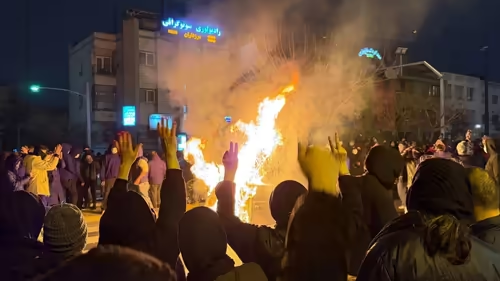
The streets of Iran are eerily quiet, but the silence is deafening. Beneath the surface of this apparent calm lies a horrifying truth: a government crackdown so severe that it has claimed the lives of more than 3,400 people in just a few weeks. This isn’t just another protest; it’s the bloodiest chapter in Iran’s post-revolution history, and the world is watching—though much of the information is being deliberately hidden.
Table of Contents
- What Happened? The Spark That Lit the Fire
- The Staggering Iran Protests Death Toll
- The Digital Blackout: Hiding a Massacre
- The Cautious US Response and Global Reactions
- The Deep Economic Roots of the Unrest
- Conclusion: A Nation on the Brink
- Sources
What Happened? The Spark That Lit the Fire
What began as a wave of frustration over Iran’s crippling economic crisis—soaring inflation, unemployment, and the collapse of the national currency—quickly evolved into something far more profound . Citizens, exhausted by decades of mismanagement and corruption, took to the streets in late December 2025. Their initial economic grievances soon transformed into a direct challenge to the very foundation of the Islamic Republic’s clerical leadership .
This new wave of dissent builds on the social momentum of the 2022 Mahsa Amini protests, which were centered on women’s rights and state-mandated morality laws . In 2026, the call for change has become all-encompassing, demanding not just economic relief but a complete political overhaul.
The Staggering Iran Protests Death Toll
The human cost of this uprising is almost unimaginable. While the Iranian government remains silent or offers wildly inaccurate figures, independent human rights organizations have been working tirelessly to document the true scale of the massacre.
According to Iran Human Rights (IHRNGO), as of January 14, 2026, at least 3,428 protesters had been killed by state security forces . Another prominent group, the U.S.-based Human Rights Activists News Agency (HRANA), has verified 3,090 deaths, with the vast majority—2,885—being peaceful protesters . These numbers make this the deadliest period of internal unrest in Iran since the 1979 revolution.
The violence has been indiscriminate. Reports confirm the deaths of at least twelve children, painting a grim picture of a regime willing to use any means necessary to crush dissent .
The Digital Blackout: Hiding a Massacre
To conceal its actions from the world and prevent the coordination of further protests, the Iranian government imposed a near-total internet and communications blackout on January 8, 2026 . This digital curtain has been described as one of the most severe in the country’s history, cutting off phone lines, mobile data, and even attempts to access the outside world via satellite services like Starlink .
Human rights groups argue that this deliberate information chokehold is a clear tactic to hide the “true extent of human rights violations” occurring across the nation . With the world largely in the dark, the regime has been able to escalate its lethal crackdown with minimal international scrutiny .
The Cautious US Response and Global Reactions
The international community has been left grappling with how to respond. The United States, under the Trump administration, has issued strong warnings. President Trump himself has publicly stated that if Iran “violently kills peaceful protesters,” the US “will come to their rescue” . However, the official stance has been one of caution, with the administration stating that “all options are on the table” while simultaneously imposing new sanctions on key Iranian security officials [[19], [20]].
This careful balancing act reflects the complex geopolitical reality. While there is a clear moral imperative to act, the risks of direct military intervention are immense. For now, the US and its allies are relying on diplomatic pressure and targeted sanctions to hold the regime accountable, a strategy that many critics argue is insufficient given the scale of the atrocities .
The Deep Economic Roots of the Unrest
While the current protests are undeniably political, their origin story is deeply economic. Years of international sanctions, combined with rampant corruption and a shadow economy controlled by the elite, have devastated the Iranian public welfare system .
The immediate trigger was President Masoud Pezeshkian’s attempt to push through long-delayed but deeply unpopular economic reforms, including a harsh new budget that promised more austerity for an already suffering population . Frustration over unstable prices and a lack of basic necessities boiled over, creating a tinderbox that was ready to ignite .
In essence, the Iran protests death toll is the tragic consequence of a state that has failed its people on every front—economically, politically, and socially.
Conclusion: A Nation on the Brink
The situation in Iran remains fluid and incredibly dangerous. The authorities may have succeeded in quelling the visible demonstrations through sheer brutality and a digital blackout, but the underlying anger has not disappeared—it has only been driven underground. The unprecedented Iran protests death toll is a stark warning of a regime that is willing to sacrifice its own citizens to maintain power. The world must not look away, even when the information is hard to find. The future of Iran, and the lives of its people, hang in the balance.
Sources
- Iran Human Rights (IHRNGO). (2026, January 14). At Least 3428 Protesters Killed in Iran. Retrieved from [https://iranhumanrights.org](https://iranhumanrights.org)
- Human Rights Activists News Agency (HRANA). (2026, January 17). Death toll in Iran protests over 3000. Retrieved from [https://www.hra-news.org](https://www.hra-news.org)
- Amnesty International. (2026, January 9). Iran: Authorities must end brutal crackdown on protests. Retrieved from [https://www.amnesty.org](https://www.amnesty.org)
- Human Rights Watch. (2026, January 13). Iran’s Internet Blackout Concealing Atrocities. Retrieved from [https://www.hrw.org](https://www.hrw.org)
- Council on Foreign Relations. (2026, January 15). Protests in Iran: Possible U.S. Responses and Issues for Congress. Retrieved from [https://www.cfr.org](https://www.cfr.org)
- [INTERNAL_LINK:middle-east-politics]
- [INTERNAL_LINK:human-rights-violations]