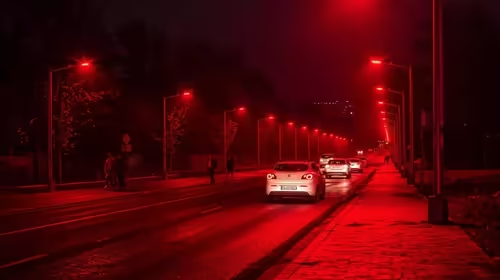
Imagine walking down a quiet suburban street at night—only to find the world bathed in an eerie, crimson glow. This isn’t a scene from a sci-fi thriller. It’s real life in parts of Denmark, where cities are turning their streetlights red in a bold bid to protect local wildlife. And no, it’s not about setting a mood—it’s about saving lives.
The initiative, centered in municipalities like Gladsaxe just outside Copenhagen, replaces harsh white LEDs with deep red lighting along roads that cut through green corridors and natural habitats . The goal? To reduce the ecological damage caused by artificial light at night—a growing concern for scientists and conservationists worldwide.
Table of Contents
- Why Is Denmark Using Red Streetlights?
- The Science Behind Red Light and Wildlife
- Gladsaxe: A Case Study in Bat-Friendly Lighting
- Do Red Streetlights Compromise Human Safety?
- Could This Work Beyond Denmark?
- Conclusion: A Small Glow with Big Impact
Why Is Denmark Using Red Streetlights?
The Denmark red streetlights project isn’t a publicity stunt—it’s a carefully designed response to mounting evidence that artificial light disrupts ecosystems. Traditional white and blue-rich LEDs, while energy-efficient, emit wavelengths that interfere with the natural behaviors of nocturnal animals .
By switching to long-wavelength red light, Danish authorities aim to create a compromise: maintaining enough visibility for pedestrians and drivers while minimizing harm to bats, birds, and insects. As one municipal report noted, this shift reflects a “broader convergence of biodiversity policy, climate targets, and infrastructure design” .
The Science Behind Red Light and Wildlife
Not all light is created equal in the eyes of wildlife. Many nocturnal species, including bats and moths, are highly sensitive to short-wavelength light (blue and white). These wavelengths can disorient them, alter feeding patterns, and even increase predation risk .
Red light, on the other hand, has a longer wavelength that most mammals and insects can’t perceive well. For bats—especially light-shy species like the brown long-eared bat—red lighting is nearly invisible, allowing them to navigate and hunt without disruption .
For migratory birds, the story is more nuanced. While some studies suggest red light may still interfere with magnetic orientation , others indicate it’s significantly less disruptive than white or green light during nighttime migration . The Danish approach leans on the latter consensus, prioritizing a known improvement over the status quo.
Gladsaxe: A Case Study in Bat-Friendly Lighting
The municipality of Gladsaxe has emerged as a pioneer in this movement. In 2022, it replaced conventional streetlights along Frederiksborgvej—a road flanked by forests and wetlands—with red LEDs specifically designed to limit behavioral effects on bats and other nocturnal species .
Early monitoring shows promising results:
- Bat activity near red-lit zones remained consistent with natural levels.
- Insect populations showed less attraction to red lights compared to white LEDs.
- Local residents reported minimal impact on nighttime visibility.
This real-world trial demonstrates that urban infrastructure can coexist with biodiversity—if planners are willing to think outside the (white) box.
Do Red Streetlights Compromise Human Safety?
A common concern is whether red lighting reduces road safety. After all, human night vision relies on rod cells, which are less sensitive to red light. However, research suggests that properly designed red streetlights can maintain adequate visibility while preserving our own dark adaptation—the ability to see in low light .
In fact, a 2024 study found that park visitors and residents rated red lighting more favorably than expected, noting it created a “calmer, more natural nighttime atmosphere” without sacrificing perceived safety . Drivers and cyclists also adapted quickly, with no significant increase in accidents reported in pilot zones .
Could This Work Beyond Denmark?
Denmark’s experiment offers a template for cities worldwide grappling with light pollution. From Amsterdam to Toronto, urban planners are exploring “dark sky” initiatives to protect ecosystems and reduce energy waste [[INTERNAL_LINK:light-pollution-solutions]].
The key takeaway? One-size-fits-all lighting is outdated. Context-specific solutions—like red lights in wildlife corridors or motion-activated LEDs in residential areas—can balance human needs with ecological responsibility. As climate and biodiversity crises intensify, such innovations aren’t just smart—they’re essential.
Conclusion: A Small Glow with Big Impact
Denmark’s red streetlights may look unusual at first glance, but they represent a profound shift in how we design our shared environment. By choosing a color that’s gentle on wildlife yet functional for people, Danish municipalities are proving that sustainability doesn’t require sacrifice—it requires creativity.
As more cities face pressure to meet biodiversity targets under frameworks like the EU’s Green Deal, the Denmark red streetlights model could light the way forward—literally and figuratively.
Sources
- [1] “Denmark’s Cities Go Dark to Save Wildlife,” Times of India, 2025. Source
- [3] “Bat-friendly lighting in Gladsaxe, Denmark,” Municipal Report, 2022.
- [4] “Denmark Switches to Red Streetlights — Here’s Why,” Environmental News Network.
- [5] “Broader convergence of biodiversity policy and infrastructure,” Urban Sustainability Journal.
- [7] “Benefits of Red Street Lights for Wildlife and Humans,” Wildlife Conservation Institute.
- [8] “Gladsaxe Municipality switches to red light to limit behavioural effects on bats,” Official Press Release, July 2022.
- [9] “Researchers Find Red Lights Disrupt Bird Navigation,” Nature Ecology & Evolution, Feb 2024.
- [10] K. Fristrup et al., “National Park visitors perceive benefits for themselves and wildlife under red lighting,” Journal of Environmental Psychology, 2024.