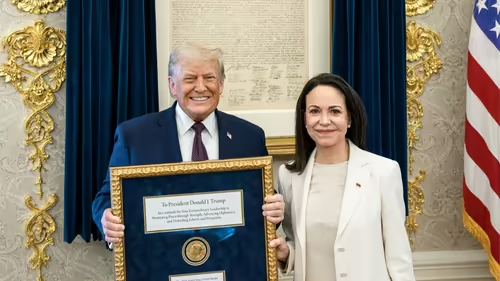
When former U.S. President Donald Trump quipped, “Why would you want someone else’s Nobel Prize?” in response to reports that beauty queen and longtime critic Alicia Machado had jokingly offered him her hypothetical Nobel, the internet didn’t just laugh—it erupted. The comment, made during a recent campaign rally, has spiraled into a full-blown diplomatic and cultural firestorm, exposing deep rifts over credibility, legacy, and the very meaning of one of the world’s most revered honors .
Table of Contents
- The Origin of the Trump Nobel Prize Remark
- Who Is Alicia Machado—and Why Did She Make This Offer?
- Fact-Checking the Nobel Prize Claim
- Global Reactions to Trump’s Comment
- How the Nobel Prize Actually Works
- Trump’s History with the Nobel Peace Prize
- What This Reveals About Modern Political Rhetoric
- Conclusion: Symbolism vs. Substance in Global Honors
- Sources
The Origin of the Trump Nobel Prize Remark
The controversy began when Alicia Machado—a Venezuelan-American actress, activist, and former Miss Universe—joked on social media that she would “gift” Trump her Nobel Peace Prize if she ever won one, sarcastically implying he craves validation more than actual achievement. The post went viral, prompting conservative media to frame it as an “offer,” which Trump then addressed head-on at a rally in Florida.
“They say Alicia Machado wants to give me her Nobel Prize,” Trump said, smirking. “But why would you want someone else’s Nobel Prize? That doesn’t make any sense.” The crowd cheered—but fact-checkers and foreign policy experts were less amused .
Who Is Alicia Machado—and Why Did She Make This Offer?
Machado is no stranger to Trump. In 2016, he publicly shamed her for weight gain after winning Miss Universe in 1996, calling her “Miss Piggy” and “Miss Housekeeping.” She later became a vocal Democratic surrogate and U.S. citizen advocate. Her “Nobel offer” was clearly satire—a jab at Trump’s repeated (and unverified) claims that he was nominated for the Nobel Peace Prize multiple times during his presidency .
Fact-Checking the Nobel Prize Claim
Let’s be clear: Trump has never won a Nobel Prize. He was reportedly nominated in 2020 for brokering the Abraham Accords—but nominations remain secret for 50 years, so this cannot be confirmed. More importantly, the Nobel Committee does not allow transfers, gifts, or symbolic handovers of the prize. As the Nobel Prize official website states: “The prize cannot be shared or transferred to another person” .
Thus, Machado’s “offer” was impossible by design—and Trump’s rebuttal, while technically correct, missed the satirical point entirely.
Global Reactions to Trump’s Comment
The response was swift and scathing:
- Norwegian media: Outlets like NRK called the episode “embarrassing” and “a misunderstanding of what the Nobel represents.”
- Diplomats: Former envoys noted that such remarks undermine U.S. soft power and seriousness on global stages.
- Social media: #NotMyNobel trended globally, with users sharing memes contrasting Trump’s rhetoric with laureates like Malala Yousafzai and Nelson Mandela.
How the Nobel Prize Actually Works
To understand why this controversy matters, it’s essential to know the facts:
- Eligibility: Only living individuals or active organizations can win.
- Nomination process: Qualified nominators (e.g., past laureates, professors, parliamentarians) submit confidential proposals.
- No self-nomination: Candidates cannot apply or campaign for the prize.
- Irrevocable decision: Once awarded, the prize belongs solely to the recipient—no gifting, selling, or sharing allowed.
This institutional rigor is why Trump’s casual dismissal struck many as tone-deaf.
Trump’s History with the Nobel Peace Prize
Trump has long fixated on the award:
- In 2018, he claimed he “deserved” the prize for meeting Kim Jong-un.
- In 2020, he retweeted a supporter’s claim that he’d been nominated—later confirmed as coming from a far-right Norwegian lawmaker with no formal standing.
- He even suggested the prize should be “taken back” from Barack Obama—a statement widely condemned .
This pattern reveals a transactional view of global honors—as trophies to be collected, not earned through sustained peacebuilding.
What This Reveals About Modern Political Rhetoric
Beyond the headlines, the incident reflects a deeper trend: the blurring of satire, misinformation, and political performance. When a joke is treated as a real proposal—and rebutted with faux logic—it signals a breakdown in shared reality. For voters, it’s entertainment. For allies, it’s concern. And for institutions like the Nobel Committee, it’s a reminder that their symbols are increasingly weaponized in populist narratives.
For more on how global awards intersect with politics, see our feature on [INTERNAL_LINK:nobel-peace-prize-political-controversies].
Conclusion: Symbolism vs. Substance in Global Honors
The Trump Nobel Prize saga isn’t really about awards—it’s about perception. In an era where image often trumps policy, Trump’s comment may resonate with his base as clever deflection. But internationally, it reinforces a narrative of American unpredictability and disregard for established norms. The Nobel Prize endures not because it’s coveted, but because it represents humanity’s highest aspirations. Confusing it with a transferable trophy misses the point entirely.
Sources
- Times of India: ‘Why would you want someone else’s Nobel Prize?’ Trump responds
- Nobel Prize Official Website: Rules and FAQs
- Reuters Fact Check: Trump Was Not Awarded a Nobel Prize
- The Guardian: Did Trump Really Deserve a Nobel for the Abraham Accords?