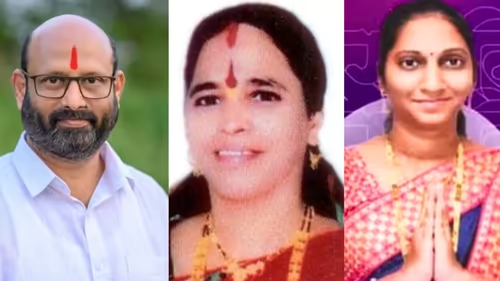
Democracy is often called the will of the people—but what happens when that will elevates the accused, the connected, and the controversial to positions of public trust? In Maharashtra’s 2026 civic elections, voters in multiple cities have done exactly that, electing tainted corporators with links to organized crime and even high-profile political murders. From Pune to Jalna, the results read like a dossier of India’s most pressing governance failures—where name recognition, muscle power, and caste equations outweigh integrity and public service .
Table of Contents
- The Most Controversial Wins
- Who Are the Tainted Corporators?
- Why Voters Chose Criminal Candidates
- Legal and Constitutional Loopholes
- Civil Society and Media Reaction
- What This Means for Local Governance
- Conclusion: Can Democracy Clean Itself?
- Sources
The Most Controversial Wins
Two cases stand out for their brazen defiance of ethical norms:
- Pune: Two relatives of Suryakant Andekar—a notorious gangster currently serving life imprisonment for multiple murders—won seats in the Pune Municipal Corporation. Their campaign leaned heavily on the Andekar family’s local influence and patronage networks.
- Jalna: Shrikant Pangarkar, named as an accused in the 2017 assassination of journalist Gauri Lankesh, was elected as an independent corporator. Despite being out on bail, his candidacy faced no legal bar—and shockingly, drew significant voter support .
These aren’t isolated incidents. Across Maharashtra, at least 12 newly elected corporators face serious criminal charges, including extortion, attempted murder, and land grabbing.
Who Are the Tainted Corporators?
Shrikant Pangarkar – Jalna
Pangarkar’s name appears in the Special Investigation Team (SIT) charge sheet related to Gauri Lankesh’s murder, linked to radical right-wing networks. Though not the triggerman, he’s accused of logistical support and conspiracy. His victory as an independent candidate suggests a disturbing normalization of association with political violence.
The Andekar Family – Pune
Suryakant Andekar, once dubbed “Pune’s don,” built a feared empire through contract killings and real estate coercion. Now behind bars, his legacy lives on through kin who’ve transitioned from shadowy influence to elected office—leveraging the same networks that once operated outside the law.
Why Voters Chose Criminal Candidates
Blaming voters alone is simplistic. The reality is layered:
- Perceived Effectiveness: Many believe “strongmen” get work done—roads repaired, water supplied—where bureaucratic systems fail.
- Caste and Community Loyalty: Candidates often represent dominant local castes; voting becomes an act of group solidarity, not individual judgment.
- Lack of Alternatives: Mainstream parties frequently field weak or unknown candidates, leaving voters with unpalatable choices.
- Money and Muscle Power: Intimidation, cash distribution, and control over local resources tilt the playing field long before polling day.
Legal and Constitutional Loopholes
India’s legal framework allows this paradox to persist. Under current law:
- A person is only disqualified upon **conviction**, not mere accusation—even in heinous crimes.
- The Representation of the People Act (RPA), 1951, lacks provisions to bar candidates facing serious charges.
- Supreme Court rulings (e.g., *Lily Thomas v. Union of India*, 2013) mandate disqualification only post-conviction.
Efforts to introduce a “criminal antecedents disclosure” rule have improved transparency—but haven’t stopped elections. As the PRS Legislative Research notes, over 40% of sitting MPs face criminal cases—yet remain eligible .
Civil Society and Media Reaction
Outrage has been swift:
- Journalist unions condemned Pangarkar’s win as a “slap to press freedom.”
- NGOs like Association for Democratic Reforms (ADR) called for urgent electoral reform.
- Social media campaigns like #NotMyCorporator trended statewide, demanding accountability.
Yet, mainstream political parties remained largely silent—many having tacitly endorsed or failed to oppose such candidacies.
What This Means for Local Governance
Electing tainted corporators Maharashtra isn’t just symbolic—it has real consequences:
- Policy capture: Urban development funds may be diverted to vested interests.
- Erosion of rule of law: When lawbreakers become lawmakers, public trust in institutions collapses.
- <Chilling effect on dissent: Journalists, activists, and whistleblowers face heightened risk in areas controlled by such figures.
For more on urban governance risks, see our analysis on [INTERNAL_LINK:maharashtra-civic-body-corruption].
Conclusion: Can Democracy Clean Itself?
The election of individuals linked to murder and organized crime reflects a crisis not of democracy itself, but of its gatekeepers—parties, regulators, and sometimes, citizens. While the ballot box remains sacred, it cannot absolve society of the duty to demand better. Until legal reforms close the loopholes and voters prioritize character over clout, Maharashtra’s civic bodies may continue to mirror the underworld they’re meant to govern—not serve.
Sources
- Times of India: From Gauri Lankesh murder accused to gangster kin: How Maharashtra voted for tainted corporators
- PRS Legislative Research: Criminal Background of Elected Representatives
- Association for Democratic Reforms (ADR): Maharashtra Civic Election Candidate Analysis 2026
- Supreme Court of India Judgments: Lily Thomas v. Union of India, (2013) 7 SCC 73