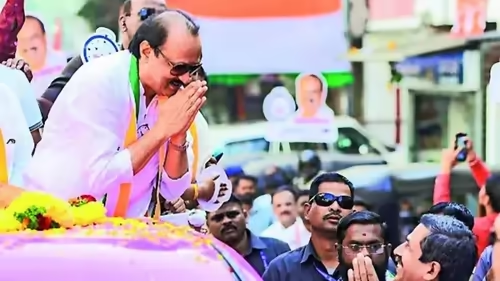
In Maharashtra’s ever-shifting political chessboard, few names carry as much weight—and controversy—as Ajit Pawar. But the recent civic election results from Pune and Pimpri-Chinchwad have delivered a sobering message: while Ajit Pawar remains a formidable individual force, his party’s electoral muscle appears dangerously thin without him at the center. The verdict isn’t just a setback—it’s a stark revelation about the true architecture of power within the Nationalist Congress Party (NCP).
Table of Contents
- Election Verdict: A Reality Check for Ajit Pawar
- Why the NCP’s Strength Revolves Only Around Ajit Pawar
- The Path to Reunification: Sharad Pawar’s Strategic Shift
- What This Means for Maharashtra’s Political Future
- Key Takeaways for Voters and Parties
- Conclusion: Beyond Personality Politics?
- Sources
Election Verdict: A Reality Check for Ajit Pawar
Deputy Chief Minister Ajit Pawar threw his full weight behind the NCP’s campaign in Pune and Pimpri-Chinchwad—two urban strongholds long considered his political backyard. He held rallies, made promises, and even staked his personal credibility on the outcome. Yet, when the votes were counted, the results were underwhelming .
The BJP retained its dominance in both municipal corporations, while the NCP failed to make significant gains despite its alliance with the Maha Vikas Aghadi (MVA) partners. The message was clear: Ajit Pawar’s charisma alone couldn’t translate into organizational strength or voter mobilization at the grassroots level.
Why the NCP’s Strength Revolves Only Around Ajit Pawar
Political analysts have long observed that the NCP, especially after its 2023 split, has become increasingly reliant on Ajit Pawar’s personal network, administrative clout as Deputy CM, and regional appeal in western Maharashtra. Unlike his uncle Sharad Pawar—who built the party on ideology, farmer advocacy, and coalition-building—Ajit’s faction leans heavily on patronage and proximity to power.
This dependency became glaringly evident in the recent polls:
- Weak local leadership: Many NCP candidates lacked name recognition or grassroots connect beyond their association with Ajit Pawar.
- Limited voter outreach: Campaigns focused more on Ajit’s image than on local issues like water supply, waste management, or public transport.
- Organizational decay: Post-split, the party’s booth-level machinery in urban centers has weakened significantly .
In essence, the party functions less as an institution and more as an extension of one man’s political brand—a risky model in India’s increasingly issue-driven urban electorates.
The Path to Reunification: Sharad Pawar’s Strategic Shift
Ironically, this electoral stumble may have opened a door to something many thought impossible: a reunified NCP. Despite the bitter family and political rift of 2023, sources indicate that Sharad Pawar’s supporters are now more open to Ajit leading a merged entity .
Why the change of heart?
- Electoral pragmatism: With both factions struggling independently, unity appears to be the only viable path to relevance.
- Ajit’s growing acceptability: His role in the current Maharashtra government has softened perceptions among Sharad loyalists who once saw him as a “traitor.”
- 2029 state elections looming: Both camps recognize that a divided NCP will be easily marginalized by the BJP-Shiv Sena duopoly.
This emerging consensus suggests that the Pune election results, while a tactical loss, could be a strategic win for Ajit Pawar in the long game of party consolidation.
What This Means for Maharashtra’s Political Future
Maharashtra’s political landscape is entering a volatile phase. The BJP, riding high on urban wins, aims to deepen its footprint in traditional NCP bastions. Meanwhile, the Congress remains weak, and the Shiv Sena is split between Uddhav and Eknath factions.
In this vacuum, a reunited NCP led by Ajit Pawar could become the nucleus of a new opposition coalition. But success hinges on whether the party can evolve beyond personality-driven politics and rebuild its ideological core—something Sharad Pawar championed for decades .
Key Takeaways for Voters and Parties
For voters and political observers, the Pune-Pimpri Chinchwad results offer critical lessons:
- Personality ≠ Party: A leader’s popularity doesn’t automatically guarantee electoral success if the party lacks structure.
- Urban voters demand performance: Civic issues trump loyalty in cities like Pune, where service delivery is paramount.
- Unity is survival: In a polarized polity, fragmented parties risk irrelevance. The NCP’s future likely depends on reconciliation.
For more on Maharashtra’s evolving political map, see our analysis on [INTERNAL_LINK:maharashtra-2029-election-outlook].
Conclusion: Beyond Personality Politics?
The civic election verdict in Pune and Pimpri-Chinchwad is more than a local story—it’s a microcosm of a larger crisis in Indian regional politics. Ajit Pawar remains a central figure, but the results prove that even he cannot carry a party on his shoulders alone. The path forward demands institutional rebuilding, ideological clarity, and, perhaps most importantly, healing old wounds. Whether the NCP can rise to this challenge will determine not just its fate, but the balance of power in Maharashtra for years to come.
Sources
- Times of India: ‘NCP’s strength revolves only around Ajit Pawar’: Pune, Pimpri Chinchwad election verdict a lesson
- Election Commission of India: Official Civic Election Data
- The Hindu: Analysis of NCP Split and Reunification Prospects