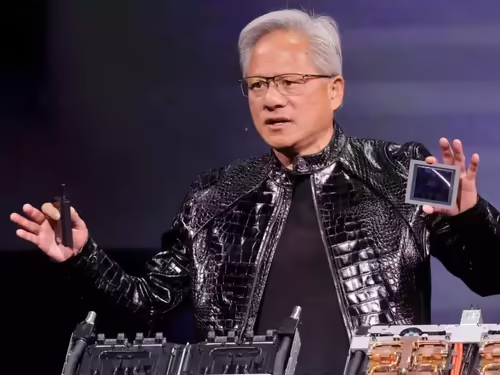
Imagine a world where writing code is no longer the core skill of an engineer. Sounds radical? That’s exactly what Jensen Huang, the visionary CEO of Nvidia, is proposing. In a recent interview that sent ripples through the tech world, Huang dropped a bombshell: “Engineers shouldn’t code at all.”
Before you assume this is a dismissal of the engineering profession, let’s be clear: Huang isn’t saying engineers are obsolete. Far from it. His point is far more profound—and potentially transformative. He’s arguing that with the rise of powerful AI tools, the act of coding has become a mere task, not the purpose of engineering. And that distinction changes everything.
Table of Contents
- What Jensen Huang Really Meant
- The Radiology Analogy: AI as an Augmenter, Not a Replacer
- Why the Role of the Engineer Is Evolving
- What Engineers Should Focus On Instead of Coding
- Practical Steps for Engineers in the AI Era
- Conclusion: Embracing the Future of Engineering
- Sources
What Jensen Huang Really Meant
The headline-grabbing quote—“engineers shouldn’t code at all”—is easily misunderstood. Huang’s full context is crucial. He believes that the future of engineering lies not in the mechanical act of writing lines of code, but in the higher-order cognitive skills of problem discovery and solution design.
In his view, AI is now so advanced that it can efficiently generate, debug, and optimize code based on a well-defined problem statement. Therefore, the engineer’s primary value shifts from being a coder to being a strategist and a designer. The human’s job is to ask the right questions, frame the problem correctly, and validate the AI’s output against real-world constraints and ethical considerations .
The Radiology Analogy: AI as an Augmenter, Not a Replacer
To illustrate his point, Huang drew a compelling parallel to the field of radiology. For years, there was fear that AI would replace radiologists by automatically reading X-rays and MRIs. But the reality has been different. AI hasn’t replaced radiologists; it has augmented them.
Today, AI tools can quickly flag potential anomalies in scans, allowing radiologists to focus their expertise on complex diagnoses, patient consultation, and treatment planning. The radiologist’s role has evolved from a technician who reads images to a clinical decision-maker who interprets AI-generated insights .
Likewise, Huang envisions a future where AI handles the “typing,” freeing engineers to focus on the creative, strategic, and ethical dimensions of building technology. This is the essence of his argument for why Jensen Huang engineers shouldn’t code in the traditional sense.
Why the Role of the Engineer Is Evolving
The evolution isn’t just theoretical—it’s already happening. Tools like GitHub Copilot, Amazon CodeWhisperer, and Google’s AI-powered coding assistants are becoming standard in many development workflows. These tools can write boilerplate code, suggest functions, and even complete entire modules based on natural language prompts.
This shift means that the bottleneck in software development is no longer the speed of coding, but the clarity of the problem definition and the quality of the architectural design. An engineer who can articulate a problem precisely and design a robust, scalable solution will be infinitely more valuable than one who can merely write syntactically correct code.
What Engineers Should Focus On Instead of Coding
If coding is becoming a task for AI, what should human engineers prioritize? Here’s a roadmap for the future-proof engineer:
- Problem Framing & Critical Thinking: The ability to deeply understand user needs, business constraints, and technical trade-offs to define the right problem to solve.
- System Design & Architecture: Crafting high-level designs that are scalable, secure, and maintainable—skills that AI cannot yet replicate.
- Domain Expertise: Deep knowledge of a specific industry (e.g., healthcare, finance, robotics) allows engineers to build solutions that are truly relevant and effective.
- Ethics & Societal Impact: As AI systems become more powerful, engineers must be equipped to evaluate the ethical implications of their work and ensure fairness and accountability.
- Communication & Collaboration: The ability to explain complex technical concepts to non-technical stakeholders and work effectively in cross-functional teams is more critical than ever.
[INTERNAL_LINK:future-of-tech-careers] This new skill set represents a significant upgrade from the traditional coding-centric curriculum.
Practical Steps for Engineers in the AI Era
For practicing engineers and students, this shift isn’t a threat—it’s an opportunity. Here’s how to adapt:
- Master AI Coding Tools: Don’t resist them; learn to use them effectively. Understand their strengths and limitations.
- Focus on Learning Concepts, Not Just Syntax: Prioritize data structures, algorithms, and system design over memorizing language-specific quirks.
- Build a Portfolio of Problem-Solving: Showcase projects that demonstrate your ability to identify a problem, design a solution, and validate its impact—not just that you wrote the code.
- Engage with Interdisciplinary Fields: Take courses in ethics, product management, or a specific domain area to broaden your perspective.
Conclusion: Embracing the Future of Engineering
Jensen Huang’s statement that “engineers shouldn’t code at all” is not a call to abandon the profession, but a clarion call to elevate it. By offloading the mechanical task of coding to AI, engineers can finally focus on what they do best: innovating, designing, and solving humanity’s most complex challenges. The future belongs not to the fastest coder, but to the deepest thinker. And that’s a future worth building.
Sources
- Times of India: Why Nvidia CEO Jensen Huang says engineers ‘shouldn’t code at all’: Here’s what he thinks matters more
- NVIDIA Official Blog: Insights from Jensen Huang and the NVIDIA team
- Harvard Business Review: How AI Is Changing the Role of Software Engineers