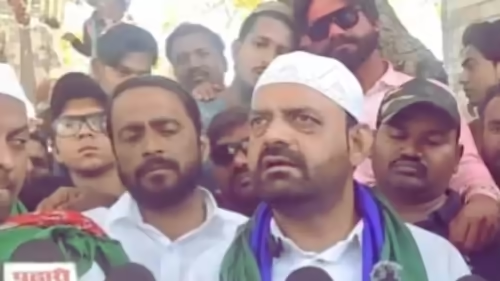
Political earthquakes don’t always happen in state capitals or during national elections. Sometimes, they rumble through small towns—and send shockwaves across an entire region. That’s exactly what happened in **Malegaon**, a historically significant town in Maharashtra’s Nashik district, during the recent municipal corporation polls.
In its very first electoral contest, the newly formed **ISLAM party**—founded by former NCP MLA Asif Shaikh—stormed to victory, bagging **35 seats** and abruptly ending the Indian National Congress’s long-standing dominance in the city. While falling just short of an outright majority in the 57-member council, the party’s performance has redrawn the political map of one of Maharashtra’s most sensitive urban centers .
Table of Contents
- The Rise of the ISLAM Party: A New Force in Malegaon
- ISLAM Party Malegaon: How Congress Lost Its Stronghold
- Alliances and Strategic Shifts: The Path to Power
- Broader Implications for Maharashtra Politics
- What Next for Malegaon and the ISLAM Party?
- Sources
The Rise of the ISLAM Party: A New Force in Malegaon
Founded just months before the polls by **Asif Shaikh**, a former NCP MLA known for his grassroots work in the Malegaon region, the ISLAM party (an acronym for Ittehad Samajwadi Loktantrik Azad Morcha) positioned itself as a voice for local identity, development, and community representation. Despite its name, party leaders insist it is not a religious outfit but a secular platform focused on social justice and civic empowerment.
“People were tired of empty promises,” Shaikh told reporters after the results. “They wanted action—not just legacy.”
And act they did. With a hyper-local campaign centered on water supply, sanitation, unemployment, and youth engagement, the ISLAM party tapped into deep-seated frustrations with established parties—especially the Congress, which had governed Malegaon for decades.
ISLAM Party Malegaon: How Congress Lost Its Stronghold
For years, Malegaon was considered a Congress bastion. But the party’s grip had been weakening due to internal factionalism, lack of visible development, and a growing disconnect with younger voters. In this election, the Congress managed to win only **9 seats**—a dramatic collapse from its previous dominance .
Analysts point to several key factors behind the fall:
- Leadership vacuum: The Congress failed to project a strong local face capable of countering Shaikh’s narrative.
- Youth disillusionment: Young voters, frustrated by unemployment and poor infrastructure, saw the ISLAM party as a fresh alternative.
- Fragmented opposition: While the BJP and Shiv Sena also competed, their vote share diluted the anti-ISLAM front, indirectly helping the newcomer.
Alliances and Strategic Shifts: The Path to Power
Although the ISLAM party fell short of the 29-seat majority mark, it quickly moved to consolidate power. It has forged a post-poll alliance with the **Samajwadi Party (SP)**, which won 2 seats, and is in talks with independent candidates to secure a stable administration.
Meanwhile, other parties also saw notable shifts:
- AIMIM made significant gains, emerging as a key player with 8 seats—highlighting its expanding footprint beyond Hyderabad.
- Shiv Sena (UBT) improved its tally compared to last time, signaling a modest revival in the region.
- BJP was left reeling, managing only **2 seats**—a stark reminder of its limited appeal in this particular demographic landscape.
This realignment shows that identity-based and hyper-local parties can disrupt even the most entrenched political orders when they align with ground-level aspirations.
Broader Implications for Maharashtra Politics
The Malegaon result isn’t just a local story—it’s a warning shot across the bow of Maharashtra’s major parties. With assembly elections due in 2029, the rise of micro-regional forces like the ISLAM party could fragment vote banks and complicate coalition math.
Moreover, it underscores a growing trend: voters are increasingly prioritizing **local governance over national narratives**. As urban issues like waste management, public transport, and housing dominate civic discourse, parties that fail to deliver tangible results at the municipal level risk being swept aside—even if they’re giants at the state or national level.
According to the Election Commission of India, over 40% of urban voters in Maharashtra now cite “local development” as their top voting criterion—up from 28% a decade ago .
What Next for Malegaon and the ISLAM Party?
All eyes are now on Asif Shaikh and his team. Can they translate electoral success into effective governance? Delivering on promises of clean water, job creation, and transparent administration will be their true test.
If they succeed, the ISLAM party could expand beyond Malegaon—to Bhiwandi, Dhule, or even Aurangabad—where similar socio-political conditions exist. If they falter, they may become another footnote in Maharashtra’s ever-evolving political drama.
One thing is certain: the era of automatic loyalty to legacy parties in Maharashtra’s urban centers is over. Voters have spoken—and they want change, not just continuity.