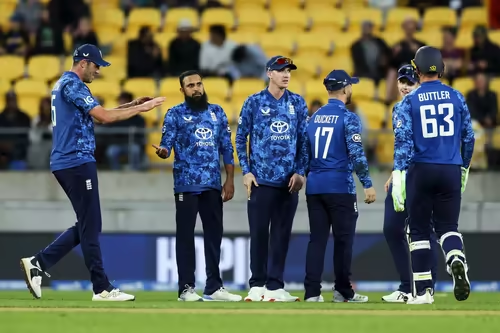
Visa Woes Cast Shadow Over T20 World Cup Kickoff
Just weeks before the highly anticipated ICC Men’s T20 World Cup 2026 in India, a growing diplomatic and logistical headache is unfolding: T20 World Cup visa issues are now ensnaring top international players. After four Pakistan-origin cricketers from the USA squad were delayed due to visa processing bottlenecks, England’s campaign has been thrown into uncertainty—with star leg-spinner Adil Rashid and teenage sensation Rehan Ahmed reportedly stuck in bureaucratic limbo. The situation raises urgent questions about whether these key players will be available for crucial warm-up matches, and potentially even the opening fixtures of cricket’s biggest global event .
Table of Contents
- USA Players First Hit by Visa Delays
- T20 World Cup visa issues: England’s Turn – Rashid & Ahmed in Jeopardy
- Why Are Visas Taking So Long?
- ECB Response and Official Assurances
- Impact on England’s Tournament Preparations
- Broader Implications for the T20 World Cup
- Conclusion: A Race Against Time
- Sources
USA Players First Hit by Visa Delays
The visa crisis first emerged when four members of the USA cricket team—Nosthush Kenjige, Shadley van Schalkwyk, Andries Gous, and Aaron Jones—all of whom have Pakistani heritage, encountered unexpected delays in securing Indian visas . Despite having valid passports and tournament accreditation, their applications reportedly triggered additional security screenings, a common hurdle for travelers with ties to certain countries. This left the USA Cricket Board scrambling to finalize its squad and disrupted vital pre-tournament training camps. The ICC and BCCI were forced to intervene, urging expedited processing to avoid last-minute squad changes.
T20 World Cup visa issues: England’s Turn – Rashid & Ahmed in Jeopardy
Now, England faces a nearly identical predicament. According to sources within the England and Wales Cricket Board (ECB), both Adil Rashid—who was born in Bradford to Pakistani parents—and 20-year-old Rehan Ahmed, whose father is of Pakistani descent, have experienced significant delays in receiving their Indian visas . While the ECB confirms that applications were submitted well in advance, the approvals have not yet materialized. As a result, both players may miss England’s scheduled warm-up games against Australia and Afghanistan in Dubai—a major setback given their roles as frontline spinners in subcontinental conditions.
Why Are Visas Taking So Long?
India’s e-visa system, while efficient for many nationalities, often subjects applicants with dual heritage or connections to “sensitive” regions to enhanced scrutiny. This isn’t discrimination per se, but a standard security protocol under India’s Ministry of Home Affairs guidelines . However, with over 20 teams descending on the country for a high-profile event, the volume has overwhelmed consular offices. Compounding the issue is the fact that some players hold British passports but list ancestral origins that trigger manual review—a process that can take days or even weeks without direct intervention from host authorities.
ECB Response and Official Assurances
The ECB has maintained a calm public stance, stating it has received “verbal assurances” from Indian officials that the visas for Rashid and Ahmed are being prioritized . A spokesperson emphasized that both players remain fully integrated into planning discussions and are expected to join the squad in time for the tournament opener. Still, insiders acknowledge private frustration. “Warm-up games aren’t just practice—they’re critical for acclimatizing to pitch behavior and building combinations,” said one team source. “Losing them would be a real blow.”
Impact on England’s Tournament Preparations
England’s T20 strategy heavily relies on spin, especially in India’s slow, turning tracks. Rashid is the team’s most experienced wrist-spinner, while Ahmed offers mystery and energy. Without them in warm-ups:
- Batters won’t get quality match-like spin practice.
- Field placements and DRS strategies can’t be fine-tuned.
- Team chemistry in high-pressure bowling scenarios remains untested.
Backup options like Moeen Ali or Liam Dawson could step in, but neither offers the same tactical nuance. The situation is especially tense given England’s recent struggles in Asian conditions.
Broader Implications for the T20 World Cup
This isn’t just an England or USA problem—it’s a reputational risk for the entire tournament. If multiple teams face entry barriers, it undermines the ICC’s promise of a seamless, inclusive global festival of cricket. The BCCI, as host, is under pressure to demonstrate administrative competence. Already, England is awaiting clarity on whether its group-stage match against Bangladesh will be held in Bengaluru or shifted due to venue logistics—a separate but compounding uncertainty . Fans and sponsors alike expect professionalism; visa chaos threatens that image.
Conclusion: A Race Against Time
The T20 World Cup visa issues surrounding Adil Rashid, Rehan Ahmed, and the USA contingent highlight a critical gap between sporting ambition and bureaucratic reality. While officials express confidence that all will be resolved before the first ball is bowled on June 1, 2026, every passing day increases the risk of disruption. For now, cricket fans worldwide are left hoping that diplomacy moves as fast as a T20 boundary—and that talent, not paperwork, decides the tournament’s outcome.
Sources
- Original Report: Times of India
- ICC Tournament Guidelines: ICC Official T20 World Cup Site
- Indian Visa Policy Overview: Ministry of Home Affairs, Government of India
- ECB Official Statement Archive: England and Wales Cricket Board
- USA Cricket Team Updates: USA Cricket