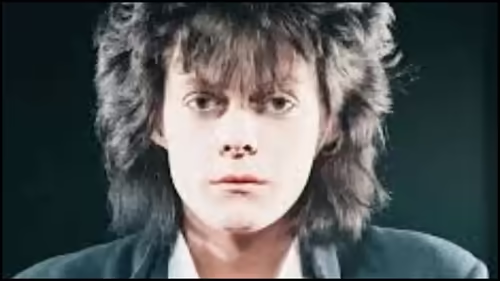
A Rhythm Lost: Punk Legend Kenny Morris Passes Away
The music world is mourning the loss of Kenny Morris, the pioneering drummer of Siouxsie and the Banshees, who has died at the age of 68. Best known for laying the percussive foundation of one of post-punk’s most influential bands, Morris wasn’t just a timekeeper—he was a sonic architect whose tribal, propulsive beats helped define the sound of goth and alternative rock in the late 1970s. His passing, confirmed by a close friend, marks the end of an era for fans who grew up on the raw energy of albums like The Scream and Join Hands . Beyond music, Morris also carved a quiet but respected path as a visual artist in Dublin, proving that his creativity knew no bounds.
Table of Contents
- Who Was Kenny Morris?
- Kenny Morris death: His Impact on Siouxsie and the Banshees
- The Unique Drumming Style That Shaped Goth Rock
- Life After Music: A Second Act as an Artist
- Tributes from Fans and Fellow Musicians
- Legacy of a Quiet Revolutionary
- Conclusion: More Than Just a Drummer
- Sources
Who Was Kenny Morris?
Born in London in 1957, Kenny Morris emerged from the chaotic crucible of the UK punk scene in 1976. He was just 19 when he joined forces with Siouxsie Sioux (vocals), Steven Severin (bass), and John McKay (guitar) to form Siouxsie and the Banshees—a band that would quickly outgrow punk’s three-chord simplicity to pioneer a darker, more atmospheric sound. Morris played on the band’s first two groundbreaking albums: The Scream (1978) and Join Hands (1979). His departure in 1979, alongside guitarist McKay, during a tour marked a turning point for the group, but his contributions remained foundational .
Kenny Morris death: His Impact on Siouxsie and the Banshees
Morris’s drumming was anything but conventional. Rejecting the standard rock backbeat, he favored tom-heavy patterns, syncopated fills, and a relentless, almost ritualistic pulse that gave tracks like “Hong Kong Garden,” “Metal Postcard,” and “Icon” their haunting urgency. Producer Steve Lillywhite once described his style as “primal yet precise—a heartbeat from another dimension” . Without Morris’s rhythmic innovation, the Banshees’ early sound—raw, angular, and emotionally charged—would have lacked its defining tension. His work directly influenced generations of drummers in goth, post-punk, and alternative rock, from The Cure’s Lol Tolhurst to Joy Division’s Stephen Morris (no relation).
The Unique Drumming Style That Shaped Goth Rock
What set Morris apart was his minimal use of cymbals and hi-hats. Instead, he built entire grooves using only snare, toms, and kick drum—creating a cavernous, echo-laden soundscape that mirrored the band’s lyrical themes of alienation and decay. This approach wasn’t just aesthetic; it was practical. Early gigs were often in small, reverberant venues where cymbal wash would muddy the mix. Morris turned limitation into signature style—a hallmark of true innovation .
Life After Music: A Second Act as an Artist
After leaving the music industry in the early 1980s, Morris retreated from the spotlight—but not from creativity. He moved to Dublin, Ireland, where he dedicated himself to painting. His abstract works, often exploring themes of memory, rhythm, and urban decay, were exhibited in local galleries and earned quiet acclaim in the Irish art scene . Friends described him as introspective, gentle, and endlessly curious. “He wasn’t interested in fame,” said a longtime friend who confirmed his passing. “He just wanted to make things that mattered—whether with sticks or a brush” .
Tributes from Fans and Fellow Musicians
News of Morris’s death sparked an outpouring of grief online. Siouxsie Sioux has not yet issued a public statement, but fans flooded social media with clips of early performances, calling him “the unsung hero of post-punk.” Drummer Budgie—who replaced Morris in the Banshees and later married Siouxsie—reportedly shared private condolences with mutual friends. Meanwhile, contemporary artists like Jehnny Beth of Savages cited Morris as a key influence, writing: “He taught us that drums could be voice, not just rhythm” .
Legacy of a Quiet Revolutionary
Unlike many rock stars, Kenny Morris never sought the limelight. He played his part, left on his own terms, and built a new life far from amplifiers and stage lights. Yet his impact endures. Every time a modern band uses tribal toms instead of crash cymbals, or builds tension through silence rather than volume, they’re echoing Morris’s vision. In an age of overproduction, his stripped-down, emotionally resonant approach feels more relevant than ever.
Conclusion: More Than Just a Drummer
The Kenny Morris death announcement is a reminder that some of the most transformative artists work in the shadows. He wasn’t just the drummer for Siouxsie and the Banshees—he was a co-creator of a sound that redefined what rock music could be. And in his second life as a painter, he proved that true artistry transcends medium. As fans revisit “Hong Kong Garden” or gaze at his canvases in Dublin galleries, they’ll hear—and see—the quiet thunder of a man who changed music without ever needing to shout.
Sources
- Original Obituary Report: Times of India
- Band History & Discography: AllMusic – Siouxsie and the Banshees
- Post-Punk Drumming Analysis: Rolling Stone – The Architects of Post-Punk Rhythm
- Dublin Art Scene Archives: Visual Artists Ireland