Trump’s Surprise Offer in a Decades-Old Water War
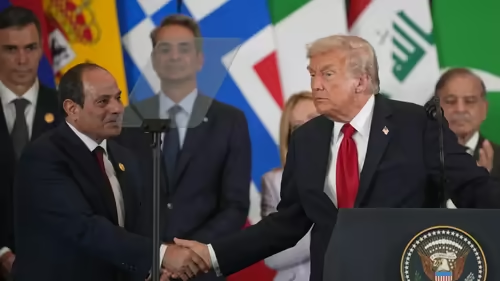
In a move that has sent ripples through diplomatic circles, former U.S. President Donald Trump has offered to step in as a mediator in the volatile Nile water sharing dispute between Egypt and Ethiopia. In a personal letter addressed to Egyptian President Abdel Fattah el-Sisi, Trump expressed his willingness to help resolve the bitter standoff over the Grand Ethiopian Renaissance Dam (GERD)—a flashpoint that has brought two of Africa’s most powerful nations to the brink of conflict . This unsolicited offer raises urgent questions: Is this a genuine peace effort, or a strategic play by Trump to reassert global influence? And more importantly—will either side accept his help?
Table of Contents
- Background of the Nile Water Sharing Dispute
- What Is the Grand Ethiopian Renaissance Dam (GERD)?
- Trump’s Letter and His Stated Motives
- Egypt and Ethiopia’s Positions on External Mediation
- Why Trump’s Involvement Is Controversial
- Past U.S. Efforts and the African Union’s Role
- Conclusion: A Diplomatic Wild Card in a High-Stakes Game
- Sources
Background of the Nile water sharing dispute
The Nile River is the lifeblood of northeastern Africa, supporting over 250 million people across 11 countries. But for decades, water rights have been dominated by a colonial-era agreement from 1929—and later reinforced in 1959—that granted Egypt and Sudan the lion’s share of the river’s flow, with little to no allocation for upstream nations like Ethiopia . Ethiopia, home to the Blue Nile (which contributes 85% of the Nile’s water), has long rejected these agreements as unjust. The construction of the GERD, which began in 2011, is Ethiopia’s bold assertion of its sovereign right to develop its water resources—a move Egypt views as an existential threat to its national security .
What Is the Grand Ethiopian Renaissance Dam (GERD)?
Located on the Blue Nile near Ethiopia’s border with Sudan, the GERD is Africa’s largest hydroelectric project. Once fully operational, it will generate over 6,000 megawatts of electricity—enough to power millions of homes and fuel Ethiopia’s industrial ambitions . However, the dam’s filling process directly impacts downstream water flow. Egypt fears that rapid filling could drastically reduce its water supply, threatening agriculture, drinking water, and the stability of the Aswan High Dam. Ethiopia insists the impact will be minimal and temporary, but years of failed negotiations have bred deep mistrust .
Trump’s Letter and His Stated Motives
According to reports from the Egyptian presidency, Trump wrote to President Sisi expressing “deep concern” over the impasse and offering his “personal assistance” to broker a deal . While the full text hasn’t been released, sources close to the matter say Trump framed his offer as a continuation of his administration’s earlier efforts during his presidency, when he famously (and controversially) suggested in 2020 that Egypt might “blow up” the dam if talks failed—a comment that drew sharp rebuke from Ethiopia . Now out of office, Trump appears eager to position himself as a global dealmaker once again, leveraging his self-proclaimed reputation as a negotiator.
Egypt and Ethiopia’s Positions on External Mediation
Egypt has historically welcomed international involvement, especially from the U.S., EU, and UN, viewing it as a way to pressure Ethiopia into binding commitments on water release during droughts. Ethiopia, however, has consistently rejected “external interference,” insisting the issue must be resolved solely through African-led mechanisms like the African Union (AU) . Addis Ababa sees third-party mediation—especially from Western powers—as a neo-colonial attempt to uphold outdated water hierarchies. Given this stance, it’s highly unlikely Ethiopia would agree to Trump, a figure already viewed with suspicion there, as a neutral arbiter.
Why Trump’s Involvement Is Controversial
Trump’s offer is fraught with complications:
- Perceived Bias: During his presidency, Trump openly sided with Egypt, even cutting aid to Ethiopia over the GERD issue .
- Lack of Mandate: As a private citizen, he has no official diplomatic authority. His intervention could undermine ongoing AU-led talks.
- Geopolitical Timing: With China and Russia increasing influence in the Horn of Africa, some analysts see Trump’s move as an attempt to reassert U.S. relevance—but without a coherent strategy .
His past inflammatory rhetoric (“They’ll blow up the dam!”) further erodes his credibility as a peacemaker in this context.
Past U.S. Efforts and the African Union’s Role
The U.S. has been involved in GERD negotiations since 2019, with the World Bank also participating as an observer. A draft agreement was nearly finalized in 2020, but Ethiopia walked away, citing sovereignty concerns . Since then, the African Union has taken the lead, hosting multiple rounds of talks with limited success. Most experts agree that any lasting solution must emerge from African ownership—not imposed by external actors, however well-intentioned. As Dr. Annette Weber of the German Institute for International and Security Affairs notes, “The Nile is not just a water issue—it’s about dignity, history, and post-colonial justice” .
Conclusion: A Diplomatic Wild Card in a High-Stakes Game
While Trump’s offer to mediate the Nile water sharing dispute has grabbed headlines, its practical impact is likely to be minimal. Without Ethiopia’s consent—and given the strong preference for African-led solutions—his intervention may amount to little more than political theater. Yet, it underscores a critical truth: the GERD crisis remains dangerously unresolved. With climate change intensifying water scarcity across the region, the need for a fair, science-based, and mutually binding agreement has never been more urgent. Whether that comes through the African Union, quiet diplomacy, or another channel, one thing is clear: the fate of millions depends on it.
Sources
- Official Statement from Egyptian Presidency: Presidency of the Arab Republic of Egypt
- Original Report: Times of India
- Background on GERD & Nile Basin: Encyclopædia Britannica
- African Union Position on GERD: African Union Official Site
- U.S. State Department Archives on Nile Talks: U.S. Department of State