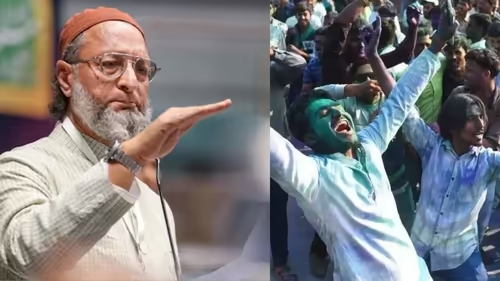
AIMIM’s Unlikely Triumph in Maharashtra’s Political Landscape
In a move that has left political analysts scrambling for explanations, the All India Majlis-e-Ittehadul Muslimeen (AIMIM) has pulled off a historic performance in Maharashtra’s recent civic body elections. Winning a staggering 126 seats across the state—including a commanding 33 in Chhatrapati Sambhajinagar (formerly Aurangabad)—the party has not only silenced its critics but also rewritten its own narrative. This victory is all the more remarkable because it comes on the heels of significant internal dissent and widespread skepticism about its ability to appeal beyond its traditional voter base. The AIMIM Maharashtra civic polls result marks a seismic shift in the state’s urban political dynamics.
Table of Contents
- The Numbers Behind the Victory
- Defying Internal Turmoil and Leadership Challenges
- Beyond a Single Community: AIMIM’s New Electoral Strategy
- Chhatrapati Sambhajinagar: The Epicenter of Change
- Owaisi’s Grand Design for Maharashtra
- Reactions from Opposition Parties
- Conclusion: A New Chapter for Urban Politics in Maharashtra
- Sources
The Numbers Behind the Victory
The scale of AIMIM’s success is undeniable. From a modest presence in previous local body elections, the party has now emerged as a major force in Maharashtra’s urban centers. The 126 seats are spread across multiple municipal corporations and councils, but the crown jewel is undoubtedly Chhatrapati Sambhajinagar, where it bagged 33 out of 100 seats . This isn’t just incremental growth; it’s a quantum leap. For context, in the 2017 civic polls, AIMIM had won just a handful of seats statewide. This exponential jump signals a well-executed, ground-level strategy that resonated with a diverse electorate .
Defying Internal Turmoil and Leadership Challenges
What makes this victory even more impressive is the backdrop against which it was achieved. In the months leading up to the polls, AIMIM was plagued by public infighting and resignations from key local leaders who accused the central leadership of being disconnected from grassroots realities . Several high-profile figures even floated the idea of forming breakaway factions. Conventional wisdom suggested such internal chaos would be fatal for any party’s electoral prospects. Yet, AIMIM not only held its ground but surged forward. This suggests that the party’s brand, largely built around national president Asaduddin Owaisi’s charismatic leadership, remains strong enough to override local-level disarray .
AIMIM Maharashtra civic polls: Beyond a Single Community
For years, AIMIM has been stereotyped as a party that caters exclusively to the Muslim community. This election result forcefully challenges that perception. In cities like Nanded, Latur, and Parbhani, the party made significant inroads among Dalit, OBC, and even some Maratha voters by focusing on hyper-local issues: water scarcity, poor sanitation, and unemployment . Their campaign shifted from identity politics to governance-centric promises, a strategic pivot that broadened their appeal. This new approach signals a matured political strategy aimed at becoming a viable alternative in Maharashtra’s complex social fabric.
Chhatrapati Sambhajinagar: The Epicenter of Change
Chhatrapati Sambhajinagar has long been a political battleground, historically dominated by the NCP, Shiv Sena, and Congress. AIMIM’s capture of 33 seats here is a game-changer. The party capitalized on a sense of neglect among residents, particularly in the city’s eastern and southern zones, where infrastructure development has lagged. Their candidates, many of them young professionals and first-time politicians, ran disciplined, door-to-door campaigns that focused on tangible solutions rather than grand rhetoric . This localized, issue-based strategy proved far more effective than the vague promises of their established rivals.
Owaisi’s Grand Design for Maharashtra
This victory is no accident. It’s the culmination of a deliberate, long-term plan by Asaduddin Owaisi to expand AIMIM’s footprint beyond its Hyderabad stronghold. Maharashtra, with its large urban population and complex caste equations, was always a key target. Over the past five years, the party has invested heavily in building a state unit, recruiting local leaders, and establishing a robust social media and ground communication network . The “This Is Me… Now” style of political rebranding—focusing on youth, development, and inclusive welfare—has clearly found an audience in Maharashtra’s aspirational urban class.
Reactions from Opposition Parties
Unsurprisingly, the result has sent shockwaves through Maharashtra’s political establishment. The ruling Maha Vikas Aghadi (MVA) alliance and the BJP-Shiv Sena camp have both expressed concern over what they see as a dangerous fragmentation of the secular vote. Some opposition leaders have dismissed the win as a temporary phenomenon, while others are scrambling to understand how they lost so much ground so quickly. The real test will come in the 2024 Lok Sabha elections, where AIMIM is expected to field candidates in multiple constituencies, potentially altering the balance of power .
Conclusion: A New Chapter for Urban Politics in Maharashtra
The AIMIM Maharashtra civic polls outcome is more than just a set of numbers; it’s a signal that the state’s urban electorate is ready for new political narratives. By successfully navigating internal dissent and expanding its appeal beyond traditional lines, AIMIM has proven it is a serious player in Maharashtra’s future. Whether this momentum can be sustained at the state or national level remains to be seen, but one thing is clear: the old political order in Maharashtra’s cities has been irrevocably shaken.
Sources
- Official Election Results & Analysis: Chief Electoral Officer, Maharashtra
- Original News Report: Times of India
- Political Context on Urban Maharashtra: The Hindu – National News
- Background on AIMIM’s National Strategy: Press Information Bureau, Government of India