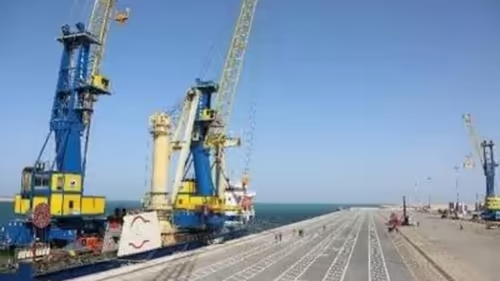
Chabahar Port Sanctions Waiver: India’s High-Stakes Diplomatic Push
In a move that underscores the growing geopolitical tightrope India walks between global powers, New Delhi has confirmed it is actively engaged with Washington to secure a long-term Chabahar port sanctions waiver. This isn’t just bureaucratic negotiation—it’s a fight for India’s strategic autonomy in a region increasingly shaped by U.S.-China rivalry and Iranian isolation .
For years, the Chabahar Port—India’s $500 million gateway to Afghanistan and Central Asia—has operated under temporary U.S. exemptions from sanctions targeting Iran. But with global tensions rising and U.S. policy on Iran fluctuating, India is now pushing for a permanent, legally binding waiver to protect its investment and ensure uninterrupted access to a critical trade corridor.
Table of Contents
- What Is Chabahar Port and Why Does It Matter?
- Current Status of the Chabahar Port Sanctions Waiver
- Why Chabahar Is a Game-Changer for India
- The Delicate Dance of U.S.-India Diplomacy
- Challenges and Risks Ahead
- Conclusion: More Than a Port—A Symbol of Strategic Sovereignty
What Is Chabahar Port and Why Does It Matter?
Located on Iran’s southeastern coast along the Gulf of Oman, Chabahar is India’s only direct maritime access point to landlocked Afghanistan and beyond—bypassing arch-rival Pakistan entirely. Since 2016, India has invested heavily in developing the port’s infrastructure, including berths, cargo terminals, and a dedicated rail link to Zahedan on the Iran-Afghan border.
The goal? To create a seamless International North-South Transport Corridor (INSTC) connecting Mumbai to Moscow via Iran, cutting shipping time and costs by up to 30% compared to traditional routes through the Suez Canal [[External Link: https://www.meas.gov.in/instc]].
Current Status of the Chabahar Port Sanctions Waiver
Since 2018, when the U.S. reimposed “maximum pressure” sanctions on Iran after withdrawing from the JCPOA nuclear deal, India’s work on Chabahar has relied on temporary waivers. The latest extension, granted in 2023, allowed continued operations—but without long-term certainty .
Now, according to official statements from India’s Ministry of External Affairs, “We are in touch with the U.S. on the issue of a permanent waiver for Chabahar-related activities” . This signals a shift from reactive extensions to proactive diplomacy aimed at institutionalizing the exemption.
Why Chabahar Is a Game-Changer for India
The strategic value of Chabahar extends far beyond commerce. Here’s why it’s non-negotiable for India:
- Bypassing Pakistan: Provides a secure, sovereign route to deliver humanitarian aid and trade goods to Afghanistan without relying on Pakistani territory.
- Countering Gwadar: Directly offsets China’s $60 billion China-Pakistan Economic Corridor (CPEC) and its deep-sea port at Gwadar, just 170 km west of Chabahar.
- Central Asian Access: Opens markets in Turkmenistan, Uzbekistan, and Kazakhstan for Indian goods and energy imports.
- Humanitarian Role: Since the Taliban takeover, Chabahar has been India’s primary channel for sending wheat, medicine, and aid to Afghanistan .
The Delicate Dance of U.S.-India Diplomacy
Washington has historically supported Chabahar as a stabilizing force in Afghanistan and a counterweight to Chinese influence. In fact, the U.S. Congress explicitly exempted Chabahar from sanctions in the 2019 National Defense Authorization Act .
However, future U.S. administrations may not share this view. India’s push for a permanent Chabahar port sanctions waiver is therefore also about future-proofing its interests against political shifts in Washington. By framing Chabahar as a tool for regional stability—not just an India-Iran project—New Delhi hopes to secure bipartisan American backing.
Challenges and Risks Ahead
Despite progress, significant hurdles remain:
- Iran’s Internal Instability: Protests, economic collapse, and potential regime change could disrupt operations.
- Slow Infrastructure Development: The promised rail link to Afghanistan remains incomplete due to funding and security issues.
- U.S. Policy Volatility: A new U.S. president in 2025 could reverse current exemptions.
For deeper insights into India’s Indo-Pacific strategy, see our analysis on [INTERNAL_LINK:india-indo-pacific-strategy-explained].
Conclusion: More Than a Port—A Symbol of Strategic Sovereignty
The quest for a Chabahar port sanctions waiver is more than a technical legal request—it’s a declaration of India’s intent to carve its own path in a multipolar world. By securing this lifeline, India not only protects its economic interests but also asserts its role as a responsible stakeholder in regional peace and connectivity. As New Delhi navigates the complex currents of great-power politics, Chabahar stands as both a physical port and a metaphorical anchor for its strategic independence.
Sources
- In touch with US on Chabahar port sanctions waiver: Govt – Times of India
- U.S. extends sanctions waiver for India’s Chabahar port – Reuters
- India uses Chabahar to send aid to Afghanistan – The Hindu
- U.S. Congress NDAA 2019 – Section 1292 on Chabahar Exemption
- Ministry of External Affairs, India – https://www.mea.gov.in/
- INSTC Official Portal – https://www.meas.gov.in/instc