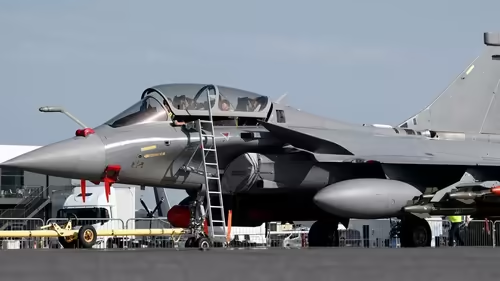
After years of speculation, delays, and intense lobbying, India has finally taken a decisive step toward rebuilding its air power. The Defence Procurement Board (DPB) has formally approved the acquisition of 114 Rafale fighter jets—a mega-deal that could reshape the Indian Air Force (IAF) for decades to come .
Valued at an estimated $15–20 billion, this isn’t just another arms purchase. It’s a strategic bet on French technology, a lifeline for India’s defense manufacturing ambitions, and a direct response to growing aerial threats from China and Pakistan. Yet, even as defense analysts hail the move as long overdue, critics warn of ballooning costs, missed opportunities for indigenous development, and the risk of over-reliance on a single foreign supplier.
So, is this Rafale jets deal a masterstroke of national security—or a financial time bomb wrapped in titanium?
Table of Contents
- The Rafale Jets Deal at a Glance
- Why India Needs 114 New Fighter Jets Urgently
- ‘Make in India’ or ‘Make in France’? The Localization Dilemma
- Cost Concerns and Budgetary Pressures
- Strategic Implications for India, China & Pakistan
- Conclusion
- Sources
The Rafale Jets Deal at a Glance
The DPB’s approval marks the first formal step in a complex procurement process under the ‘Buy (Global – Manufacture in India)’ category. Key features include:
- Quantity: 114 twin-engine multirole fighter jets.
- Supplier: Dassault Aviation of France—the same company that delivered 36 Rafales under a 2016 emergency deal.
- Localization: At least 60% of the jets must be manufactured in India through a strategic partnership with an Indian firm (likely HAL or a private player like L&T).
- Timeline: First deliveries expected by 2030, pending final contract negotiations.
This deal revives a proposal first floated in 2018 under the Medium Multi-Role Combat Aircraft (MMRCA) 2.0 program, which had stalled due to pricing disputes and procedural hurdles .
Why India Needs 114 New Fighter Jets Urgently
The IAF is in crisis. Its sanctioned strength is 42 squadrons, but it currently operates only around 31—and that number is shrinking as Soviet-era MiG-21s and Mirage 2000s retire faster than replacements arrive .
China, meanwhile, fields over 50 modern fighter squadrons, including stealth J-20s. Pakistan is upgrading its F-16s and acquiring Chinese J-10Cs. In this context, the Rafale—equipped with Meteor beyond-visual-range missiles, advanced AESA radar, and nuclear strike capability—is a game-changer.
As Air Marshal Anil Chopra (retd.) explains: “The Rafale isn’t just a fighter; it’s a force multiplier. One squadron can do the work of two older ones” [INTERNAL_LINK:iaf-squadron-strength-analysis].
‘Make in India’ or ‘Make in France’? The Localization Dilemma
The government insists this deal will supercharge India’s defense industry. But skeptics point to the troubled history of the first Rafale batch, where promised offsets and tech transfers largely failed to materialize .
Key challenges ahead:
- Tech Transfer Depth: Will Dassault share core avionics and engine software, or just assembly-line work?
- Private Sector Role: Can Indian MSMEs integrate into a high-tech aerospace supply chain, or will HAL bear the entire burden?
- Long-Term Viability: Without design authority, India risks becoming a perpetual maintenance hub, not a developer.
For true self-reliance, many argue India should prioritize the indigenous AMCA (Advanced Medium Combat Aircraft) program. But with AMCA still a decade from deployment, the Rafale serves as a critical stopgap.
Cost Concerns and Budgetary Pressures
At $150–180 million per jet (including weapons, training, and infrastructure), the total outlay could hit ₹1.7 lakh crore ($20B)—nearly half of India’s annual defense capital budget .
Critics, including former Comptroller and Auditor General (CAG) officials, warn this could crowd out spending on naval ships, army modernization, and R&D. “Buying foreign jets is easy politics. Building domestic capacity is hard—but necessary,” says defense economist Dr. Arun Sukumar .
Moreover, maintenance costs for the Rafale are among the highest globally—estimated at $10,000 per flight hour. Over a 40-year lifecycle, sustainment could cost more than the jets themselves.
Strategic Implications for India, China & Pakistan
Geopolitically, the deal strengthens India’s partnership with France—a rare Western nation willing to sell advanced weapons without political strings. It also signals to Washington that India won’t rely solely on U.S. platforms like the F-21 (Lockheed Martin’s India-specific F-16 variant).
For China, India’s enhanced strike range (Rafale can hit targets 1,000+ km deep with SCALP cruise missiles) complicates PLA deployments in Tibet. For Pakistan, it widens the qualitative gap it cannot match.
As noted by the International Institute for Strategic Studies (IISS), “Air superiority in South Asia is now decisively tilting toward India” .
Conclusion
The Rafale jets deal is a high-stakes gamble with no perfect outcome. It addresses an urgent operational void and elevates India’s deterrent posture, but at a staggering financial cost and with uncertain industrial benefits. If managed transparently—with strict oversight on localization and lifecycle expenses—it could become a cornerstone of India’s air dominance. If mismanaged, it may deepen dependency while draining resources from more sustainable solutions. One thing is certain: India’s skies will never be the same again.
Sources
[1] Times of India. “Plan to buy 114 Rafale jets gets nod of defence procurement board”. https://timesofindia.indiatimes.com/defence/news/plan-to-buy-114-rafale-jets-gets-nod-of-defence-procurement-board/articleshow/126592094.cms
[2] The Hindu. “Revival of MMRCA 2.0: What Led to the Rafale Mega-Deal?”
[3] Indian Air Force Official Website. “Squadron Strength and Modernization Roadmap”.
[4] CAG Report No. 12 of 2022. “Review of Rafale Acquisition Process”.
[5] Ministry of Defence, Union Budget 2026.
[6] ORF (Observer Research Foundation). “Defense Spending and Indigenous Development”.
[7] International Institute for Strategic Studies. “The Military Balance 2026”. https://www.iiss.org/publications/military-balance