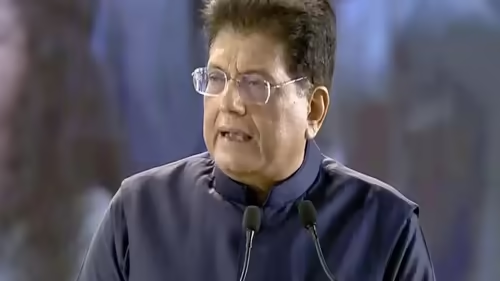
“The mother of all deals.”
That’s how India’s Commerce and Industry Minister, Piyush Goyal, recently described the long-anticipated EU-India trade pact—a comprehensive agreement that’s been in negotiation for over two decades . With both sides pushing for a final deal by late 2026, the stakes couldn’t be higher. The European Union is India’s third-largest trading partner, with bilateral trade in goods and services exceeding €124 billion in 2024 . A successful pact could turbocharge exports, attract investment, and cement a strategic alliance against global economic headwinds.
But is this deal truly a golden ticket—or a Trojan horse wrapped in bureaucratic red tape? As optimism mounts in Delhi and Brussels, critical voices warn of hidden costs for Indian farmers, small manufacturers, and data privacy frameworks. Let’s unpack what this historic agreement really means for India’s economic future.
Table of Contents
- What Is the EU-India Trade Pact?
- Why Piyush Goyal Calls It the ‘Mother of All Deals’
- Key Benefits for India
- Major Concerns and Sticking Points
- Global Context: Why Now?
- Conclusion
- Sources
What Is the EU-India Trade Pact?
The proposed agreement is more than just a standard free trade deal. It’s a trilateral framework encompassing:
- Free Trade Agreement (FTA): Eliminating tariffs on thousands of goods.
- Investment Protection Agreement (IPA): Safeguarding European investments in India.
- Geographical Indications (GI) Agreement: Protecting products like Darjeeling tea and Champagne from imitation.
Negotiations began in 2007 but stalled in 2013 over disagreements on market access, labor standards, and intellectual property. Talks resumed in 2022 amid shifting geopolitical dynamics—particularly the Russia-Ukraine war and China’s growing assertiveness .
Why Piyush Goyal Calls It the ‘Mother of All Deals’
Goyal’s enthusiasm isn’t unfounded. The EU-India trade pact promises transformative gains:
- Market Access: The EU has offered to eliminate duties on 95% of Indian goods, including textiles, gems & jewelry, and processed foods—sectors that employ millions .
- Digital & Green Tech Collaboration: Joint ventures in renewable energy, AI, and semiconductor manufacturing could position India as a trusted alternative to China in global supply chains.
- Strategic Leverage: Closer EU ties counterbalance over-reliance on any single power, aligning with India’s “multi-alignment” foreign policy.
For a government eager to showcase economic diplomacy wins ahead of state elections, this deal is political gold.
Key Benefits for India
If implemented well, the pact could deliver significant upside:
- Boost to MSMEs: Easier access to the EU’s 450-million-consumer market could help small exporters scale globally [INTERNAL_LINK:how-indian-msmes-can-enter-eu-market].
- Pharma & IT Expansion: While services aren’t fully covered, mutual recognition of professional qualifications could ease entry for Indian IT and healthcare professionals.
- Technology Transfer: EU firms may bring advanced manufacturing techniques, raising productivity across sectors like automotive and electronics.
According to a 2025 study by the European Commission, the FTA could increase India’s GDP by up to 0.8% annually over the next decade .
Major Concerns and Sticking Points
Despite the optimism, serious hurdles remain—and critics fear Indian interests are being compromised:
- Agricultural Imports: The EU demands greater access for dairy, wine, and apples. Indian farmers worry cheap imports will flood markets, undercutting local producers—echoing fears from the 2019 RCEP backlash .
- Data Localization: The EU insists on cross-border data flows without localization, potentially undermining India’s Digital Personal Data Protection Act and exposing citizen data to foreign jurisdictions.
- Labour & Environmental Standards: The EU wants binding clauses on climate action and workers’ rights—well-intentioned but potentially used as non-tariff barriers against Indian goods.
As Dr. Rekha Chowdhary, trade policy expert at NCAER, warns: “Without strong safeguards, this deal could benefit big corporates while leaving vulnerable sectors exposed” .
Global Context: Why Now?
The timing isn’t accidental. Both India and the EU are seeking to diversify away from China. The EU’s “de-risking” strategy and India’s “China+1” supply chain model converge perfectly here. Moreover, with the U.S. turning inward under potential 2024 election outcomes, the EU sees India as a stable democratic partner in Asia.
Yet, as noted by the World Trade Organization, modern trade deals are increasingly about regulatory alignment, not just tariffs . India must ensure its domestic priorities—like food security and digital sovereignty—aren’t sacrificed for market access.
Conclusion
The EU-India trade pact holds immense promise, but calling it the “mother of all deals” risks oversimplifying a deeply nuanced negotiation. For India, the true test lies in balancing ambition with protection—opening doors for exporters while shielding farmers and citizens from unintended consequences. If structured with equity and foresight, this agreement could indeed be transformative. But if rushed for political optics, it may become a cautionary tale of asymmetrical globalization. The world is watching; India must negotiate not just for today’s headlines, but for tomorrow’s resilience.
Sources
[1] Times of India. “EU trade pact to be ‘mother of all deals’, says Piyush Goyal”. https://timesofindia.indiatimes.com/business/india-business/eu-trade-pact-to-be-mother-of-all-deals-says-piyush-goyal/articleshow/126591572.cms
[2] European Commission. “EU-India Trade Relations Factsheet”, 2025.
[3] Brookings Institution. “Reviving the EU-India Trade Deal in a Multipolar World”.
[4] Ministry of Commerce, India. “Draft Text of EU-India FTA: Market Access Offers”.
[5] European Commission Impact Assessment Report, 2025.
[6] Down To Earth. “Farmers’ Fears Over EU Dairy Imports”.
[7] NCAER Policy Brief. “Assessing the Distributional Impact of the EU-India FTA”.
[8] World Trade Organization. “World Trade Report 2024: Trade and Inclusiveness”. https://www.wto.org/english/res_e/publications_e/world_trade_report24_e.htm