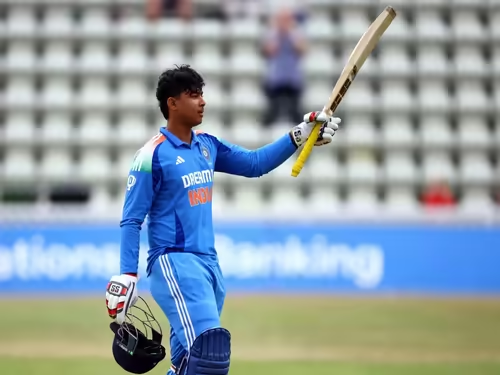
Meet Vaibhav Sooryavanshi: 14 years old, IPL debutant, and now representing India at the U19 World Cup. On paper, it’s a dream trajectory. But former India women’s head coach WV Raman has issued a stark warning: this level of exposure at such a tender age might be “detrimental to his growth” .
His caution comes as India kicked off their U19 World Cup 2026 campaign with a comfortable win over the USA—a match where Sooryavanshi had a quiet outing, scoring just 8 runs before being dismissed. While fans celebrated the team’s victory, Raman’s comments sparked a crucial debate in Indian cricket circles: are we accelerating young talents too fast, sacrificing long-term potential for short-term spectacle?
Table of Contents
- The Prodigy and the Pressure
- Why WV Raman Is Worried About U19 World Cup Exposure
- Historical Precedents: Successes and Burnouts
- What Does Science Say About Early Sports Specialization?
- Balancing Act for BCCI and Coaches
- Conclusion
- Sources
The Prodigy and the Pressure
Vaibhav Sooryavanshi isn’t your average teenager. He made headlines in 2025 when he became one of the youngest players ever to feature in the IPL, turning out for Rajasthan Royals. His clean strokeplay and composure drew comparisons to a young Virat Kohli. Now, at 14, he’s the youngest member of India’s U19 World Cup squad—a tournament typically dominated by 17- and 18-year-olds.
While his inclusion showcases India’s depth of talent, it also places immense physical and psychological demands on a child still in middle school. The jump from age-group cricket to international junior tournaments—and then to the glitz of the IPL—is enormous. As Raman pointed out, “He’s very talented, no doubt. But is this the right environment for him to learn and grow?” .
Why WV Raman Is Worried About U19 World Cup Exposure
Raman’s concern isn’t about Sooryavanshi’s skill—it’s about developmental timing. Playing in the U19 World Cup at 14 means competing against players who are not only older but often physically mature, stronger, and more experienced. This mismatch can lead to:
- Premature Technical Compromise: To survive against faster bowlers, young batters may alter their natural technique, developing bad habits that are hard to unlearn later.
- Psychological Strain: Public scrutiny, performance pressure, and fear of failure can erode confidence during a critical phase of mental development.
- Physical Overload: Intense training and match schedules increase injury risk, especially during growth spurts common in early adolescence.
Raman advocates for a more measured approach: “Let him play age-appropriate cricket—U16, domestic inter-school, maybe some A-team games. Build his foundation first. The U19 World Cup will still be there in two years” .
Historical Precedents: Successes and Burnouts
Cricket history offers mixed lessons. On one hand, players like Sachin Tendulkar (debut at 16) and Mohammad Amir (starred in 2009 U19 WC at 17) thrived under early pressure. But for every success story, there’s a cautionary tale.
Rehan Ahmed, England’s youngest Test cricketer, faced intense media glare after his 2022 debut at 18—and while he’s progressing, experts note he was carefully managed with limited workload. Contrast that with countless “wonder kids” from the 2000s U19 circuits—names like Tanmay Srivastava or Ravindra Jadeja’s early peers—who faded due to burnout or lack of structured progression .
The key difference? Support systems. As noted by the National Institutes of Health (NIH), early specialization without holistic development often leads to dropout rates exceeding 70% in adolescent athletes .
What Does Science Say About Early Sports Specialization?
Sports science is clear: diversification before age 14–15 yields better long-term athletic outcomes. A landmark study published in the British Journal of Sports Medicine found that elite athletes typically played multiple sports until their mid-teens, which enhanced motor skills, reduced injury risk, and prevented psychological fatigue .
For cricket—a sport demanding nuanced hand-eye coordination, strategic thinking, and emotional resilience—rushing a child into high-stakes environments can stunt cognitive and technical growth. As Dr. Neeraj Chaudhary, a sports psychologist working with NCA, explains: “A 14-year-old’s brain is still developing impulse control and emotional regulation. Throwing them into a World Cup final-like pressure is like asking a sapling to weather a hurricane” [INTERNAL_LINK:sports-psychology-youth-cricket].
Balancing Act for BCCI and Coaches
The Board of Control for Cricket in India (BCCI) faces a dilemma. On one side, there’s public demand to showcase prodigies; on the other, a duty of care. Their current pathway includes:
- National Cricket Academy (NCA): Offers age-specific training blocks with emphasis on skill over results.
- Gradual Exposure Policy: Typically, players enter U19 setup at 16–17 after performing in U16 and Vinoo Mankad tournaments.
- Mental Conditioning Programs: Psychologists are now embedded in junior camps to monitor stress levels.
Sooryavanshi’s case may force a policy rethink. Should exceptions be made for “once-in-a-generation” talents? If so, what safeguards must accompany them? Perhaps a hybrid model—limited overs in the tournament, heavy focus on practice sessions, and mandatory rest periods—could offer a middle ground.
Conclusion
The U19 World Cup is a launchpad for future stars, but it’s not a one-size-fits-all solution. WV Raman’s warning about Vaibhav Sooryavanshi isn’t pessimism—it’s prudence. Talent alone isn’t enough; it needs time, space, and the right environment to blossom. India has a golden opportunity to lead in youth athlete development, not just produce precocious performers. The real victory won’t be measured in runs scored at 14, but in Tests played—and enjoyed—at 28. Let’s ensure Sooryavanshi’s journey is a marathon, not a sprint that ends before it truly begins.
Sources
[1] Times of India. “‘Detrimental to growth’: Ex-India coach questions Sooryavanshi playing U19 WC”. https://timesofindia.indiatimes.com/sports/cricket/icc-u-19-world-cup/detrimental-to-his-growth-ex-india-coach-questions-vaibhav-sooryavanshi-playing-u19-world-cup/articleshow/126568611.cms
[2] ESPNcricinfo. “Vaibhav Sooryavanshi: The 14-year-old IPL sensation”.
[3] Wisden India. “Where Are They Now? U19 World Cup Stars of the Past”.
[4] National Institutes of Health (NIH). “Early Sport Specialization: A Review of the Literature”. https://www.ncbi.nlm.nih.gov/pmc/articles/PMC6133527/
[5] British Journal of Sports Medicine. “The benefits of early diversification in youth sports”.