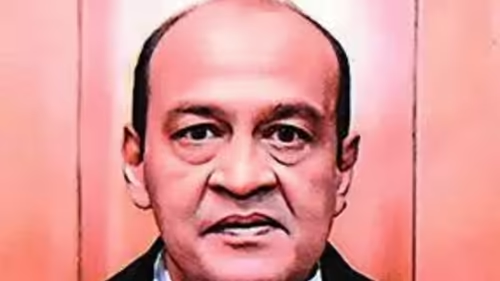
Democracy just got a powerful judicial endorsement.
In a decisive and constitutionally significant ruling, the Supreme Court of India has shut down an attempt to use the courts to derail ongoing proceedings in Parliament. The bench, led by Chief Justice of India, firmly stated: “You cannot use the law to scuttle the Parliamentary process” .
The case centered around a public interest litigation (PIL) filed by advocate M.L. Varma, who sought directions from the Court to restrain Parliament from considering or passing certain legislation, citing alleged procedural irregularities. The Court’s swift and unequivocal rejection of this plea isn’t just about one petition—it’s a vital reaffirmation of a core democratic principle: the separation of powers between the legislature, executive, and judiciary.
Table of Contents
- The Supreme Court’s Clear Message on Parliamentary Process
- Why the Court Rejected Varma’s Plea
- Constitutional Safeguards: Article 122 and Judicial Restraint
- Historical Precedents: Setting the Boundary
- What This Means for Indian Democracy
- Conclusion
- Sources
The Supreme Court’s Clear Message on Parliamentary Process
The Court’s language was direct and unambiguous. It emphasized that while the judiciary is the ultimate guardian of the Constitution, it must exercise extreme caution when it comes to matters that are squarely within the domain of the legislature. Interfering with the internal workings of Parliament—its debates, procedures, and law-making functions—is not just inappropriate; it’s a violation of the delicate balance enshrined in our constitutional framework .
This ruling serves as a crucial reminder that Parliament is a sovereign body. Its members are elected by the people to deliberate and legislate. Allowing the courts to step in and halt this process based on speculative grievances would set a dangerous precedent, effectively giving unelected judges veto power over the will of the electorate as expressed through their representatives.
Why the Court Rejected Varma’s Plea
The petitioner’s argument likely hinged on claims of procedural impropriety or potential violations of rules of procedure. However, the Supreme Court recognized a fundamental flaw in this approach:
- Lack of Justiciability: Many aspects of parliamentary conduct are considered “political questions” that are non-justiciable, meaning they are not suitable for judicial determination.
- Internal Remedies Exist: Parliament has its own robust mechanisms to address procedural issues. The Speaker of the Lok Sabha and the Chairman of the Rajya Sabha are the final arbiters of their respective House’s rules and decorum. Members can raise points of order, move adjournment motions, or even initiate no-confidence votes if they believe the process is being subverted.
- Potential for Abuse: Allowing such PILs would open the floodgates for frivolous litigation aimed at stalling legislation for political gain, paralyzing the entire legislative machinery.
In essence, the Court ruled that the proper forum to challenge the conduct of Parliament is within Parliament itself, not in a courtroom.
Constitutional Safeguards: Article 122 and Judicial Restraint
The bedrock of the Court’s decision lies in Article 122 of the Indian Constitution. This article explicitly states that the validity of any proceedings in Parliament “shall not be called in question on the ground of any alleged irregularity of procedure” .
This provision is not a loophole; it’s a deliberate shield. It was included by the framers of the Constitution to ensure that the legislative process could function without constant fear of legal challenges over minor procedural hiccups. It protects the independence and autonomy of the legislature.
The principle of judicial restraint, where courts decline to rule on matters better left to other branches of government, is a cornerstone of a healthy democracy. This judgment is a textbook application of that principle. For a deeper dive into how this works in practice, see our analysis on [INTERNAL_LINK:separation-of-powers-in-india].
Historical Precedents: Setting the Boundary
This isn’t the first time the Supreme Court has drawn this line in the sand. A key precedent is the landmark 1990 case of Ram Jethmalani vs Union of India. In that case, the Court refused to intervene in the expulsion of a member from Parliament, stating that such matters were internal to the House and beyond judicial review .
Another critical case is State of Karnataka vs Union of India (1977), where the Court, while asserting its power of judicial review, also cautioned against interfering in the day-to-day functioning of a co-equal branch of government. These rulings have consistently upheld the idea that while the courts can examine the substantive validity of a law *after* it’s been passed (for example, if it violates fundamental rights), they cannot stop the process of making that law in the first place .
What This Means for Indian Democracy
This judgment is a win for institutional integrity. It prevents the judiciary from becoming a political battleground for parties that have lost the argument on the floor of the House. It forces political disputes to be resolved through political means—debate, negotiation, and voting—rather than through legal technicalities.
However, this doesn’t mean Parliament is above the law. The Court’s hands are not tied forever. Once a law is enacted, its constitutional validity can be thoroughly challenged in court. If a law infringes upon fundamental rights or falls outside the legislative competence of Parliament, the judiciary has the full authority—and duty—to strike it down. This system of checks and balances ensures that while the process is protected, the final product is still subject to constitutional scrutiny.
As noted by legal scholars at the Centre for Policy Research, “This judgment reinforces the maturity of India’s constitutional democracy, where each institution respects the domain of the others” .
Conclusion
The Supreme Court’s rejection of Varma’s plea is far more than a procedural dismissal. It is a powerful, timely affirmation of the sanctity of the Parliamentary process and the foundational principle of separation of powers. By refusing to let the courts be used as a tool to obstruct the legislature, the Court has safeguarded the very engine of India’s democracy. The message is clear: political battles must be fought in the arena for which they were designed—Parliament—not in the courtrooms of the nation.
Sources
[1] Times of India. “Can’t use law to scuttle Parliamentary process, says SC…”. https://timesofindia.indiatimes.com/india/cant-use-law-to-scuttle-parliamentary-process-says-sc-rejects-varmas-plea/articleshow/126593022.cms
[2] Constitution of India, Article 122.
[3] Ram Jethmalani vs Union of India, 1990 SCR (3) 181.
[4] State of Karnataka vs Union of India, AIR 1978 SC 69.
[5] Centre for Policy Research. “Judicial Restraint and Legislative Autonomy in India”.