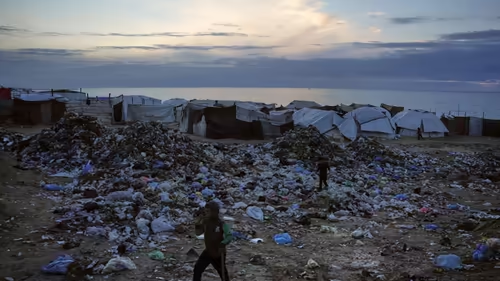
In a development that has stunned diplomats and analysts alike, former U.S. President Donald Trump is reportedly set to chair a newly proposed initiative called the Gaza Board of Peace—a high-profile panel aimed at overseeing reconstruction and fostering long-term stability in war-torn Gaza. The board’s proposed membership reads like a who’s who of international politics: Senator Marco Rubio, former UK Prime Minister Tony Blair, and other influential figures are said to be tapped as key members .
But here’s the catch: this announcement comes amid deep skepticism. Critics question whether such a board—especially one led by Trump, whose previous Middle East policies were widely seen as pro-Israel and dismissive of Palestinian statehood—can genuinely deliver peace or merely serve as political theater. With Gaza in ruins and humanitarian needs soaring, the stakes couldn’t be higher.
Table of Contents
- What Is the Gaza Board of Peace?
- Key Members and Their Roles
- Trump’s Controversial Middle East Legacy
- Can This Board Really Deliver Peace?
- Global and Regional Reactions
- What Comes Next?
- Conclusion: Hope or Hype?
- Sources
What Is the Gaza Board of Peace?
According to reports from the Times of India, the Gaza Board of Peace is envisioned as a multinational oversight body tasked with coordinating reconstruction efforts, managing aid distribution, and laying the groundwork for a sustainable political solution in Gaza . Unlike traditional UN-led initiatives, this board appears to be a privately backed or semi-official coalition, possibly aligned with U.S. strategic interests.
The timing is critical. After months of devastating conflict, Gaza faces an estimated $18 billion in infrastructure damage, with over 1.9 million people displaced and basic services like water, electricity, and healthcare in collapse . A coordinated, well-funded recovery mechanism is urgently needed—and that’s where the board claims it will step in.
Key Members and Their Roles
The proposed lineup blends American political heavyweights with seasoned international diplomats:
- Donald Trump (Chair): As the driving force behind the 2020 Abraham Accords, Trump brings name recognition and a transactional approach to diplomacy—but also deep mistrust from many Arab and Palestinian leaders.
- Marco Rubio (U.S. Senator): A staunch supporter of Israel and vocal critic of Hamas, Rubio would likely push for security-first reconstruction tied to demilitarization guarantees.
- Tony Blair: As the former UK PM and ex-Quartet Representative for the Middle East, Blair has decades of experience—but his legacy is mixed, with critics accusing him of enabling Israeli settlement expansion.
- Other unnamed members are rumored to include Gulf envoys and private-sector leaders focused on infrastructure and investment.
Trump’s Controversial Middle East Legacy
Trump’s previous Middle East policy was defined by bold moves: recognizing Jerusalem as Israel’s capital, moving the U.S. embassy there, cutting aid to Palestinians, and brokering normalization deals between Israel and Arab states—all without addressing core Palestinian demands like statehood or refugee rights.
While the Abraham Accords were hailed as historic by some, they largely bypassed the Palestinian Authority, deepening its political isolation. Many experts argue that any Gaza Board of Peace led by Trump must reckon with this legacy if it hopes to gain legitimacy among Palestinians and regional actors.
Can This Board Really Deliver Peace?
The short answer: it depends.
On one hand, the board could unlock significant private investment and streamline aid delivery—areas where traditional multilateral bodies have struggled. On the other, its success hinges on three critical factors:
- Inclusivity: Will Palestinian voices—especially from Gaza—be meaningfully included, or will decisions be made top-down?
- Neutrality: Can a board chaired by Trump and stacked with pro-Israel figures be seen as impartial?
- Coordination: How will it work alongside the UN, Egypt, Qatar, and other key players already involved in Gaza’s recovery?
Without addressing these questions, the initiative risks becoming another well-intentioned but ineffective gesture. For deeper context on past peace efforts, see the Council on Foreign Relations’ analysis of U.S. involvement in the Middle East peace process.
Global and Regional Reactions
Initial reactions have been sharply divided. Pro-Israel groups in the U.S. welcomed the move as “pragmatic and results-oriented.” Meanwhile, Palestinian factions and human rights organizations expressed alarm, calling the proposal “tone-deaf” and “a repackaging of failed policies.”
Arab states like Saudi Arabia and Jordan have not yet commented officially, but sources suggest they’re wary of any plan that sidelines the Palestinian Authority or ignores the two-state solution framework. The European Union, too, has emphasized that reconstruction must be linked to political progress—not just technical fixes.
What Comes Next?
If the Gaza Board of Peace moves beyond concept stage, its first test will be securing buy-in from key stakeholders: the Palestinian Authority, Hamas (however unlikely), Israel, and major donor nations. It will also need a clear mandate, funding mechanism, and operational base—likely outside Gaza due to security concerns.
For now, the proposal remains in its early phases. But with Trump potentially returning to the White House in 2025, this board could become a cornerstone of a second-term foreign policy agenda. Stay updated with our [INTERNAL_LINK:middle-east-peace-initiatives] coverage.
Conclusion: Hope or Hype?
The idea of a Gaza Board of Peace chaired by Donald Trump is undeniably bold—but boldness alone won’t rebuild homes, heal wounds, or forge lasting peace. For this initiative to succeed, it must transcend symbolism and deliver tangible, inclusive, and equitable outcomes for all Gazans. Until then, it remains a controversial proposal hanging in the balance between ambition and realism.