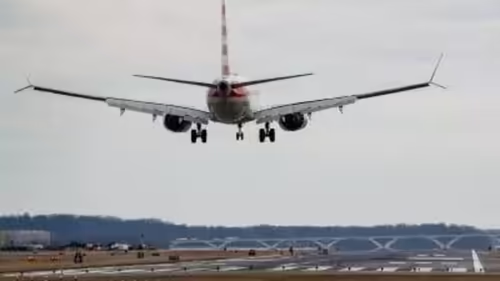
Airspace over a vast swath of the Americas is now under an unusual cloud of uncertainty. The U.S. Federal Aviation Administration (FAA) has issued a rare and serious Notice to Airmen (NOTAM), urging all U.S. aircraft operators to “exercise caution” due to “potential military activity” across Mexico, Central America, and South America . This 60-day advisory, effective immediately, has sent ripples through the global aviation community, raising urgent questions about regional stability, flight safety, and the nature of the undisclosed threat.
Table of Contents
- The FAA Warning: What It Actually Says
- Why This Is Highly Unusual
- Possible Scenarios Behind the Military Activity
- Impact on Commercial and Private Flights
- Historical Context of FAA NOTAMs in Latin America
- What Travelers Should Do Next
- Conclusion: A Cautious Sky Ahead
- Sources
The FAA Warning: What It Actually Says
The core of the advisory is a formal NOTAM (Notice to Airmen) that explicitly states: “Operators should exercise caution when planning flight operations in this area due to potential military activity.” The notice covers an enormous geographic area, stretching from just south of the U.S.-Mexico border all the way down through the entire continent of South America .
Critically, the FAA has not specified the source, nature, or location of this potential activity. It hasn’t named any specific country’s military or any particular type of operation. This lack of detail is both standard procedure for security reasons and deeply concerning for those who rely on clear information to make critical safety decisions. The US FAA military activity warning is a blanket advisory, forcing airlines and pilots to assess their own risk tolerance for every flight in the region.
Why This Is Highly Unusual
While the FAA regularly issues NOTAMs for things like volcanic ash, severe weather, or known conflicts (like the long-standing warnings for parts of Ukraine or the Middle East), a broad, unspecific warning covering an entire hemisphere is exceptionally rare. Such a move signals that the U.S. government has credible intelligence about a significant, but not yet fully defined, threat to civil aviation.
This isn’t a routine update; it’s a red flag. The decision to issue such a sweeping notice suggests that the intelligence community believes the risk is real enough to warrant a formal, public caution, even at the cost of causing operational headaches and potential panic among travelers. The 60-day duration also implies this is not a fleeting concern but a developing situation expected to persist for the foreseeable future.
Possible Scenarios Behind the Military Activity
In the absence of official details, speculation is rampant. Experts point to several plausible scenarios that could trigger such a high-level warning:
- Large-Scale Joint Military Exercises: Nations like Russia or China have conducted joint exercises with countries in the region (e.g., Venezuela). An unusually large or complex drill involving advanced weaponry could pose a navigational hazard.
- Escalation of Regional Tensions: An uptick in drug interdiction operations by multiple nations, or a sudden flare-up in a long-standing border dispute (such as between Venezuela and Guyana over the Essequibo region), could lead to increased and unpredictable military flights.
- Unauthorized or Rogue Activity: In a more alarming scenario, the warning could relate to intelligence about non-state actors or unauthorized military movements that could threaten civilian aircraft.
Without more information, it’s impossible to know which, if any, of these is accurate. However, the mere fact that the U.S. felt compelled to issue this notice underscores a growing unease about security dynamics in its own backyard.
Impact on Commercial and Private Flights
The immediate impact of this US FAA military activity warning is on flight planning and operations. Major U.S. airlines are now required to conduct enhanced risk assessments for every route that traverses the affected airspace. This could lead to:
- Flight Rerouting: Airlines may choose to fly longer, more fuel-intensive routes to avoid the region entirely, leading to delays and increased ticket prices.
- Cancellations: Some smaller carriers or private operators might decide the risk is too great and cancel flights altogether.
- Increased Passenger Anxiety: Even if flights operate as scheduled, the public knowledge of this warning will undoubtedly cause concern among travelers.
Passengers are advised to stay in close contact with their airlines for any updates on their specific itineraries.
Historical Context of FAA NOTAMs in Latin America
Historically, the FAA has maintained a relatively stable view of Latin American airspace. While there have been specific warnings for countries experiencing acute political instability (like Haiti or Nicaragua during periods of unrest), a blanket advisory for the entire region is unprecedented in recent memory. This marks a significant shift in the U.S. government’s assessment of the security environment south of its border, reflecting a more complex and potentially volatile geopolitical landscape.
What Travelers Should Do Next
If you have upcoming travel plans to or through Latin America, here’s what you should do:
- Check with Your Airline: Don’t rely on general news; get specific information about your flight from your carrier.
- Monitor Official Sources: Keep an eye on updates from the FAA (https://www.faa.gov/) and the U.S. Department of State’s travel advisories.
- Purchase Flexible Tickets: If possible, book refundable or changeable fares to give yourself options in case of disruptions.
- Stay Informed, Not Alarmed: While caution is warranted, this is a precautionary measure. There is no indication of an imminent, specific threat to any particular flight.
Conclusion: A Cautious Sky Ahead
The US FAA military activity warning is a stark reminder that the skies we take for granted as safe and predictable can quickly become uncertain. This advisory, while lacking in specifics, is a powerful signal from the highest levels of the U.S. government that something significant is brewing in the Americas. For now, the message is clear: proceed with extreme caution. The next 60 days will be crucial in determining whether this is a temporary blip or the start of a new, more turbulent chapter in regional aviation security.
Sources
- Times of India: ‘Exercise caution’: US FAA warns of ‘potential military activity’ over Mexico, South America
- U.S. Federal Aviation Administration (FAA): Official source for all NOTAMs and aviation safety information
- International Civil Aviation Organization (ICAO): Global standards and best practices for international air navigation