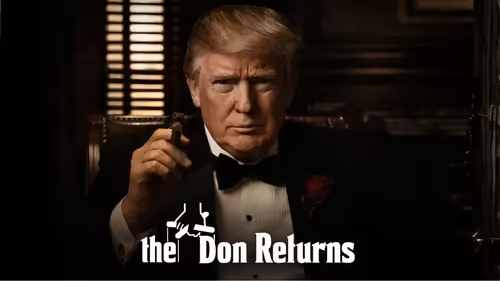
It started with paragliders and ended with a new world order. On October 7, 2023, a terrorist group’s grotesque assault on an Israeli music festival wasn’t just a regional atrocity—it became the spark that ignited a global realignment. The chaos that followed, with its tangled web of military responses, diplomatic ruptures, and electoral tremors, ultimately reinforced one undeniable truth: in the eyes of the world, America is still Daddy .
This isn’t hyperbole. In the months since that fateful day, the United States has not only reasserted its military and diplomatic supremacy but has also catalyzed the collapse of adversarial networks from Tehran to Damascus. The ripple effects have even reached the U.S. presidential race, potentially paving the way for Donald Trump’s return. Let’s unpack how a single day of horror reshaped the planet.
Table of Contents
- The October 7 Attack and Israel’s Furious Response
- The Collapse of Iran’s Axis of Resistance
- How the October 7 World Order Empowered America
- Global Ripples: Russia, China, and Europe Humbled
- The Trump Factor: How It Hastened a Comeback
- Conclusion: The New American Century?
- Sources
The October 7 Attack and Israel’s Furious Response
The Hamas-led assault on southern Israel was unprecedented in its brutality and coordination. But its strategic miscalculation was fatal: it drew Israel—and by extension, the United States—into a full-throated, uncompromising war. Backed by massive U.S. military aid, intelligence sharing, and diplomatic cover, Israel launched a campaign that didn’t just target Gaza but systematically dismantled Hezbollah’s capabilities in Lebanon and degraded Iranian proxy networks across the region .
Crucially, the U.S. didn’t just support from the sidelines. President Biden deployed aircraft carriers, missile defense systems, and special forces to the Eastern Mediterranean, sending a clear message: any escalation would be met with overwhelming American force .
The Collapse of Iran’s Axis of Resistance
Before October 7, Iran’s “Axis of Resistance”—a network linking Hamas, Hezbollah, the Houthis, and Shia militias in Iraq and Syria—appeared formidable. Afterward, it began to crumble.
- Hezbollah: Suffered devastating leadership losses and lost its strategic depth near the Israeli border.
- Houthis: Their Red Sea attacks, meant to show strength, instead invited relentless U.S.-UK airstrikes that crippled their logistics.
- Iran itself: Faced internal unrest and international isolation, with even traditional allies like China urging restraint .
The axis, once touted as a counterweight to U.S. influence, was exposed as brittle and overextended. Its rapid disintegration is one of the most significant geopolitical outcomes of the October 7 world order.
How the October 7 World Order Empowered America
Far from being a passive observer, the U.S. leveraged the crisis to reassert its role as the indispensable nation. While Europe dithered and China stayed silent, Washington acted decisively:
- It coordinated a multinational naval coalition to secure the Red Sea.
- It brokered quiet understandings between Israel and Arab states like Saudi Arabia to prevent regional conflagration.
- It used the moment to reinforce NATO unity and redirect focus from Ukraine to broader Middle East stability .
In essence, the U.S. demonstrated that, despite talk of multipolarity, no other power can project force, mediate crises, or guarantee security on a global scale. As one European diplomat reportedly quipped, “When the world burns, everyone calls Daddy” .
Global Ripples: Russia, China, and Europe Humbled
Russia, already bogged down in Ukraine, could do little more than issue hollow statements. China, eager to avoid antagonizing either side, remained conspicuously neutral—a stance that pleased no one. And Europe? Divided and dependent on U.S. security guarantees, it was reduced to issuing moral appeals while relying on American firepower to protect its shipping lanes .
The episode laid bare the limits of strategic autonomy. For all their rhetoric about sovereignty, when real danger emerged, these powers had no choice but to defer to Washington’s lead.
The Trump Factor: How It Hastened a Comeback
Domestically, the fallout from October 7 also reshaped U.S. politics. President Biden’s handling of the crisis—seen by many as too cautious—fueled criticism from both hawks and progressive voters. Meanwhile, Donald Trump seized the moment, framing himself as the strong leader who “would have prevented October 7” through his past pressure on Iran and recognition of Jerusalem .
Polls in early 2026 show Trump gaining ground among undecided voters who prioritize national security. The crisis, ironically, may have accelerated the very political comeback it was meant to prevent .
For more on how foreign policy shapes U.S. elections, see our analysis on [INTERNAL_LINK:us-election-2026-foreign-policy-impact].
Conclusion: The New American Century?
The October 7 world order didn’t create American dominance—it revealed it. In a chaotic, multipolar world, the U.S. remains the only nation with the will, capability, and alliances to enforce stability. The events since that horrific day have reminded friend and foe alike: when the chips are down, there’s only one Daddy in the room. Whether this leads to lasting peace or further entanglement remains to be seen—but for now, the world order has been decisively reset.
Sources
- “The Butterfly Effect: How Oct 7 made America the world’s ‘daddy'”, Times of India
- Israel-Hamas war timeline and U.S. response, Council on Foreign Relations
- U.S. military deployments post-October 7, Department of Defense
- Iran’s Axis of Resistance under strain, International Crisis Group
- U.S. diplomatic initiatives in the Middle East, Reuters
- European diplomatic sentiment, Financial Times
- Global power dynamics post-October 7, Brookings Institution
- Trump’s campaign messaging on Israel, The New York Times
- U.S. election polling trends 2026, Pew Research Center