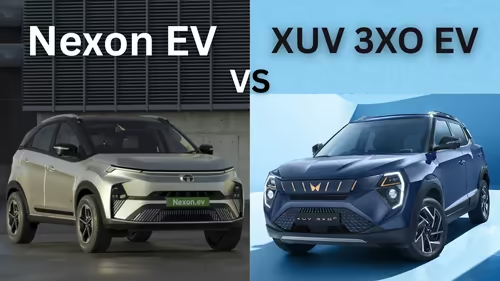
So, you’re ready to go electric. Great choice! But now you’re stuck between two of India’s most talked-about subcompact SUVs: the veteran Tata Nexon EV and the flashy newcomer, the Mahindra XUV 3XO Electric. It’s a classic showdown—experience versus innovation, proven reliability versus fresh design. And with both packing impressive specs, the decision isn’t easy.
Luckily, you’re in the right place. We’ve dug deep into the details—from battery range and real-world performance to cabin tech and ownership costs—to give you a clear, no-nonsense comparison. Forget the marketing fluff; this is the guide you need to pick your perfect electric companion.
Table of Contents
- Tata Nexon EV: The Established Contender
- Mahindra XUV 3XO Electric: The Bold Challenger
- Head-to-Head: Specs Comparison
- Real-World Range and Charging
- Interior, Tech, and Features
- Pricing and Value Proposition
- Verdict: Which One Should You Buy?
- Sources
Tata Nexon EV: The Established Contender
Launched in 2020, the Tata Nexon EV has been the undisputed king of India’s affordable electric SUV segment. Its biggest strength? A proven track record. Thousands of happy owners, a vast service network, and consistent software updates have built immense trust.
The current model offers two battery pack options: a 30kWh unit and a larger 45kWh pack. Both are powered by the same front-mounted electric motor that delivers a peppy 145 hp and 215 Nm of instant torque . This setup provides a smooth, responsive drive perfect for city commutes and weekend getaways.
Where it truly shines is in its ARAI-certified range. The 30kWh version promises 325 km, while the 45kWh variant boasts an impressive 489 km on a single charge . While real-world figures will be lower (typically 20-25% less), it still places the Nexon among the longest-range EVs in its class.
Mahindra XUV 3XO Electric: The Bold Challenger
Mahindra’s XUV 3XO Electric is the brand’s answer to the booming subcompact EV demand. Built on a new skateboard platform, it promises a more modern driving experience with a focus on design and digital connectivity.
While official final specs are still being confirmed, early reports suggest it will offer competitive range and performance. Mahindra is betting big on its futuristic interior, featuring a massive dual-screen setup and advanced ADAS features that could give it an edge over the Nexon in the tech department .
Head-to-Head: Specs Comparison
Let’s put the key numbers side by side:
| Feature | Tata Nexon EV (45kWh) | Mahindra XUV 3XO Electric (Expected) |
|---|---|---|
| Power | 145 hp | ~130-150 hp (TBC) |
| Torque | 215 Nm | ~220-240 Nm (TBC) |
| Battery | 45 kWh | ~39-45 kWh (TBC) |
| ARAI Range | 489 km | ~400-450 km (TBC) |
| Charging (DC Fast) | 0-80% in ~60 mins | 0-80% in ~50 mins (claimed) |
As you can see, the Tata Nexon EV currently holds a slight edge in certified range, but the XUV 3XO might counter with faster charging and a more engaging drive.
Real-World Range and Charging
ARAI numbers are great for brochures, but what matters is how far you can actually go. In mixed city-highway driving, the Nexon EV’s 45kWh variant typically delivers around 370-400 km—a very usable figure for most Indian buyers .
Both cars support DC fast charging, which is crucial for long trips. The Nexon’s 50 kW charger is widely compatible with public networks across India. Mahindra claims its XUV 3XO will support even faster charging speeds, which would be a significant advantage if their infrastructure keeps pace .
Interior, Tech, and Features
This is where the battle gets interesting. The Nexon EV’s cabin is functional and well-built, with a 10.25-inch touchscreen and a digital driver’s display. It’s user-friendly but starting to feel a bit dated next to newer rivals.
The XUV 3XO Electric, however, is expected to feature a stunning dual 10.25-inch screen setup, a panoramic sunroof, and a host of Level 2 ADAS features like adaptive cruise control and lane-keeping assist . If Mahindra delivers on this promise, it could set a new benchmark for tech in this segment.
For a deeper dive into the latest EV infotainment systems, check out our guide on [INTERNAL_LINK:best-ev-tech-features-in-india].
Pricing and Value Proposition
The Tata Nexon EV starts at around ₹14.5 lakh (ex-showroom) for the base model and goes up to ₹19.5 lakh for the top-spec 45kWh variant . Its value lies in its maturity, reliability, and extensive service network—a huge peace-of-mind factor.
The Mahindra XUV 3XO Electric is expected to be priced competitively, likely starting just under the Nexon. If it can match the Nexon’s range while offering superior tech and design, it could be a compelling package for early adopters who prioritize the latest features.
Verdict: Which One Should You Buy?
It boils down to your priorities. If you want a safe, proven, and reliable electric SUV with the best-in-class range and a trusted brand behind it, the Tata Nexon EV remains the smart, sensible choice. It’s the EV that’s already won the trust of thousands of Indian families.
But if you’re a tech enthusiast who craves the latest gadgets, a head-turning design, and don’t mind being an early adopter, the Mahindra XUV 3XO Electric could be your perfect match. It’s a bold gamble that could pay off with a more future-proof vehicle.
Either way, you’re choosing a fantastic step towards a cleaner, smarter driving future.
Sources
- “Mahindra XUV 3XO electric vs Tata Nexon: Subcompact EV comparison”, Times of India
- Mahindra XUV 3XO Electric specifications, Web Search Result
- Real-world range tests for Nexon EV, Autocar India
- EV charging infrastructure in India, NITI Aayog Report
- Expected features of XUV 3XO Electric, Web Search Result
- On-road price of Tata Nexon EV, CarDekho