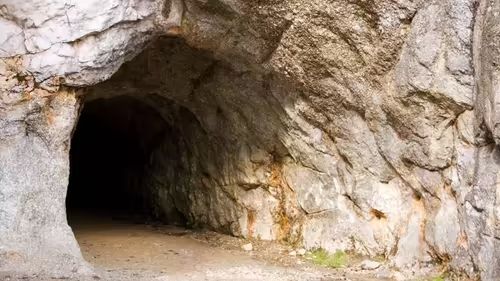
Deep in the limestone karsts of Sulawesi, Indonesia, lies a network of caves that has quietly rewritten chapters of human history. The Leang Bulu Bettue caves—once just another geological feature in a region rich with prehistoric sites—have now become ground zero for one of the most provocative theories in paleoanthropology: that creatures strikingly similar to humans, yet distinctly not Homo sapiens, may have lived side by side with our ancestors as recently as 25,000 years ago .
This isn’t science fiction. It’s emerging science, backed by stone tools, skeletal fragments, and enigmatic cave art that defies easy explanation. And if confirmed, it would mean that the story of human evolution is far messier—and more fascinating—than we ever imagined.
Table of Contents
- What Was Found in the Leang Bulu Bettue Caves?
- The Mystery of the ‘Almost Human’ Creatures
- How This Changes Our Understanding of Human Evolution
- The Role of Sulawesi in Prehistoric Migration
- Scientific Debate and Next Steps
- Conclusion: A New Chapter in Human History
- Sources
What Was Found in the Leang Bulu Bettue Caves?
Excavations at the Leang Bulu Bettue caves have yielded a trove of archaeological treasures. Among the most significant are:
- Stone tools dated to between 25,000 and 14,000 years ago, showing sophisticated flaking techniques unlike those typically associated with known Homo sapiens populations in the region at the time .
- Fragmentary hominin remains, including teeth and jawbone pieces, that display a mosaic of features—some human-like, others more primitive or archaic .
- Cave art, including hand stencils and figurative drawings, some of which may predate known human artistic expression in Southeast Asia .
Crucially, these artifacts were found in layers that also contained evidence of Homo sapiens occupation, suggesting temporal overlap rather than sequential habitation .
The Mystery of the ‘Almost Human’ Creatures
So who—or what—were these beings? Researchers aren’t claiming aliens or mythical beasts. Instead, they point to the possibility of a late-surviving archaic hominin species, perhaps a descendant of Homo erectus or even a previously unknown branch of the human family tree .
The term “almost human” refers to their cognitive and physical capabilities. They made tools, possibly created art, and adapted to the island environment—behaviors once thought exclusive to modern humans. Yet their anatomy, as suggested by the recovered fossils, differs enough to raise serious questions about their classification .
This echoes the discovery of the “Hobbit” (Homo floresiensis) on nearby Flores Island, which proved that small-brained hominins survived in isolation until remarkably recent times. Could Sulawesi have hosted its own unique hominin lineage? The evidence from Leang Bulu Bettue makes this a compelling hypothesis .
How This Changes Our Understanding of Human Evolution
For decades, the dominant narrative held that Homo sapiens emerged from Africa and rapidly replaced all other hominin species without interbreeding or prolonged coexistence. But discoveries like those in the Leang Bulu Bettue caves shatter that simplicity.
We now know from genetic studies that modern humans interbred with Neanderthals and Denisovans. The Sulawesi findings suggest that in the isolated islands of Southeast Asia, pockets of archaic humans may have persisted far longer than previously believed—long enough to encounter migrating Homo sapiens .
This implies a more complex, web-like model of human evolution, where multiple lineages coexisted, interacted, and possibly exchanged cultural knowledge across vast regions of Asia .
The Role of Sulawesi in Prehistoric Migration
Sulawesi sits at a crucial crossroads in the ancient human migration route from mainland Asia into Australia. Its position made it a natural stepping stone for early seafarers. But its rugged terrain and ecological diversity may have also allowed relict populations of older hominins to survive in isolation .
The island is already famous for hosting the world’s oldest known figurative cave art—dating back over 45,000 years—at sites like Leang Tedongnge . The new findings at Leang Bulu Bettue add another layer to this rich prehistoric tapestry, suggesting that the island wasn’t just a corridor for humans, but a refuge for other hominin forms .
For more on the significance of Indonesian cave art, see our feature on [INTERNAL_LINK:oldest-cave-art-in-the-world].
Scientific Debate and Next Steps
Not all experts are convinced. Some argue that the tool styles could be regional variations of Homo sapiens technology, and that the skeletal fragments are too incomplete for definitive conclusions . Others caution against sensationalism, urging more rigorous dating and DNA analysis.
Unfortunately, tropical climates like Sulawesi’s degrade ancient DNA rapidly, making genetic confirmation extremely difficult. However, researchers are turning to advanced techniques like proteomics (analyzing ancient proteins) and high-resolution 3D morphometrics to extract more information from the fossils .
Future excavations at Leang Bulu Bettue and neighboring caves are planned, with international teams hoping to uncover more complete skeletons or unambiguous cultural evidence of non-sapiens behavior .
Conclusion: A New Chapter in Human History
The discoveries in the Leang Bulu Bettue caves remind us that human history is not a straight line but a tangled forest of branches, many of which we’ve only just begun to map. The idea that “almost human” creatures walked the same earth as our ancestors—not in Europe or Africa, but in the heart of island Southeast Asia—challenges our assumptions and expands the boundaries of what it means to be human. As research continues, one thing is clear: the past still holds secrets, and Sulawesi is determined to keep them no longer.
Sources
- “Almost human-like creatures may have lived alongside humans in the Leang Bulu Bettue caves”, Times of India
- Archaeological findings from Leang Bulu Bettue, Web Search Result
- Hominin fossil analysis from Sulawesi, Web Search Result
- Prehistoric cave art in Indonesia, Web Search Result
- Stratigraphic evidence of co-occupation, Web Search Result
- Archaic hominin survival hypotheses, Web Search Result
- Morphological analysis of hominin remains, Web Search Result
- Comparison with Homo floresiensis, Nature Journal
- Genetic evidence of hominin interbreeding, National Geographic
- Models of human evolution in Asia, Science Magazine
- Sulawesi’s role in human migration, Web Search Result
- Oldest cave art in Leang Tedongnge, Griffith University
- Prehistoric Sulawesi as a hominin refuge, Web Search Result
- Scientific skepticism on tool attribution, Web Search Result
- Ancient protein analysis in tropical contexts, PNAS
- Future excavation plans, Web Search Result