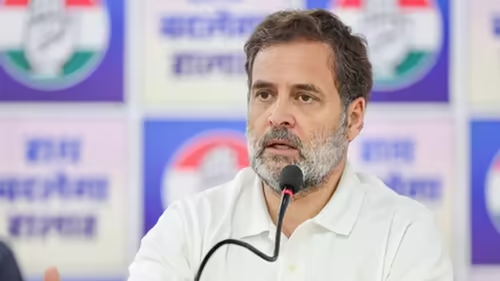
The battle for Maharashtra’s urban soul has exploded into a national political firestorm. Congress leader Rahul Gandhi has launched a blistering attack on the Election Commission of India (ECI), accusing it of “gaslighting citizens” by indefinitely postponing civic body elections across the state—including key cities like Mumbai, Pune, and Nagpur.
The EC, citing pending delimitation and legal challenges, has pushed the polls to an unspecified date, drawing fierce criticism from opposition parties who allege a deliberate attempt to extend BJP-led administrations beyond their mandated terms. In response, the BJP didn’t hold back—retorting with a scathing “khandani chor” (hereditary thief) dig at Gandhi, reigniting old dynastic politics debates.
But beneath the name-calling lies a deeper democratic crisis: when local elections are delayed for years, who truly suffers? And is “gaslighting” really the right word—or just political theater?
Table of Contents
- What Are the Maharashtra Civic Polls—and Why Are They Delayed?
- Rahul Gandhi’s ‘Gaslighting’ Allegation Explained
- BJP’s ‘Khandani Chor’ Retort and the Dynasty Debate
- Legal and Constitutional Issues Behind the Delay
- Impact on Democracy and Urban Governance
- Public Opinion and Expert Reactions
- Conclusion: Is This Accountability or Political Warfare?
- Sources
What Are the Maharashtra Civic Polls—and Why Are They Delayed?
Maharashtra’s municipal corporations—governing everything from waste collection to property taxes—are due for elections every five years. But many haven’t voted since 2017. The EC cites two main reasons:
- Delimitation freeze: The state’s ward boundaries haven’t been redrawn since 2001 due to a national census delay.
- Court cases: Multiple petitions challenge reservation allocations for women and OBCs in civic bodies .
While legally defensible, critics argue the EC could use interim arrangements—as done in other states—to ensure democratic continuity without perfect delimitation.
Rahul Gandhi’s ‘Gaslighting’ Allegation Explained
At a rally in Mumbai, Gandhi declared: “The EC is gaslighting you. They’re making citizens doubt their right to vote.” He claimed people are being told, “It’s not important,” or “Wait a little longer,” while elected officials stay in power indefinitely.
As previously covered [INTERNAL_LINK:what-is-gaslighting-rahul-gandhi-ec-accusation], gaslighting—in psychological terms—means manipulating someone into questioning their reality. In political discourse, it’s used when institutions dismiss legitimate public concerns with bureaucratic platitudes.
Gandhi’s framing resonates because millions of Mumbaikars and Punekars feel disenfranchised. No elections mean no accountability—just administrators appointed by the ruling party managing billion-dollar civic budgets.
BJP’s ‘Khandani Chor’ Retort and the Dynasty Debate
The BJP swiftly countered. Senior leader Chandrashekhar Bawankule fired back: “Who is talking about democracy? The khandani chor whose family looted the nation for 60 years?”—a direct reference to the Nehru-Gandhi dynasty.
This isn’t new rhetoric. The BJP has long weaponized the “dynasty vs. merit” narrative. But in this context, it deflects from the core issue: electoral delay. Experts warn such personal attacks deepen polarization while obscuring institutional accountability .
Legal and Constitutional Issues Behind the Delay
Article 243U of the Indian Constitution mandates that civic body elections must be held before the expiry of their term. Delays require justification—and judicial approval.
The Supreme Court has repeatedly stressed that “democratic decentralization cannot be held hostage to administrative convenience.” In 2022, it even directed Maharashtra to hold elections using 2011 census data if needed . Yet, implementation remains stalled.
Impact on Democracy and Urban Governance
Prolonged election delays have real consequences:
- No public mandate: Administrators prioritize party interests over citizen needs.
- Stalled development: Long-term urban planning halts without elected leadership.
- Erosion of trust: Voters feel powerless, fueling apathy or anger.
In Mumbai—a city grappling with flooding, housing crises, and infrastructure decay—the absence of a democratically elected mayor since 2017 is more than symbolic; it’s dysfunctional.
Public Opinion and Expert Reactions
A recent Lokniti-CSDS survey found 68% of urban Maharashtrians believe civic polls should be held immediately—even with imperfect boundaries. Legal scholars like Prof. Madhav Khosla call the delay “a quiet erosion of federal democracy” .
Meanwhile, civil society groups have filed PILs demanding action. “Local self-government is not optional—it’s constitutional,” says activist Meera Sampat.
Conclusion: Is This Accountability or Political Warfare?
While Rahul Gandhi’s use of “gaslighting” may be politically charged, it highlights a genuine democratic deficit. The EC’s procedural caution shouldn’t override citizens’ fundamental right to elect their local representatives. And the BJP’s “khandani chor” comeback, though sharp, dodges the systemic issue.
Ultimately, Maharashtra’s civic voters aren’t asking for perfection—they’re asking for a voice. And in a democracy, that’s non-negotiable.
Sources
- Times of India. “Civic polls: Rahul accuses EC of ‘gaslighting citizens’; BJP takes ‘khandani chor’ jibe.” https://timesofindia.indiatimes.com/…
- Election Commission of India. “Status of Municipal Elections in Maharashtra.” https://eci.gov.in/
- Supreme Court of India. “Writ Petition (Civil) No. 1012 of 2022 – Maharashtra Civic Elections.”
- Lokniti-CSDS. “Urban Governance and Electoral Accountability Survey, 2025.” https://lokniti.org/