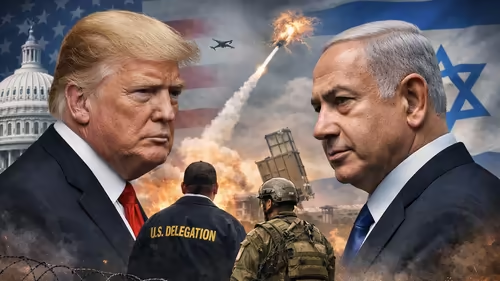
For over seven decades, the phrase “America has Israel’s back” has been a cornerstone of Middle Eastern geopolitics. This isn’t just political rhetoric; it’s a financial reality backed by a staggering sum: over $180 billion in U.S. military assistance since 1949 . This alliance, forged in the Cold War and solidified through countless conflicts, has made Israel the largest cumulative recipient of American foreign aid in history.
But now, in a move that has sent shockwaves through diplomatic circles, Israeli Prime Minister Benjamin Netanyahu has declared his intention to bring this era to a close. In a recent interview with The Economist, he stated his goal is to “taper off” all U.S. military aid to zero within the next ten years . This announcement marks a profound pivot from dependence to a declared ambition of strategic self-reliance. So, what’s behind this dramatic shift, and how will it reshape the future of the US-Israel relationship?
Table of Contents
- The Historical Backbone: US Military Aid to Israel
- The Ultimate Defense Pact: The $38 Billion MOU
- Netanyahu’s Bold Vision: Tapering Off Aid by 2035
- Why Now? The Drivers of Strategic Self-Reliance
- The Future of the Alliance: Beyond the Checkbook
- Sources
The Historical Backbone: US Military Aid to Israel
The foundation of the modern US-Israel alliance was laid in 1979, when the U.S. began providing a consistent annual military aid package of $3 billion . This commitment was a direct response to the strategic realities of the time and has been renewed and expanded ever since. Adjusted for inflation, the total economic and military aid from the U.S. to Israel between 1951 and 2022 alone amounts to a colossal $225.2 billion .
This aid has been instrumental in building Israel’s qualitative military edge (QME) in the region. It has funded everything from advanced fighter jets like the F-35 to the Iron Dome missile defense system, which has become a symbol of Israeli technological prowess. The relationship is so intertwined that a significant portion of the aid must be spent on purchasing American-made weapons and defense systems, creating a powerful economic and industrial link between the two nations.
The Ultimate Defense Pact: The $38 Billion MOU
The current framework for this partnership is the 10-year Memorandum of Understanding (MOU) signed in 2016 under the Obama administration. This landmark agreement pledged $38 billion in military aid from 2019 to 2028, making it the single largest military aid package in U.S. history . The deal breaks down to $3.3 billion in Foreign Military Financing and an additional $500 million for joint missile defense programs like Iron Dome and David’s Sling .
This MOU was more than just a financial transaction; it was a strategic guarantee. It provided Israel with long-term budgetary certainty while giving the U.S. a formalized role in Israel’s defense planning and procurement. The agreement is set to expire in 2028, and until Netanyahu’s recent comments, it was widely assumed that negotiations for its renewal would begin in the coming years.
Netanyahu’s Bold Vision: Tapering Off Aid by 2035
Prime Minister Netanyahu’s declaration to end US military aid to Israel represents a radical departure from decades of precedent. His stated goal is to achieve complete strategic independence by phasing out the aid over the next decade . This isn’t just about saving money; it’s a calculated political and nationalistic statement. By declaring that Israel no longer needs this financial crutch, Netanyahu is projecting an image of a strong, sovereign, and technologically advanced nation capable of defending itself without external subsidy.
His announcement comes at a time of heightened tension in the US-Israel relationship, particularly regarding the ongoing war in Gaza. The Biden administration has been increasingly vocal about its concerns over civilian casualties and humanitarian access, leading to public disagreements with the Israeli government . Netanyahu’s move can be seen as a way to preempt any potential future conditions or restrictions the U.S. might try to attach to its aid, thereby safeguarding Israel’s freedom of action.
Why Now? The Drivers of Strategic Self-Reliance
Several key factors are converging to make this moment ripe for such a bold declaration:
- Shifting American Public Opinion: Support for Israel among the American public, particularly among younger demographics, has shown signs of softening due to the Gaza conflict . This creates political uncertainty for the future of unconditional aid in the U.S. Congress.
- Israel’s Booming Defense Industry: Israel is now a global leader in defense technology, with its own drones, cyber capabilities, and missile systems. Its domestic industry is mature enough to sustain its military needs without relying on foreign grants for procurement.
- Political Posturing: For Netanyahu, this announcement serves as a powerful domestic narrative, reinforcing his image as a strong leader who can stand up to even Israel’s closest ally and secure the nation’s future on its own terms.
The Future of the Alliance: Beyond the Checkbook
It’s crucial to understand that ending the formal aid package does not mean the end of the US-Israel alliance. The strategic, intelligence, and diplomatic ties between the two countries run far deeper than a line item in the U.S. budget. The U.S. will likely continue to be Israel’s primary arms supplier through direct commercial sales, and their intelligence-sharing and joint military exercises will almost certainly continue.
However, the symbolic weight of this change cannot be overstated. Moving from a grant-based relationship to a purely transactional one fundamentally alters the dynamic. It signals a new phase where Israel positions itself not as a dependent client state, but as a fully independent strategic partner. This evolution will be closely watched by allies and adversaries alike across the globe. For more on global political shifts, see our analysis on [INTERNAL_LINK:middle-east-geopolitics-2026] and [INTERNAL_LINK:us-foreign-policy-challenges].