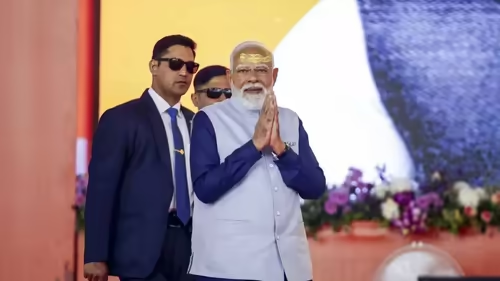
“Thank you, Maharashtra!”
With just four words, Prime Minister Narendra Modi captured the national mood following the resounding victory of the NDA-led Mahayuti alliance in the Maharashtra civic polls 2026. The results weren’t just a win—they were a political earthquake that reshaped the urban power structure of India’s financial capital and beyond .
From the corridors of the Brihanmumbai Municipal Corporation (BMC) to the council halls of Nagpur and Pune, the message from voters was clear: competence, unity, and visible development matter more than legacy or emotional appeals. And PM Modi, ever the astute communicator, didn’t just celebrate—he interpreted the mandate for the nation.
Table of Contents
- PM Modi’s Victory Message: A Leader’s Thank You
- Maharashtra Civic Polls 2026: The Sweeping Mandate
- The Mahayuti Formula: Unity + Development
- Why BMC Was the Crown Jewel
- Fadnavis: The Architect of Urban Revival
- National Implications: A Blueprint for 2029?
- Conclusion: Gratitude, Governance, and the Future
- Sources
PM Modi’s Victory Message: A Leader’s Thank You
In a series of social media posts and public remarks, PM Modi extended his gratitude not only to the people of Maharashtra but also to the grassroots workers of the BJP and its Mahayuti allies. “Your faith in the path of development has been reaffirmed,” he said, framing the electoral outcome as a validation of his government’s infrastructure-driven vision—from the Mumbai Coastal Road to the Nagpur Metro .
Notably, Modi avoided overtly divisive rhetoric. Instead, he emphasized seva (service), vikas (development), and sangathan (organization)—three pillars that have defined his political brand since 2014. This tone signals a strategic shift: in urban India, governance is the new ideology.
Maharashtra Civic Polls 2026: The Sweeping Mandate
The scale of the Mahayuti alliance’s victory is unprecedented in Maharashtra’s recent urban electoral history:
- Brihanmumbai Municipal Corporation (BMC): BJP alone won over 100 seats, ending years of MVA control.
- Pune, Nagpur, Thane, Nashik, Aurangabad: Clear majorities secured across all major cities.
- Statewide Corporator Count: NDA crossed 1,800 seats, dwarfing the opposition’s combined tally.
This wasn’t a narrow win—it was a comprehensive rejection of fragmented coalitions and a strong endorsement of stable, single-party-led governance at the local level .
The Mahayuti Formula: Unity + Development
The success of the BJP-Shiv Sena (Shinde)-NCP (Ajit Pawar) alliance—dubbed “Mahayuti”—rests on two key factors:
- Political Unity: Unlike the fractured opposition (Uddhav Sena, Sharad Pawar’s NCP, and Congress fighting separately), Mahayuti presented a united front, avoiding vote-splitting.
- Hyper-Local Development Narrative: Campaigns focused on tangible issues—garbage collection, water supply, street lighting—not abstract ideology. CM Devendra Fadnavis repeatedly stated, “We don’t separate Hindutva from development,” blending cultural identity with civic efficiency .
This dual-track strategy resonated deeply with the urban middle class, who prioritize functional city services over political nostalgia.
Why BMC Was the Crown Jewel
Winning the BMC isn’t just symbolic—it’s strategic. As India’s richest municipal body with an annual budget exceeding ₹50,000 crore, it controls everything from public health to real estate regulation .
For years, the BMC was a thorn in the BJP’s side—a stronghold of rival parties despite Modi’s national dominance. Regaining it in 2026 signals that even the most entrenched urban bastions are now within the NDA’s reach. It also gives the party direct control over Mumbai’s transformation into a global smart city.
Fadnavis: The Architect of Urban Revival
While Modi provided the national halo, Devendra Fadnavis was the ground-level architect of this victory. Returning as Chief Minister in 2024 after a five-year hiatus, he methodically rebuilt the BJP’s urban machinery, focusing on:
- Fast-tracking stalled infrastructure projects.
- Empowering local corporators with decision-making power.
- Leveraging central schemes like AMRUT and Smart Cities Mission for visible on-ground impact.
His personal credibility—and his ability to work seamlessly with allies Shinde and Pawar—proved decisive in convincing voters that Mahayuti meant stability, not opportunism.
National Implications: A Blueprint for 2029?
The Maharashtra civic polls 2026 offer a potential roadmap for the BJP ahead of the 2029 general elections. If urban India—which contributes over 70% of GDP—is shifting toward performance-based voting, then the party’s fusion of cultural nationalism and administrative efficiency could become its winning formula nationwide.
As noted by the Centre for Policy Research, “Local body elections are the truest barometer of urban sentiment. Maharashtra’s verdict suggests a new political equilibrium is forming” .
Conclusion: Gratitude, Governance, and the Future
PM Modi’s “Thank you, Maharashtra!” is more than politeness—it’s recognition of a pivotal moment. The Maharashtra civic polls 2026 have demonstrated that in today’s India, voters reward those who deliver clean streets, reliable water, and efficient transport—not just fiery speeches. For the NDA, it’s a mandate to accelerate. For the opposition, it’s a stark lesson in relevance. And for the nation, it’s a glimpse into the future of urban democracy.
Sources
- Times of India: ‘Thank you Maharashtra!’ PM Modi hails civic poll results
- LiveMint: Analysis: How Mahayuti Won Urban Maharashtra
- BMC Official Portal: BMC Budget and Functions
- Centre for Policy Research: Urban Governance in India Report 2025