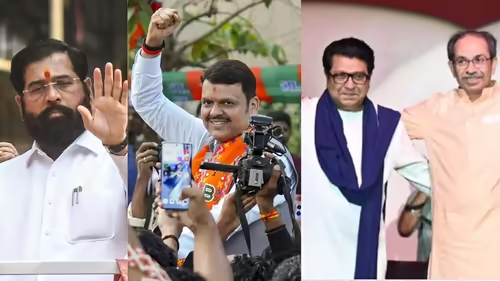
The dust has settled on the Maharashtra civic polls 2026, and what remains is a dramatically redrawn political map of India’s most economically vital state. In a stunning reversal of fortune, the BJP-led Mahayuti alliance has not just won—it has dominated, snatching control of the Brihanmumbai Municipal Corporation (BMC) after years of opposition rule and sweeping across major urban centers from Pune to Nagpur .
This wasn’t just another election. It was a referendum on leadership, unity, and vision. And as the results poured in, clear victors emerged—alongside some of the most humbling defeats in recent memory. Let’s break down the 10 biggest winners and losers who shaped this historic mandate.
Table of Contents
- The Big Picture: Mahayuti’s Urban Tsunami
- Top 5 Winners of Maharashtra Civic Polls 2026
- Top 5 Losers of Maharashtra Civic Polls 2026
- What This Means for the 2029 State Elections
- Conclusion: A New Urban Order in Maharashtra
- Sources
The Big Picture: Mahayuti’s Urban Tsunami
The Mahayuti alliance—comprising BJP, Shiv Sena (Eknath Shinde faction), and NCP (Ajit Pawar group)—secured commanding majorities in 13 of 14 key municipal corporations. The crown jewel? The BMC, where the BJP alone won over 100 seats, ending the Maha Vikas Aghadi’s (MVA) turbulent reign .
Voter turnout was high, especially among the urban middle class, who prioritized efficient governance, infrastructure delivery, and stability over emotional or ideological appeals. The message was clear: performance trumps nostalgia.
Top 5 Winners of Maharashtra Civic Polls 2026
1. Devendra Fadnavis – The Architect of the Comeback
Once written off after the 2019 political drama, CM Devendra Fadnavis has staged a masterful political resurrection. By unifying the Mahayuti alliance and focusing relentlessly on development narratives—from metro expansions to waste management—he turned urban discontent into a landslide. His personal credibility is now at an all-time high, positioning him as the undisputed face of Maharashtra BJP ahead of 2029.
2. BJP – The Undisputed Urban Kingmaker
The BJP didn’t just win—it rewrote the rules. With over 1,800 corporator seats statewide, it has become the single largest party in Maharashtra’s urban local bodies. Its success in Mumbai, a traditional Sena bastion, signals a fundamental realignment of voter loyalty toward competence and central government-backed projects.
3. Eknath Shinde – Legitimacy Through Alliance
Despite internal criticism, Chief Minister Eknath Shinde’s decision to align with BJP has paid off electorally. His faction of Shiv Sena gained significant ground in Thane and surrounding belts, proving that his “realistic” politics resonates with voters tired of ideological purism. This win cements his position as a viable regional leader—not just a BJP proxy.
4. Young BJP Corporators – The Next Generation Rises
A wave of first-time, tech-savvy BJP candidates under 35 won seats across Mumbai, Pune, and Nashik. Trained in digital campaigning and hyper-local issue advocacy, they represent the future of urban governance—focused on citizen apps, transparency, and data-driven solutions.
5. PM Narendra Modi – The Invisible Campaigner
Though not on the ballot, PM Modi’s shadow loomed large. His recent inaugurations—Mumbai Coastal Road, Nagpur Metro Phase 2—were constantly referenced in BJP campaigns. Voters saw these as proof of “Delhi’s commitment to Maharashtra,” turning national pride into local votes.
Top 5 Losers of Maharashtra Civic Polls 2026
1. Uddhav Thackeray – The Fall of the Shiv Sena Patriarch
Perhaps the most painful loss belongs to Uddhav Thackeray. His Shiv Sena (UBT) lost its last stronghold—Mumbai—and saw its seat count plummet by over 60%. The emotional appeal of “Balasaheb’s legacy” failed to translate into votes, exposing a generational disconnect and strategic drift.
2. Congress – Irrelevant in the Urban Arena
The Congress party’s performance was abysmal. In Mumbai, it won just 3 seats. Across Maharashtra, it failed to cross double digits in any major city. Without a strong local narrative or charismatic leadership, it has been reduced to a footnote in urban politics—a cautionary tale of organizational decay.
3. Sharad Pawar – The Waning Influence of a Veteran
Despite his enduring rural clout, Sharad Pawar’s NCP (SP) could not replicate its influence in cities. The party’s urban vote share collapsed, revealing that even his legendary stature can’t overcome the perception of being a junior partner in unstable coalitions.
4. Raj Thackeray’s MNS – A Fading Force
Once a kingmaker in Mumbai, the MNS managed to win only a handful of seats. Its Marathi identity plank has been effectively co-opted by both Sena factions, leaving it with no unique selling proposition. Unless it reinvents itself, its political relevance may be confined to history books.
5. The Maha Vikas Aghadi (MVA) Model – Discredited
The grand anti-BJP coalition of 2019 is now politically bankrupt. Its tenure in BMC was marred by infighting, stalled projects, and poor monsoon preparedness. Voters punished this instability harshly, signaling that forced alliances without a common vision are doomed to fail.
What This Means for the 2029 State Elections
The Maharashtra civic polls 2026 are a powerful predictor of the 2029 assembly elections. The BJP-Mahayuti alliance has demonstrated it can deliver a unified, development-focused message that cuts across caste and community lines in urban areas. If it maintains this momentum and expands into semi-urban belts, a two-thirds majority in the state assembly is not out of reach.
For the opposition, the path forward is steep. They must either reunite under a compelling new leadership or risk permanent marginalization. As political analyst Pratap Bhanu Mehta noted, “Urban India now votes for governance, not grievance” .
Conclusion: A New Urban Order in Maharashtra
The Maharashtra civic polls 2026 have ushered in a new era—one where efficiency, unity, and visible development trump divisive rhetoric and legacy politics. The winners understood this shift; the losers ignored it at their peril. As Maharashtra looks toward the future, one thing is certain: the city halls of today will shape the state assembly of tomorrow.
Sources
- Times of India: BMC and other Maharashtra civic poll results 2026: Top 10 winners and losers
- The Indian Express: Analysis on Maharashtra Urban Voting Trends
- Election Commission of India: Official Civic Election Data