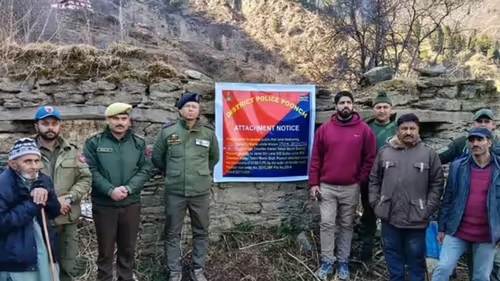
In a significant development that underscores India’s zero-tolerance policy towards terrorism, the J&K Police attach terror property belonging to a Pakistan-based handler in the Poonch district. This strategic action is not just a seizure of bricks and mortar; it’s a direct strike at the financial arteries that fuel cross-border terror operations .
Table of Contents
- The Target: Abdul Aziz and His Terror Network
- Details of the Attached Property in Mandi
- The Legal Framework Behind the Seizure
- How Narcotics Fund Terrorism in Jammu and Kashmir
- Broader Implications for Regional Security
- Conclusion: A Strategic Victory Against Terror Financing
The Target: Abdul Aziz and His Terror Network
The property in question belongs to Abdul Aziz, son of Ahmeda Lone, a resident of Chamber Kanari in Tehsil Mandi, Poonch . While his roots are in Poonch, Aziz is now based in Pakistan, where he operates as a key terror handler. Indian security agencies have long suspected him of orchestrating and financing militant activities across the Line of Control (LoC). His role involves not only directing operations but also managing the flow of funds and logistics for terrorist groups operating in the region.
Details of the Attached Property in Mandi
The attached assets are located in the Mandi area of Poonch and include a residential house along with a parcel of land. According to official police statements, the total value of these immovable properties is estimated at ₹25,35,882 . The most damning detail is the alleged source of this wealth: the illicit narcotics trade. This connection between drugs and terrorism is a well-documented and persistent threat in the Jammu and Kashmir region, where drug money is often laundered to finance weapons, training, and other terror-related activities .
The Legal Framework Behind the Seizure
This action by the J&K Police was not taken in isolation. It was executed under a specific legal framework designed to dismantle the economic infrastructure of terrorism. The attachment was carried out in compliance with official directives and is directly linked to a First Information Report (FIR) registered against Abdul Aziz . This legal process allows authorities to freeze and eventually confiscate assets that are proven to be proceeds of crime or used to support unlawful activities. It’s a powerful tool that moves beyond merely apprehending individuals to actively crippling their operational capabilities by cutting off their resources.
How Narcotics Fund Terrorism in Jammu and Kashmir
The case of Abdul Aziz is a textbook example of a dangerous nexus that has plagued the region for years. Here’s how the cycle typically works:
- Smuggling: Narcotics, primarily heroin and synthetic drugs, are smuggled from Pakistan into Jammu and Kashmir across the porous LoC.
- Distribution & Profit: These drugs are distributed within the state and across India, generating massive illegal profits.
- Laundering & Funding: The illicit cash is laundered through various channels, including the purchase of real estate, and is then used to fund terrorist activities, recruit new members, and procure arms.
By attaching a property explicitly bought with drug money, the J&K Police are sending a clear message: they are targeting the entire ecosystem, not just its visible actors. This approach aligns with global counter-terrorism strategies that emphasize disrupting financial networks. For more on international efforts to combat terror financing, you can refer to resources from the United Nations Security Council.
Broader Implications for Regional Security
This single act of property attachment has far-reaching consequences. It serves as a strong deterrent to others who might consider using their assets to support terrorism. It demonstrates the proactive and intelligence-driven nature of the J&K Police, who are now focusing on a multi-pronged strategy that includes financial investigations alongside traditional policing. Furthermore, it highlights the ongoing challenge posed by Pakistan-based handlers who continue to operate from across the border, attempting to destabilize the region. Actions like this are crucial steps in reclaiming the narrative and asserting control over local communities that have been affected by this shadow economy.
Conclusion: A Strategic Victory Against Terror Financing
The J&K Police attach terror property in Poonch is more than a routine administrative action; it’s a calculated and strategic victory in the long war against terrorism. By seizing assets worth over ₹25 lakh that were allegedly bought with blood money from the narcotics trade, the authorities have dealt a tangible blow to the financial health of a Pakistan-based terror network. This move not only punishes the individual involved but also disrupts the broader machinery of terror financing, making it harder for such networks to operate and thrive. It’s a clear signal that the era of impunity for those who bankroll terror from afar is coming to an end.
Sources
- Poonch Police attaches Property of Pakistan-based Terror handler Abdul Aziz in Mandi Area.
- Poonch police attaches property belonging to Pakistan-based terror handler Abdul Aziz. The attachment has been effected in connection with FIR.
- Poonch Police have attached an immovable property belonging to a Pakistan-based terror handler.
- The attached property includes a residential house and land worth ₹25,35,882, allegedly acquired through illicit narcotic trade.
- According to the police, the attached property belongs to Abdul Aziz, son of Ahmeda Lone, resident of Chamber Kanari, Tehsil Mandi, Poonch.
- Jammu and Kashmir Police on Thursday attached the immovable property of a Pakistan-based terror handler in Poonch.
- The attached property includes a residential house and land worth ₹25,35,882, allegedly acquired through illicit narcotic trade.