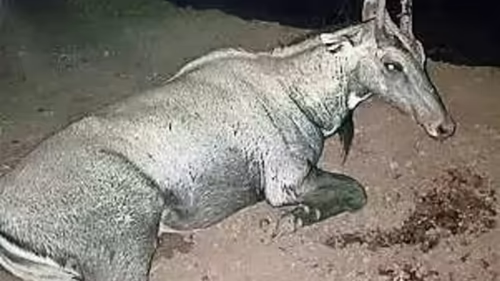
It was supposed to be an ordinary drive home. Instead, it became a nightmare that no parent should ever endure. On a quiet stretch of the Guna highway in Madhya Pradesh, a family’s car was suddenly and violently struck by a massive nilgai—India’s largest antelope—that leaped directly onto the vehicle, shattering the windshield and fatally injuring a four-year-old girl sitting in her mother’s lap .
The child died instantly from the impact. Her parents, both injured but conscious, were rushed to a nearby hospital. Meanwhile, forest officials managed to rescue the stunned but alive nilgai, which is now under veterinary care. This horrific event isn’t just a tragic accident—it’s a stark symbol of a growing crisis: the deadly intersection of expanding road networks and unchecked wildlife movement in rural India.
Table of Contents
- The Tragic Incident on the Guna Highway
- Why Do Nilgai Jump on Cars?
- The Rise of Nilgai Population and Human Conflict
- Nilgai Crashes Through Windshield: A Pattern, Not an Anomaly
- Legal and Ecological Status of Nilgai in India
- What Can Be Done? Road Safety and Wildlife Corridors
- Conclusion: A Call for Balanced Coexistence
- Sources
The Tragic Incident on the Guna Highway
According to police reports, the family was traveling from Bhopal to their village near Guna when, around dusk, a large male nilgai—estimated to weigh over 200 kg—suddenly darted across the road. Startled by the headlights or perhaps disoriented, the animal didn’t just cross; it leaped onto the hood of the moving sedan with such force that the windshield imploded inward .
The child, strapped in a booster seat but seated on her mother’s lap at the time (a common but unsafe practice in India), took the full brunt of the impact. Emergency responders described the scene as “devastating.” The father, who was driving, suffered facial lacerations, while the mother sustained chest trauma from the airbag deployment combined with the animal’s weight.
Why Do Nilgai Jump on Cars?
Unlike deer that typically flee, nilgai—especially males during mating season (October–March)—can exhibit erratic, aggressive behavior when startled. Experts from the Wildlife Institute of India explain that nilgai have poor depth perception and may misjudge the speed and distance of oncoming vehicles . In panic, they sometimes attempt to “clear” the car by jumping—only to land directly on it.
Additionally, many rural highways in Madhya Pradesh, Rajasthan, and Uttar Pradesh cut through agricultural fields and scrub forests—prime nilgai habitat. With no fencing, underpasses, or warning signs, these roads become death traps for both animals and humans.
The Rise of Nilgai Population and Human Conflict
Once revered and protected, the nilgai population has exploded in recent decades due to a combination of factors:
- Legal Protection: Classified as “vermin” only in select states (like Bihar and Uttarakhand), nilgai enjoy general protection under the Wildlife Protection Act, 1972, in most regions.
- Habitat Loss: As forests shrink, nilgai increasingly raid crops, pushing them closer to human settlements.
- Lack of Natural Predators: With tigers and leopards confined to reserves, adult nilgai face few threats.
In Madhya Pradesh alone, nilgai numbers are estimated at over 100,000—and rising. Farmers routinely report crop damage, and now, tragically, lives are being lost on roads.
Nilgai Crashes Through Windshield: A Pattern, Not an Anomaly
This Guna tragedy is not isolated. Similar incidents have occurred across North and Central India:
- 2023, Rajasthan: A nilgai crashed into a Maruti Swift, causing severe head injuries to the driver.
- 2022, Haryana: A pregnant woman lost her unborn child after a nilgai collision.
- 2021, Uttar Pradesh: Two teenagers were killed when a nilgai struck their motorcycle.
Yet, national road safety guidelines rarely account for large ungulate collisions—a gap that must be addressed urgently.
Legal and Ecological Status of Nilgai in India
The nilgai (Boselaphus tragocamelus) is native to the Indian subcontinent and holds cultural significance—its name literally means “blue cow,” and it’s often spared by Hindu communities. However, its ecological role is complex. While it helps maintain grassland diversity, unchecked populations degrade farmland and compete with livestock.
Some states have sought culling permissions, but public sentiment and legal hurdles make this controversial. Conservationists argue for non-lethal solutions: sterilization, translocation, and habitat restoration. But without immediate infrastructure fixes, tragedies like the one in Guna will keep happening.
What Can Be Done? Road Safety and Wildlife Corridors
Experts recommend a multi-pronged approach:
- Wildlife Fencing: Install robust fencing along high-risk highway stretches.
- Animal Underpasses/Overpasses: Build eco-ducts where roads intersect migration paths.
- Speed Limits & Signage: Enforce lower speeds and install “Nilgai Crossing” warning signs in known hotspots.
- Community Patrols: Train local villagers to monitor animal movements near roads.
- Public Awareness: Educate drivers on how to react if they encounter large wildlife at night.
For more on sustainable coexistence, see our feature on [INTERNAL_LINK:wildlife-conservation-india].
Conclusion: A Call for Balanced Coexistence
The image of a child lost to a nilgai crashes through windshield incident is haunting—but it must serve as a catalyst for change. India cannot afford to treat wildlife and infrastructure planning as separate domains. As roads expand and habitats shrink, the line between human and animal space blurs. Protecting both lives requires foresight, investment, and compassion. For the sake of every family on the road—and every creature in the field—we must act before the next tragedy strikes.
Sources
- Times of India: Girl, 4, in mom’s lap dies as nilgai jumps on car
- Wildlife Institute of India: Research on Human-Wildlife Conflict
- Ministry of Road Transport and Highways: Road Safety Guidelines
- Down To Earth: Nilgai Management and Policy Challenges
- Madhya Pradesh Forest Department: Annual Wildlife Report 2025