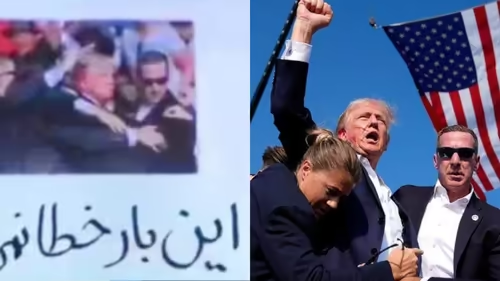
In a move that has sent shockwaves through diplomatic circles and raised global security concerns, Iranian state television has aired a segment containing what can only be described as a direct and chilling threat against U.S. President Donald Trump. The broadcast featured footage from the July 2024 assassination attempt at his rally in Butler, Pennsylvania, accompanied by a placard bearing his image and a stark, ominous message: “This time the bullet won’t miss its target.”
This is not merely inflammatory rhetoric; it’s a calculated escalation from a regime that has a documented history of plotting against the former and current U.S. president. For anyone following the fraught relationship between Washington and Tehran, this latest development is a dangerous new chapter in a long-running saga of mutual hostility.
Table of Contents
- The Broadcast and Its Chilling Message
- The Context: Trump’s Military Warnings to Iran
- A History of Hostility: Iranian Plots Against Trump
- What Does This Mean for US-Iran Relations?
- Conclusion: A Dangerous New Escalation
- Sources
The Broadcast and Its Chilling Message
The Iranian state-run network didn’t just air old news footage. It deliberately curated a segment that juxtaposed the chaotic scenes from the 2024 rally with the threatening placard, creating a narrative that the previous attempt was a failure they intend to correct . This is a significant departure from the usual veiled threats or statements from proxy groups. By using its official state media platform, the Iranian government has taken direct ownership of this menacing communication, lending it an unprecedented level of official sanction.
The choice of the 2024 assassination attempt as the backdrop is particularly provocative. That event was a major moment in recent American political history, and by referencing it, Iran is signaling a deep awareness of U.S. domestic vulnerabilities and a willingness to exploit them. The message is clear: they are watching, they are planning, and they believe they can succeed where others have failed.
The Context: Trump’s Military Warnings to Iran
This threat doesn’t exist in a vacuum. It comes on the heels of renewed and forceful warnings from President Trump himself. In early January 2026, Trump declared that “help is on the way” for anti-government protesters in Iran and again floated the possibility of taking “very strong actions” against Tehran . He has repeatedly stated that the U.S. is prepared to use military force if necessary, a stance that has clearly rattled the Iranian leadership.
Tehran has responded to these warnings by stating it is “ready for war,” creating a classic and perilous cycle of escalation . The UN has even stepped in, with an Assistant Secretary-General warning that such public threats of military action significantly increase regional volatility and the risk of a catastrophic miscalculation . The Iranian state TV broadcast appears to be Tehran’s chosen method of psychological warfare—a way to signal resolve and deterrence in the face of American pressure.
A History of Hostility: Iranian Plots Against Trump
The Iran Trump assassination threat is not a new phenomenon. The animosity between the two nations reached a fever pitch during Trump’s first term, most notably with the U.S. withdrawal from the JCPOA (Iran nuclear deal) and the assassination of Qasem Soleimani. Since then, U.S. intelligence has repeatedly uncovered Iranian-backed plots targeting Trump.
Most notably, in 2024—the very year of the rally shooting—the U.S. Justice Department announced it had thwarted another Iranian-led plot to assassinate Trump. The plan involved an individual named Farhad Shakeri, who was arrested for his role in the scheme . This historical context makes the recent state TV broadcast far more than just propaganda; it’s a continuation of a well-established pattern of hostile intent from elements within the Iranian regime .
Key Incidents in US-Iran Tensions Under Trump
- 2018: U.S. withdraws from the Iran nuclear deal (JCPOA).
- 2019: Heightened tensions with attacks on oil tankers and the downing of a U.S. drone .
- 2020: U.S. airstrike kills Iranian General Qasem Soleimani.
- 2022: A video circulated by an Iranian source contained threats against Trump .
- 2024: U.S. thwarts an Iranian plot to assassinate Trump; the Butler rally shooting occurs.
- 2026: Iran airs direct assassination threat on state TV.
What Does This Mean for US-Iran Relations?
This latest development pushes the already fragile relationship between the U.S. and Iran to a critical juncture. The use of official state media for such a direct threat is a serious breach of international norms and will be seen in Washington as a major provocation. It effectively shuts down any near-term hope for diplomatic dialogue and will likely harden the U.S. position.
Security for President Trump and other high-profile U.S. officials will undoubtedly be reviewed and intensified. The threat also serves as a stark reminder of the complex and dangerous security landscape facing the United States, where state actors are willing to engage in direct, personal threats against its leaders. For more on the broader implications of Middle Eastern geopolitics, see our analysis on [INTERNAL_LINK:middle-east-geopolitical-strategy].
Conclusion: A Dangerous New Escalation
The Iranian state television broadcast is a watershed moment. It transforms the long-standing, often shadowy conflict between the U.S. and Iran into a frighteningly personal one. The message “this time the bullet won’t miss” is a deliberate, state-sanctioned act of intimidation aimed directly at the leader of the free world. In the context of Trump’s own military warnings and Iran’s history of plotting against him, this threat must be taken with the utmost seriousness. It represents a dangerous new escalation that could have profound and unpredictable consequences for global security in 2026 and beyond.
Sources
- Times of India: ‘This time bullet won’t miss target’: Iran airs clip of Trump’s 2024 assassination attempt
- CNN: Iran issues sickening assassination threat against Trump
- Al Jazeera: ‘Bullet Won’t Miss This Time’: Iran’s Assassination Threat To Trump
- The Guardian: Donald Trump declares ‘help is on the way’ for Iranian protesters
- U.S. Department of Justice: Justice Department Announces Charges Related to Iranian Plot to Assassinate Former President