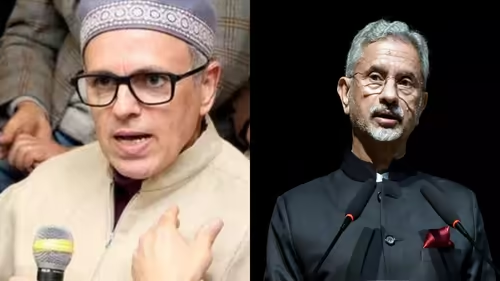
As geopolitical tensions simmer in the Middle East, a quiet humanitarian crisis is unfolding for dozens of Indian students—many from Jammu and Kashmir—who remain stranded in Iran with dwindling support and no clear path home. The situation has escalated to the point where former J&K Chief Minister Omar Abdullah personally reached out to Union External Affairs Minister S. Jaishankar, demanding urgent intervention to ensure their safe return .
This isn’t just a logistical issue—it’s a test of India’s commitment to its citizens abroad, especially those from vulnerable regions. With flights disrupted, financial resources running low, and local conditions growing increasingly unstable, these students are caught in a diplomatic limbo that demands immediate attention.
Table of Contents
- Who Are the Stranded Students?
- Why Are They Stuck in Iran?
- Omar Abdullah’s Intervention
- India’s Track Record on Overseas Evacuations
- What Needs to Happen Now
- Conclusion
- Sources
Who Are the Stranded Students?
Reports indicate that over 50 students from Jammu and Kashmir are currently in Iran, primarily enrolled in private medical and engineering colleges in cities like Tehran and Mashhad . Many come from modest, middle-class families who invested heavily in their education abroad, hoping for better career prospects.
Unlike students in Western countries, those in Iran often face additional challenges: limited access to Indian banking services due to sanctions, language barriers, and minimal institutional support from host universities. When crisis hits, they’re among the most isolated members of the Indian diaspora.
Why Are They Stuck in Iran?
Several converging factors have created this crisis:
- Flight disruptions: Commercial air links between India and Iran have been inconsistent due to regional instability and reduced airline operations.
- Financial constraints: Many students have exhausted their savings. International money transfers to Iran are severely restricted under U.S. sanctions, making it nearly impossible for families to send emergency funds.
- Lack of consular visibility: While the Indian Embassy in Tehran remains operational, its capacity to assist large groups of students—especially outside the capital—is limited .
- Visa and documentation issues: Some students’ visas have lapsed or are nearing expiration, complicating re-entry into India or transit through third countries.
The result? A growing sense of abandonment among young Indians who believed their government would have their back.
Omar Abdullah’s Intervention
Recognizing the urgency, Omar Abdullah took to social media before making a direct appeal to Minister Jaishankar. In a public statement, he emphasized that these students “are not just numbers—they are sons and daughters of J&K families who trusted the system” .
His call wasn’t merely political; it was humanitarian. Abdullah urged the Ministry of External Affairs (MEA) to:
- Initiate an emergency evacuation plan similar to past missions like Vande Bharat or Ganga.
- Coordinate with Iranian authorities to grant temporary travel permits.
- Provide emergency financial aid through embassy channels.
Notably, Abdullah stressed that the issue transcends politics: “Their safety is a national responsibility, not a regional one.”
India’s Track Record on Overseas Evacuations
India has a strong history of rescuing citizens in distress. From Yemen in 2015 to Ukraine in 2022, the government has launched large-scale operations to bring Indians home . The MEA’s Madad portal and 24/7 helpline are well-established tools.
Yet, smaller crises—like students stranded in Sudan, Lebanon, or now Iran—often receive delayed responses. This raises questions about equity in consular assistance. Are students from conflict-affected regions like J&K getting the same priority as others?
According to the Ministry of External Affairs, over 17 million Indians live overseas, and protecting them is a “core diplomatic mandate.” But implementation on the ground can be uneven—especially in sanctioned or politically sensitive countries like Iran.
What Needs to Happen Now
Time is of the essence. Here’s what experts and affected families are calling for:
- Immediate charter flight coordination: Partner with airlines willing to operate special flights from Tehran to Delhi or Srinagar.
- Emergency financial bridge: Use diplomatic channels to facilitate small cash disbursements or prepaid travel cards.
- Dedicated nodal officer: Assign a single point of contact at the Indian Embassy to manage all student cases.
- Transparency dashboard: Publish regular updates on evacuation timelines to reduce panic and misinformation.
Crucially, this must be handled with sensitivity. These students aren’t tourists—they’re young adults whose education and future are on hold. Delaying action risks long-term psychological and academic consequences.
Conclusion
The plight of J&K students stuck in Iran is more than a foreign policy footnote—it’s a moral imperative. Omar Abdullah’s outreach to S. Jaishankar has rightly spotlighted a vulnerable group that deserves swift, compassionate action. In an era where India prides itself on global influence, protecting every citizen—especially the most isolated—must remain non-negotiable. For ongoing updates on international student safety, see our coverage on [INTERNAL_LINK:indian-students-abroad-crisis].