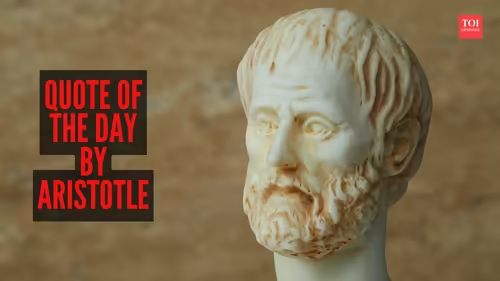
We live in an age obsessed with emotional optimization—where the goal is to feel ‘good’ all the time, avoid discomfort, and mute pain with distractions. But what if real strength isn’t about feeling nothing… but about feeling everything—and still choosing to stand tall? That’s the radical message hidden in a timeless Aristotle quote on hardship that’s been circulating for centuries, often misquoted but never less potent.
The full sentiment, sometimes attributed to Aristotle (though scholars debate its exact origin), goes like this: “The beauty of the soul shines out when a man bears calmly great misfortune, not because he feels no suffering, but because he overcomes it.” This isn’t Stoic detachment—it’s something far more human, courageous, and deeply relevant to our modern struggles.
Table of Contents
- The Quote and Its Confusing Origins
- What It Really Means: Overcoming, Not Avoiding
- Epictetus: The Slave Who Taught True Freedom
- Why This Matters in Modern Life
- How to Cultivate a Noble Spirit
- Conclusion
- Sources
The Quote and Its Confusing Origins
While widely shared as Aristotle’s, this specific phrasing doesn’t appear verbatim in his surviving works like the Nicomachean Ethics or Rhetoric. However, the idea aligns closely with his concept of megalopsychia—the “great-souled” person who faces adversity with dignity and proportionate response .
Interestingly, the summary you provided references Epictetus—a former slave and leading Stoic philosopher—who taught that true freedom comes from mastering your inner world, not controlling external events . So while the wording may be apocryphal, the philosophical DNA is real: both Aristotle and Epictetus believed virtue is revealed not in ease, but in struggle.
What It Really Means: Overcoming, Not Avoiding
This is where the quote cuts against today’s wellness culture. Many interpret resilience as emotional suppression—“stay strong,” “don’t cry,” “just move on.” But Aristotle’s insight is subtler and more honest: you do feel the pain. You grieve, you ache, you despair. The nobility lies not in numbness, but in refusing to let that pain define your actions or extinguish your spirit.
Consider these contrasts:
- False strength: Pretending you’re fine when you’re crumbling inside.
- True strength: Saying, “This hurts deeply—but I will not let it break my integrity or kindness.”
That’s the “beauty of the soul” in action. It’s not polished perfection; it’s grace under fire, compassion amid chaos, and hope in the face of repeated setbacks.
Epictetus: The Slave Who Taught True Freedom
Epictetus, born into slavery in 55 AD, had every reason to be bitter. Yet he taught that no one can enslave your mind unless you allow it. His famous line—“It’s not what happens to you, but how you react to it that matters”—echoes the same truth as the Aristotle quote .
For Epictetus, freedom wasn’t about changing your circumstances (he couldn’t). It was about changing your relationship to them. This internal mastery is what allows someone to endure hardship without becoming hardened by it—a lesson desperately needed in our reactive, outrage-driven world.
Why This Matters in Modern Life
We’re bombarded with messages telling us to “optimize” our emotions—to eliminate stress, anxiety, and sadness through apps, pills, or avoidance. But life doesn’t work that way. Loss, failure, injustice—they’re inevitable.
The Aristotelian-Epictetan wisdom offers a healthier path:
- Acknowledge pain honestly—don’t spiritual-bypass it.
- Choose your response—your character is built in those moments.
- Let your actions reflect your values, not your temporary feelings.
This isn’t just philosophy—it’s practical psychology. Modern cognitive behavioral therapy (CBT) echoes this: we can’t always control events, but we can reframe our interpretations and choose constructive behaviors .
How to Cultivate a Noble Spirit
You don’t need to be a philosopher to live this truth. Here are three everyday practices:
- Pause before reacting: When hardship hits, take a breath. Ask: “What kind of person do I want to be in this moment?”
- Reframe suffering as a teacher: Instead of “Why is this happening to me?”, try “What is this teaching me about courage, patience, or compassion?”
- Serve others even when you’re hurting: Acts of kindness—even small ones—anchor you in purpose beyond your pain.
These aren’t quick fixes. They’re disciplines that build what the ancients called aretē—excellence of character.
Conclusion
The enduring power of this Aristotle quote on hardship isn’t in its poetic phrasing, but in its defiant humanity. It reminds us that our deepest beauty emerges not in spite of our wounds, but through them—when we refuse to let despair have the final word. In a world that glorifies either toxic positivity or helpless victimhood, this middle path of courageous vulnerability is revolutionary. For more on building resilience through ancient wisdom, explore our guide on [INTERNAL_LINK:stoic-practices-for-modern-life].