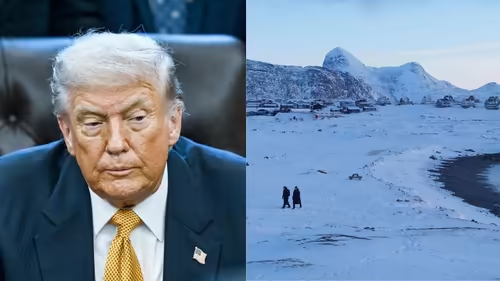
In a move that has reignited global debate over Arctic sovereignty, the White House has doubled down on former President Donald Trump’s long-standing ambition to acquire Greenland—dismissing recent European military deployments to the Danish territory as having “no impact” on America’s strategic calculus. The statement, issued by a senior administration official on January 15, 2026, comes amid heightened tensions over resource access, climate change, and great-power competition in the rapidly warming Arctic region .
Table of Contents
- Trump’s Greenland Dream Revisited
- The Latest White House Statement
- Why Greenland Matters Strategically
- European Response and Troop Deployment
- Legal and Diplomatic Realities
- Public Opinion in Greenland
- Conclusion: A Symbolic or Serious Play?
- Sources
Trump’s Greenland Dream Revisited
The idea of the United States purchasing Greenland first made headlines in 2019 when then-President Trump openly floated the idea during a meeting with Danish officials. Calling it a “large real estate deal,” he suggested the U.S. could buy the autonomous Danish territory for national security reasons. The proposal was swiftly rejected by Denmark’s Prime Minister Mette Frederiksen, who called it “absurd,” leading Trump to cancel a state visit in protest .
Now, as Trump campaigns for a potential 2028 presidential return, his allies—and even some current administration figures—are reviving the concept, framing it not as a whimsical real estate fantasy but as a critical component of U.S. Arctic strategy.
The Latest White House Statement
Responding to reports that European NATO members—including Denmark, Norway, and the UK—have increased military exercises and stationed small contingents in Greenland, a White House spokesperson declared: “The presence of European troops on the island does not alter U.S. strategic assessments. The goal of Greenland acquisition remains a valid long-term option for enhancing American security in the High North.”
Notably, the statement stopped short of confirming active negotiations but emphasized that “all options are on the table” when it comes to securing U.S. interests in the Arctic—a region where Russia and China have also expanded their footprint in recent years .
Why Greenland Matters Strategically
Greenland isn’t just ice and tundra. It’s a geopolitical linchpin for several reasons:
- Thule Air Base: The U.S. already operates a critical early-warning radar and space surveillance facility in northern Greenland under a 1951 defense agreement with Denmark.
- Mineral Wealth: The island holds vast reserves of rare earth elements—essential for electronics, EVs, and defense tech—currently dominated by Chinese supply chains.
- Arctic Shipping Routes: As sea ice melts, new trans-Arctic shipping lanes could cut Asia-Europe travel time by 40%, with Greenland controlling key chokepoints.
- Climate Monitoring: Greenland’s ice sheet is a vital indicator of global warming; controlling research access has scientific and diplomatic value.
According to the U.S. Department of Defense’s 2024 Arctic Strategy, “ensuring freedom of navigation and resource access in the Arctic is a top-tier national security priority” .
European Response and Troop Deployment
In response to perceived U.S. and Russian assertiveness, Denmark—Greenland’s sovereign power—has welcomed limited troop rotations from allied European nations. In late 2025, a joint Nordic-Baltic exercise named “Arctic Shield” saw over 1,200 personnel conduct cold-weather drills near Nuuk, Greenland’s capital .
While these forces are officially there for “search-and-rescue and environmental protection,” analysts view them as a soft-power signal: Greenland is not for sale, and its defense is a collective European responsibility.
Legal and Diplomatic Realities
Despite the White House’s rhetoric, the legal path to Greenland acquisition is nearly nonexistent. Under international law and Denmark’s constitution, Greenland is an autonomous territory with the right to self-determination. Any transfer of sovereignty would require:
- A referendum approved by Greenlandic voters
- Ratification by the Danish Parliament
- Recognition by the United Nations
Historically, the U.S. did purchase Alaska from Russia in 1867—but that was before modern norms of self-determination. Today, such a transaction would face fierce opposition from the UN, EU, and indigenous rights groups.
Public Opinion in Greenland
Crucially, most Greenlanders reject the idea of becoming part of the U.S. A 2025 University of Greenland poll found that only 12% support any form of union with America, while 68% favor eventual independence from Denmark—with strong cultural and economic ties to Europe and the Nordic bloc .
“We are not a commodity,” said Aqqaluaq B. Egede, Greenland’s Foreign Minister. “Our future will be decided by Greenlanders—not Washington or Copenhagen.”
Conclusion: A Symbolic or Serious Play?
While the White House’s reaffirmation of the Greenland acquisition goal may sound like political theater, it reflects a deeper truth: the Arctic is the next frontier of global competition. Whether through diplomacy, investment, or military presence, the U.S. is determined not to cede influence to rivals. Yet, in a world that values sovereignty and self-rule, buying Greenland remains more myth than policy. For now, the standoff serves as a stark reminder that in the 21st century, power isn’t just about territory—it’s about partnership, perception, and principle. To understand how climate change is reshaping global borders, see our feature on [INTERNAL_LINK:arctic-geopolitics-climate-change].
Sources
- The Times of India. “Greenland standoff: White House says European troops ‘won’t impact’ Trump.” January 15, 2026.
- The New York Times. “Trump’s Greenland Obsession: A Timeline.” August 21, 2019.
- U.S. Department of State. “U.S. Arctic Policy Framework 2024.” state.gov.
- U.S. Department of Defense. “Arctic Strategy Report.” defense.gov, March 2024.
- NATO Press Release. “Allied Exercise Arctic Shield Concludes in Greenland.” November 30, 2025.
- University of Greenland. “Public Opinion Survey on Sovereignty and Foreign Relations.” December 2025.