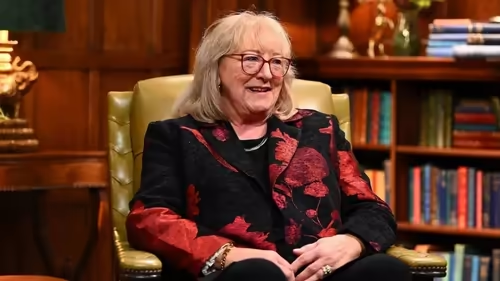
She’s cheered from the NFL sidelines, hugged Taylor Swift in viral moments, and become America’s unofficial football mom—but now, **Donna Kelce** is facing a different kind of spotlight. Her recent casting on Peacock’s hit reality series *The Traitors US* has ignited a firestorm online, with thousands of viewers accusing producers of orchestrating a “publicity stunt” that set her up to fail. The backlash over Donna Kelce The Traitors backlash isn’t just about gameplay—it’s about fairness, authenticity, and whether fame should grant a free pass into high-stakes reality TV.
Table of Contents
- The Controversial Role: Secret Traitor or Sacrificial Lamb?
- Fan Reactions: Polarized and Passionate
- Why the Casting Raised Eyebrows
- The Celebrity Advantage in Reality TV
- Defenders of Donna Kelce: A Different Perspective
- What This Means for The Traitors Franchise
- Conclusion: Fame, Fair Play, and Reality TV Ethics
- Sources
The Controversial Role: Secret Traitor or Sacrificial Lamb?
In a twist that shocked viewers, Donna Kelce was revealed to be one of the season’s **Secret Traitors**—a role that requires deception, strategic manipulation, and social cunning to eliminate fellow contestants without being banished. But critics argue she was woefully unprepared for the task.
Unlike other cast members with reality TV experience (like former *Survivor* players or *Big Brother* alumni), Kelce—a retired schoolteacher with no prior competitive TV background—struggled to lie convincingly or build complex alliances. She was eliminated early, leading many to conclude her casting was less about merit and more about leveraging her son Travis Kelce’s massive popularity .
Donna Kelce The Traitors Backlash Explodes Online
Social media erupted with criticism. On X (formerly Twitter), hashtags like #WorstCastingEver and #TraitorsFail trended, with users calling the move “lazy” and “exploitative.” One viral post read: “They gave the hardest role to someone who’s never played a game of poker. This wasn’t casting—it was clickbait.”
Reddit threads dissected every scene, noting how Kelce’s reserved demeanor and moral discomfort made her an obvious target. “You can’t cast a genuinely kind person as a villain and expect them to thrive,” wrote one top commenter on r/realitytv .
Why the Casting Raised Eyebrows
The core issue isn’t Donna Kelce herself—it’s the **mismatch between role and readiness**. *The Traitors* is known for its psychological intensity. Past Traitors have included master manipulators and seasoned strategists. Placing a novice in that role, especially one with zero reality TV instincts, felt like stacking the deck.
Moreover, the timing was suspicious. With Travis Kelce at the peak of his fame—and dating global superstar Taylor Swift—the show gained instant media coverage. Critics argue this prioritized **ratings over integrity**, turning a cerebral game into a celebrity sideshow.
The Celebrity Advantage in Reality TV
This isn’t the first time reality TV has leaned on famous names. From *Dancing with the Stars* to *Celebrity Big Brother*, networks know celebrity = clicks. But *The Traitors* prides itself on being a “pure” social strategy game—where reputation shouldn’t matter, only wit.
By casting Kelce, producers blurred that line. As one entertainment analyst noted, “When you bring in someone solely for their last name, you undermine the show’s core promise: that anyone can win if they’re clever enough” .
Defenders of Donna Kelce: A Different Perspective
Not everyone agrees with the backlash. Some fans praised Kelce’s authenticity in a genre saturated with performative drama. “She didn’t pretend to be someone she’s not,” said a supporter on Instagram. “In a sea of fakes, her honesty was refreshing—even if it got her voted out.”
Others pointed out that giving non-celebrities a platform is rare—and Kelce, as a relatable mom figure, added diversity to the cast. “Maybe the problem isn’t her casting,” one viewer argued, “but our expectation that every contestant must be a cutthroat player.”
What This Means for The Traitors Franchise
The controversy poses a dilemma for future seasons. Should *The Traitors* stay true to its roots as a merit-based game, or lean further into celebrity casting to boost viewership? The UK version famously avoids big names, focusing instead on compelling personalities—resulting in cult-like devotion.
If the US version continues down the celebrity path, it risks alienating its core fanbase who value strategic depth over tabloid appeal. Ratings may spike short-term, but long-term credibility could suffer.
Conclusion: Fame, Fair Play, and Reality TV Ethics
The Donna Kelce The Traitors backlash highlights a growing tension in modern reality TV: the clash between entertainment and authenticity. While Kelce’s presence undoubtedly drew eyes to the show, it also exposed the ethical gray zone of casting unqualified participants in high-stakes roles purely for exposure. Whether this was a misstep or a calculated risk remains debated—but one thing is clear: audiences are demanding more than just famous faces. They want fair play, genuine competition, and respect for the game. For more on the evolution of reality TV, see our deep dive on [INTERNAL_LINK:reality-tv-ethics-and-celebrity-casting].
Sources
- Times of India: Donna Kelce faces backlash over controversial casting on The Traitors US
- Reddit: r/realitytv – The Traitors US Donna Kelce Discussion
- Variety: How Celebrity Casting Is Reshaping Reality TV
- Peacock Official Site: The Traitors US – Cast & Episodes
- The Guardian: The Traitors US Review: Style Over Substance?