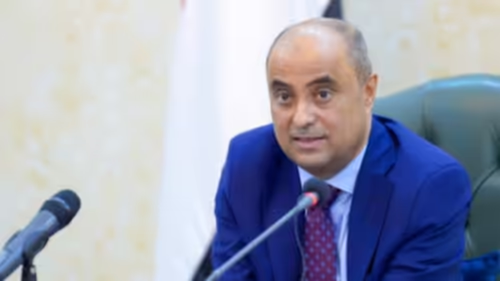
In a development that underscores the volatile nature of Yemen’s political scene, Prime Minister **Salem bin Breik** has officially resigned from his post. The announcement, confirmed by senior officials within the Southern Transitional Council (STC), comes amid growing internal pressures and an ever-shifting regional balance of power . His successor? **Shaya Mohsen Zindani**, a figure relatively unknown on the global stage but deeply embedded in southern Yemeni politics. This leadership change isn’t just a routine cabinet shuffle—it’s a potential turning point in Yemen’s long, painful journey toward stability.
Table of Contents
- Why Did Yemen PM Resign? The Hidden Pressures
- Meet Shaya Mohsen Zindani: The New Face of Yemen’s Government
- The Southern Transitional Council and Yemen’s Future
- Regional Implications: Saudi, UAE, and the Houthi Factor
- Humanitarian Crisis Continues Amid Political Chaos
- What This Means for Yemen’s Path to Peace
- Conclusion: A Precarious Transition
- Sources
Why Did Yemen PM Resign? The Hidden Pressures
The official statement cited “personal reasons” for Salem bin Breik’s resignation, but insiders suggest deeper forces were at play. As the head of the STC-aligned government based in Aden, Bin Breik faced mounting criticism over economic mismanagement, slow reconstruction efforts, and perceived favoritism toward certain tribal factions .
Moreover, tensions have been simmering between the STC and Yemen’s internationally recognized President Rashad al-Alimi, who leads the Presidential Leadership Council (PLC). While both oppose the Houthi rebels in the north, their visions for Yemen’s future—particularly regarding southern autonomy—remain fundamentally at odds. Bin Breik, seen as a hardliner on southern independence, may have become a liability in delicate unity negotiations backed by Saudi Arabia .
Yemen PM Resigns and a New Leader Emerges
With the Yemen PM resigns news confirmed, all eyes turn to **Shaya Mohsen Zindani**. Unlike his predecessor, Zindani is viewed as a pragmatic technocrat with strong administrative experience. He previously served in key economic and planning roles within the STC government and is known for advocating dialogue over confrontation .
His appointment signals a possible softening of the STC’s stance—a move likely encouraged by the UAE and Saudi Arabia, who are jointly bankrolling Yemen’s anti-Houthi coalition and pushing for a unified front. Whether Zindani can balance southern aspirations with national unity demands will define his tenure.
The Southern Transitional Council and Yemen’s Future
The STC, backed primarily by the United Arab Emirates, has long sought greater autonomy—or outright independence—for South Yemen, which was a separate state until 1990. The group controls much of the south, including the strategic port city of Aden.
While the STC is part of the PLC, its ultimate goals remain ambiguous. Bin Breik’s resignation may reflect internal STC recalibration: recognizing that full secession is unrealistic without international support, and that cooperation with Riyadh-backed factions is essential for survival—and funding.
Regional Implications: Saudi, UAE, and the Houthi Factor
This leadership change doesn’t occur in a vacuum. Saudi Arabia and the UAE, though allies, have competing interests in Yemen:
- Saudi Arabia prioritizes a unified Yemen as a buffer against Iranian influence via the Houthis.
- UAE focuses on securing southern ports and countering Islamist groups like Islah, often aligning with the STC.
Zindani’s rise could indicate a rare moment of alignment between Riyadh and Abu Dhabi—both want a stable, functional southern administration to counterbalance the Houthis, who still control the capital Sanaa and much of the north .
Meanwhile, the Houthis have intensified drone and missile attacks on Saudi targets, sensing disarray in their enemies’ ranks. A fragmented anti-Houthi front plays directly into their hands.
Humanitarian Crisis Continues Amid Political Chaos
While elites jostle for power, over 21 million Yemenis—two-thirds of the population—still require humanitarian assistance . Famine, cholera, and displacement remain daily realities. Donor fatigue is setting in, and aid access is often blocked by warring factions.
Zindani’s first test won’t be diplomacy—it will be delivering basic services. If his government fails to improve electricity, water, and food distribution in Aden and other southern cities, public frustration could boil over, regardless of who sits in the prime minister’s chair.
What This Means for Yemen’s Path to Peace
The road to peace remains steep. A nationwide ceasefire remains elusive, and UN-led talks have stalled. However, Zindani’s appointment might create a window for renewed dialogue:
- Internal Unity: He could bridge gaps between the STC and other PLC factions.
- Economic Reform: His technocratic background may attract international financial support.
- Regional Trust: Both Saudi and UAE may see him as a reliable partner for de-escalation.
But without addressing core issues—power-sharing, resource allocation, and the status of the south—even the most capable leader may falter.
Conclusion: A Precarious Transition
The Yemen PM resigns moment marks not an end, but a fragile new beginning. Shaya Mohsen Zindani inherits a nation fractured by war, ideology, and geography. His success hinges on navigating treacherous internal politics while delivering tangible hope to a war-weary population. In a region where power shifts overnight, this transition could either stabilize southern Yemen or ignite another chapter of chaos. For deeper context on the conflict, explore our analysis on [INTERNAL_LINK:yemen-civil-war-explained].
Sources
- Times of India: Yemen PM Salem bin Breik resigns; Shaya Mohsen Zindani named as replacement
- Al Jazeera: Yemen PM resigns amid deepening political divisions
- United Nations Office for the Coordination of Humanitarian Affairs (OCHA): Yemen Humanitarian Response Plan
- Council on Foreign Relations: The Yemen Crisis Explained
- International Crisis Group: Yemen Reports