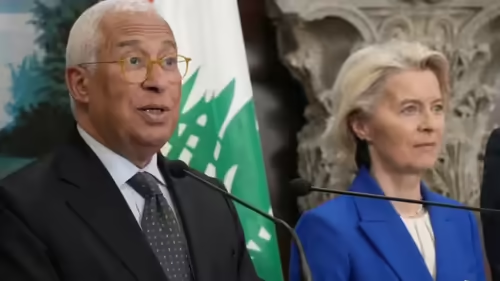
Mark your calendars: January 26, 2026, won’t just be another Republic Day parade in New Delhi—it’s set to become a historic moment in global diplomacy. For the first time, both the President of the European Commission, **Ursula von der Leyen**, and the President of the European Council, **António Costa**, will grace India’s national celebration as chief guests . Their presence isn’t ceremonial; it’s strategic. The visit culminates in a high-level **India-EU summit** aimed at reshaping one of the world’s most consequential partnerships. This is more than protocol—it’s a geopolitical signal loud and clear.
Table of Contents
- Why the EC and EU Presidents Visit India Matters
- The Agenda of the India-EU Summit 2026
- Trade and Technology: A New Era of Collaboration
- Geopolitical Alignment in a Multipolar World
- Republic Day as a Diplomatic Stage
- Challenges and Opportunities Ahead
- Conclusion: A Partnership for the Future
- Sources
Why the EC and EU Presidents Visit India Matters
The joint visit by the heads of both the European Commission and the European Council is unprecedented. It underscores the EU’s recognition of India not just as a major economy, but as a **strategic counterweight** in an increasingly fragmented world order. With tensions rising between the West and powers like China and Russia, the EU sees India as a critical partner that shares democratic values, yet operates with strategic autonomy—a rare and valuable combination .
This isn’t just about goodwill. It’s about **de-risking**—a term now central to EU foreign policy. By deepening ties with India, Europe aims to diversify supply chains, secure access to critical minerals, and build resilient tech ecosystems outside dominant U.S.-China binaries .
The Agenda of the India-EU Summit 2026
The summit, to be held shortly after Republic Day, will tackle a packed agenda. Key discussion points include:
- Free Trade Agreement (FTA): Reviving stalled negotiations on the India-EU Broad-Based Trade and Investment Agreement (BTIA), which has been on hold since 2013.
- Critical Raw Materials Partnership: Securing supplies of lithium, cobalt, and rare earths essential for green and digital transitions.
- AI and Quantum Computing: Launching joint R&D initiatives under the EU-India Trade and Technology Council (TTC).
- Climate and Green Energy: Scaling up cooperation on solar power, hydrogen, and sustainable urban development.
- Security and Defense: Expanding dialogue on maritime security in the Indo-Pacific and counter-terrorism.
As von der Leyen recently stated, “India is not just a partner of necessity—it’s a partner of choice” .
Trade and Technology: A New Era of Collaboration
Bilateral trade between the EU and India crossed €124 billion in 2024, making the EU India’s third-largest trading partner . Yet potential remains vast. The EU seeks greater market access for its automobiles, pharmaceuticals, and dairy products, while India wants easier entry for its IT services and textiles.
More importantly, both sides are racing to establish **trusted tech corridors**. With the U.S. restricting chip exports and China advancing its semiconductor ambitions, the EU and India are exploring co-development of secure 5G/6G infrastructure and AI governance frameworks that prioritize human rights and transparency—a stark contrast to authoritarian models .
Geopolitical Alignment in a Multipolar World
While the EU and India don’t always see eye-to-eye—India’s continued energy ties with Russia, for instance, have drawn quiet criticism—their convergence on core issues is growing. Both support a rules-based international order, freedom of navigation in the South China Sea, and reform of multilateral institutions like the UN Security Council.
Crucially, neither side wants to be forced into a binary choice between Washington and Beijing. This shared desire for **strategic autonomy** forms the bedrock of their evolving partnership . As global supply chains reconfigure, the India-EU axis could become a stabilizing force in the Global South.
Republic Day as a Diplomatic Stage
Inviting the EU leadership as chief guests for Republic Day is a masterstroke of soft diplomacy. It places Europe at the heart of India’s national narrative—celebrating sovereignty, diversity, and democratic resilience. For the EU, it’s a chance to showcase its commitment to a non-aligned, pluralistic world order.
Past chief guests have included leaders from France, Brazil, and ASEAN nations. But hosting *both* EU presidents simultaneously elevates the gesture to a new level, signaling that Brussels views New Delhi as a pillar of its “Global Gateway” strategy .
Challenges and Opportunities Ahead
Despite the optimism, hurdles remain:
- Trade Imbalances: EU concerns over India’s tariffs and non-tariff barriers.
- Data Privacy Laws: Divergent approaches to digital regulation could hinder tech collaboration.
- Human Rights Dialogue: Ongoing EU concerns about civil liberties in India may surface in closed-door talks.
Yet the momentum is undeniable. With both sides investing heavily in green transitions and digital sovereignty, the synergy is ripe for breakthroughs.
Conclusion: A Partnership for the Future
The EC and EU Presidents visit India is far more than a photo op. It’s a declaration that the India-EU relationship has matured from transactional engagement to strategic co-creation. In a world grappling with fragmentation, their partnership offers a model of cooperation rooted in mutual respect, shared values, and pragmatic ambition. As the tricolor unfurls on Rajpath, the world will be watching—not just the parade, but the promise of a new global alliance taking shape. For deeper insights into India’s foreign policy, explore our analysis on [INTERNAL_LINK:india-strategic-partnerships-2026].
Sources
- Times of India: Presidents of EC, EU to visit India for Republic Day, India-EU summit
- European Commission: EU-India Relations: Strategic Partnership
- Ministry of External Affairs, India: Official Website
- Carnegie Europe: EU-India Relations at an Inflection Point
- World Bank: India-EU Trade Data