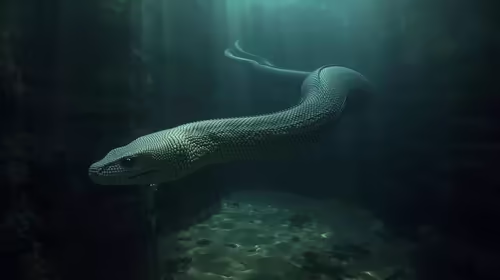
Imagine a creature so vast it made great white sharks look like snacks. Not a myth. Not a movie monster. This was real—and it ruled the ancient oceans over 40 million years ago. Scientists have confirmed that the world’s largest sea snake, *Palaeophis colossaeus*, stretched up to a staggering 12 metres (nearly 40 feet) long . And new research suggests this colossal serpent wasn’t just lurking in the deep—it was an apex predator capable of hunting and swallowing sharks whole .
Table of Contents
- Unearthing a Prehistoric Leviathan
- The World’s Largest Sea Snake: Anatomy and Habitat
- Shark Hunter or Scavenger? Decoding Its Diet
- How It Compares to Modern Sea Snakes
- Why Did It Go Extinct?
- Implications for Evolutionary Biology
- Conclusion: The Ocean’s Forgotten Giant
- Sources
Unearthing a Prehistoric Leviathan
Fossils of *Palaeophis colossaeus* were first discovered in North Africa, particularly in regions of modern-day Algeria and Egypt, which during the Eocene epoch (56–34 million years ago) were covered by warm, shallow seas teeming with life . Unlike today’s sea snakes—which are mostly small, venomous, and confined to the Indo-Pacific—the ancient *Palaeophis* belonged to a now-extinct family called Palaeophiidae.
For decades, scientists debated its true size. Early estimates varied wildly. But recent analyses of vertebrae and rib fragments, combined with comparisons to living relatives, have solidified the 10–12 metre range as the most plausible . To put that in perspective, that’s longer than a school bus and nearly twice the length of the largest known modern sea snake, the yellow-bellied sea snake (which maxes out at around 2.75 metres).
The World’s Largest Sea Snake: Anatomy and Habitat
The world’s largest sea snake wasn’t just big—it was built for domination. Paleontologists believe *Palaeophis colossaeus* had a robust, muscular body with reinforced vertebrae, suggesting it was a powerful swimmer capable of rapid bursts of speed . Its skull structure indicates a wide gape, allowing it to swallow large prey whole—a trait shared with modern constrictors like pythons.
It lived in the Tethys Sea, a vast tropical ocean that once separated the supercontinents of Laurasia and Gondwana. This ecosystem was a biodiversity hotspot, home to early whales, giant turtles, bony fish, and yes—sharks. In this rich environment, *Palaeophis* sat near the top of the food chain.
Shark Hunter or Scavenger? Decoding Its Diet
Could a snake really eat a shark? The evidence is mounting. While direct fossilized stomach contents are rare, researchers point to several clues:
- Tooth marks on shark fossils that don’t match known shark or whale predators but align with snake bite patterns.
- Size advantage: A 12-metre snake could easily overpower juvenile or mid-sized sharks common in the Eocene.
- Ecological niche: With few large marine reptiles left after the Cretaceous extinction, *Palaeophis* likely filled the void as a top-tier predator .
Some experts argue it may have been an opportunistic feeder—scavenging carcasses or ambushing weakened prey. But the consensus is shifting toward active predation. As one paleontologist put it, “If it swam in the same waters as sharks and was bigger, it probably saw them as lunch” .
How It Compares to Modern Sea Snakes
Today’s sea snakes are marvels of evolution—but they’re tiny by comparison. All 70+ species are highly venomous, adapted to coral reefs and coastal zones, and none exceed 3 metres. Crucially, they give live birth in water and can’t survive on land.
*Palaeophis*, however, may have been semi-aquatic or fully marine, but without venom. Instead, it likely relied on constriction or sheer size to subdue prey—more like a marine python than a cobra. This highlights a fascinating evolutionary divergence: while modern sea snakes specialized in toxicity and agility, their ancient cousin ruled through brute scale and power.
Why Did It Go Extinct?
Like many giants of the Eocene, *Palaeophis colossaeus* vanished during a period of dramatic climate cooling around 34 million years ago—the Eocene-Oligocene transition . As global temperatures dropped, the warm Tethys Sea shrank and fragmented. The rich, shallow ecosystems that sustained mega-predators collapsed.
Larger animals require more food and stable environments. When their habitat disappeared and prey became scarce, these giants couldn’t adapt quickly enough. Their extinction paved the way for marine mammals—like early dolphins and seals—to rise as the new oceanic rulers.
Implications for Evolutionary Biology
The story of *Palaeophis* isn’t just about a scary snake. It’s a window into how life rebounds after mass extinctions. After the dinosaurs died out, reptiles like *Palaeophis* briefly reclaimed dominance in the seas before mammals took over. This “reptilian renaissance” shows evolution isn’t linear—it’s a dynamic, opportunistic process.
Studying such creatures also helps scientists understand the limits of body size in marine environments and how climate change reshapes entire ecosystems. For more on ancient marine life, check out our feature on [INTERNAL_LINK:prehistoric-ocean-predators].
Conclusion: The Ocean’s Forgotten Giant
The world’s largest sea snake was more than a curiosity—it was a testament to nature’s capacity for awe-inspiring scale and ferocity. *Palaeophis colossaeus* reminds us that Earth’s oceans once hosted monsters far stranger than fiction. While it’s long gone, its legacy endures in the fossil record, urging us to protect today’s marine biodiversity before more wonders vanish forever.
Sources
- Times of India: World’s largest sea snake was a 12-metre giant that may have eaten sharks
- Journal of Vertebrate Paleontology: Morphology and paleoecology of *Palaeophis*
- National Geographic: Prehistoric Sea Serpents: Giants of the Ancient Ocean
- Smithsonian National Museum of Natural History: Paleobiology Research
- Encyclopedia of Marine Reptiles (Academic Press): Chapter on Palaeophiidae