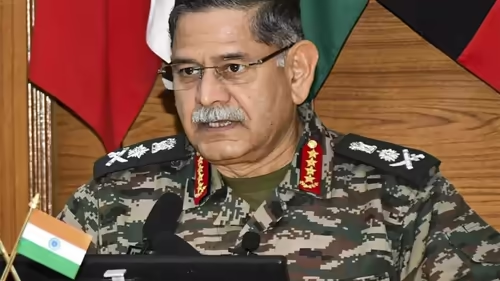
“What the country now needs is equipment designed and developed in India. Indigenisation is not just a goal; it has become a strategic necessity.” These aren’t the words of a policy wonk or an industry lobbyist—they are the stark, unequivocal declaration from India’s top soldier, Army Chief General Upendra Dwivedi, at the 78th Army Day parade in Jaipur . This powerful statement marks a pivotal moment in India’s defence journey, moving beyond aspiration to an urgent operational imperative.
Table of Contents
- Gen Dwivedi’s Bold Vision for an Atmanirbhar Army
- Why “Indigenisation a Strategic Necessity” is More Than a Slogan
- The Make in India Defence Push: Achievements and Hurdles
- From Parade to Battlefield: The Future of Indian Warfare
- The Roadmap Ahead: Challenges and Opportunities
- Conclusion: Building a Fortress of Self-Reliance
- Sources
Gen Dwivedi’s Bold Vision for an Atmanirbhar Army
Speaking with the authority of a leader preparing his force for the wars of tomorrow, Gen Dwivedi left no room for ambiguity. He emphasized that the Indian Army is not just ready for any situation but is actively transforming into a “future-ready” force . A cornerstone of this transformation is indigenisation a strategic necessity, a philosophy that permeates every aspect of modernization.
The visual proof was on full display during the Army Day parade itself, where a significant showcase of ‘Made in India’ weapon systems and equipment served as a tangible symbol of this commitment . This isn’t just about national pride; it’s about operational sovereignty. As the General noted, strong research and development are essential to sustain a long war and achieve true self-sufficiency .
Why “Indigenisation a Strategic Necessity” is More Than a Slogan
The shift from viewing indigenisation as a desirable goal to a non-negotiable strategic necessity is driven by harsh geopolitical realities. For decades, India has been one of the world’s largest arms importers, with a dependence that has at times exceeded 60% . This reliance creates critical vulnerabilities:
- Supply Chain Risks: In a conflict, foreign suppliers can impose embargoes or delays.
- Technological Dependence: Relying on foreign tech limits our ability to customize, upgrade, or maintain systems independently.
- Strategic Autonomy: True strategic autonomy—the freedom to act in our national interest—is impossible without control over our own defence hardware.
Gen Dwivedi’s message is clear: in an era of unpredictable global alliances and complex security challenges, self-reliance is the bedrock of credible deterrence .
The Make in India Defence Push: Achievements and Hurdles
The government’s ‘Make in India’ initiative has already yielded significant results in the defence sector. From the commissioning of India’s first indigenous aircraft carrier, INS Vikrant, to the successful development of advanced missile systems like Agni-V and BrahMos, the nation has proven its capability . Defence production within India reached a historic high of ₹1.27 lakh crore in 2023-24, and exports have surged dramatically .
However, the path is not without obstacles. The defence ecosystem still grapples with challenges like bureaucratic delays, a need for deeper private sector integration, and the requirement for a more robust domestic R&D infrastructure . Bridging the gap between policy intent and on-ground execution remains a key task.
From Parade to Battlefield: The Future of Indian Warfare
Gen Dwivedi’s vision extends far beyond hardware. He spoke of preparing for “future warfare,” which is increasingly defined by domains like cyber, space, and artificial intelligence . The Army’s focus on “networking and data-centricity” for 2026 underscores this shift . An indigenous foundation is crucial here to ensure data security and prevent foreign backdoors in our most sensitive military networks.
This holistic approach—combining military needs with industry and academia—aims to turn innovation into a direct battlefield advantage . It’s a model that seeks to create a self-sustaining cycle of development, production, and deployment.
The Roadmap Ahead: Challenges and Opportunities
The ultimate goal is ambitious: complete self-reliance in defence manufacturing by 2040 . To get there, the focus must be on:
- Boosting Private Sector Participation: Creating a level playing field for domestic private companies to become prime contractors.
- Investing in R&D: Channeling more resources into next-generation technologies and fostering a culture of innovation.
- Streamlining Procurement: Making the acquisition process faster and more responsive to the Army’s evolving needs.
- Building a Skilled Workforce: Developing a talent pool capable of designing and building world-class defence systems.
The success of this mission will not only secure our borders but also position India as a major global defence exporter, with a target to double exports to ₹50,000 crore by 2029 .
Conclusion: Building a Fortress of Self-Reliance
General Upendra Dwivedi’s declaration that indigenisation a strategic necessity is a clarion call to the entire nation. It’s a recognition that in the 21st century, a nation’s security is intrinsically linked to its industrial and technological prowess. The journey towards an Atmanirbhar Bharat in defence is complex and demanding, but as the Army Chief has made clear, it is a path we must walk—not for choice, but for survival and strategic sovereignty. The foundation has been laid; now, the nation must build upon it with unwavering resolve. For more on India’s strategic posture, see our analysis on [INTERNAL_LINK:india-china-border-strategy].
Sources
- Times of India: Indigenisation a strategic necessity: Gen Dwivedi
- United News of India (UNI): Self-reliance in defence key to strategic autonomy: Army chief
- Ministry of Defence, Government of India: Official Website
- Carnegie India: India’s Defense Modernization: Challenges and Opportunities
- Observer Research Foundation: Assessment of India’s Indigenous Defence Manufacturing Capabilities