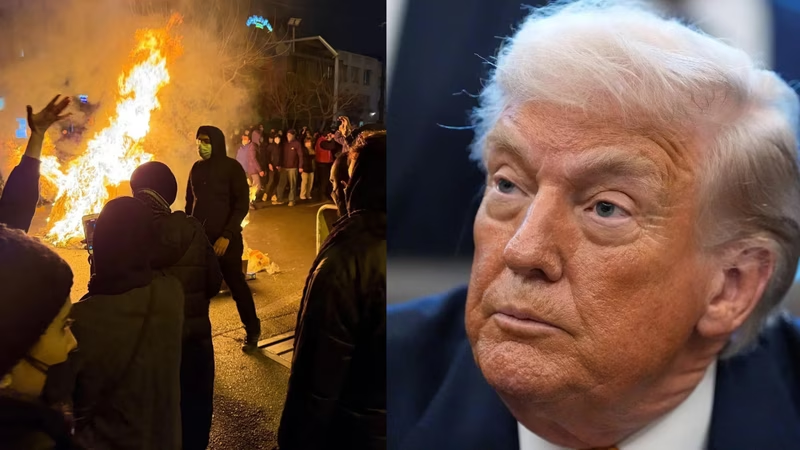
In a striking declaration that blurs the line between diplomacy and deterrence, the White House recently asserted that Iran had halted 800 executions following a direct warning from former President Donald Trump. The claim—made amid escalating protests and state crackdowns across Iran—has ignited global debate: Can a single public threat from a former U.S. leader really sway one of the world’s most secretive and authoritarian regimes?
While the Biden administration stopped short of taking credit, officials emphasized that sustained “maximum pressure” policies—initiated under Trump and continued under Biden—have forced Tehran into recalculating its domestic repression tactics . But human rights groups remain skeptical, demanding verifiable proof before celebrating any reprieve for Iran’s death row prisoners.
Table of Contents
- The White House Claim: Breaking It Down
- What Did Trump Actually Say?
- Iran Executions Halted: Fact or Diplomatic Spin?
- The Context of Iran Unrest in 2026
- How U.S.-Iran Policy Has Evolved Since 2017
- Human Rights Groups Demand Transparency
- Conclusion: Credibility and Consequences
- Sources
The White House Claim: Breaking It Down
According to a senior administration official quoted by the Times of India, “Iran has put on hold approximately 800 executions” after receiving what was described as a “grave consequences” warning from Donald Trump . The statement came during a background briefing where officials stressed that the U.S. continues to monitor the “ground situation” closely.
Importantly, the White House did not claim Trump acted alone. Instead, they framed his warning as part of a broader, continuous U.S. strategy of applying economic sanctions, diplomatic isolation, and public condemnation to pressure Tehran on human rights—a policy that began with Trump’s “maximum pressure” campaign and has been adapted under President Biden.
What Did Trump Actually Say?
While the exact wording of Trump’s message hasn’t been publicly released, sources indicate he issued a strong statement—likely via social media or through intermediaries—warning Iran’s leadership that carrying out mass executions would trigger “severe and immediate consequences.” Given Trump’s history of blunt, high-stakes rhetoric toward Iran (including the 2020 drone strike that killed Qasem Soleimani), such a warning carries weight in Tehran’s calculus.
Notably, Trump has long positioned himself as a defender of religious minorities and political dissidents in Iran, often invoking the plight of imprisoned Americans and Iranian protesters in his speeches.
Iran Executions Halted: Fact or Diplomatic Spin?
This is where skepticism arises. Iran’s judiciary operates with extreme opacity. There is no independent mechanism to confirm whether 800 executions were truly scheduled—or paused.
However, data from reputable NGOs offers context:
- According to Amnesty International, Iran executed at least 853 people in 2025—the highest number in eight years .
- Most executions are carried out secretly, often within days of sentencing, especially for protest-related charges.
- There have been no official announcements from Iranian authorities about halting executions.
This raises a critical question: Is the White House citing intelligence reports, or using strategic messaging to project influence?
The Context of Iran Unrest in 2026
The claim emerges against a backdrop of renewed civil unrest in Iran. Sparked by economic hardship, fuel price hikes, and the regime’s violent response to women-led protests, demonstrations have flared in major cities like Tehran, Mashhad, and Isfahan since late 2025.
The Iranian government has responded with mass arrests and accelerated death penalty trials—often based on coerced confessions. In this climate, any pause in executions, however temporary, could signal internal division or external sensitivity.
How U.S.-Iran Policy Has Evolved Since 2017
It’s crucial to understand that U.S. policy toward Iran hasn’t shifted dramatically between administrations—it’s evolved:
- Trump Era (2017–2021): “Maximum pressure” via sanctions, withdrawal from JCPOA, focus on regime change rhetoric.
- Biden Era (2021–present): Attempts to revive nuclear deal, but maintained core sanctions; increased emphasis on human rights and digital freedom support for protesters.
Both approaches share a common thread: using leverage to isolate Tehran. The current claim about Iran executions halted may be an attempt to show that this pressure yields tangible humanitarian results—even if indirectly.
Human Rights Groups Demand Transparency
Organizations like Human Rights Watch and Iran Human Rights (IHR) have welcomed any potential reduction in executions but insist on verification. “We cannot take governments at their word when lives are at stake,” said a spokesperson for IHR. “We need access to prison records, court documents, and family testimonies.”
They also warn against over-attributing impact to a single figure like Trump, noting that grassroots activism inside Iran—and global advocacy—plays a far more consistent role in pressuring the regime.
Conclusion: Credibility and Consequences
Whether or not the claim that Iran executions halted due to Trump’s warning is fully verifiable, it underscores a larger truth: international attention can create friction in even the most repressive systems. The White House’s statement may be partly aspirational—but it also serves as a reminder that the world is watching.
For Iranians risking their lives to demand justice, symbolic pauses matter. But lasting change will require more than warnings—it demands coordinated global action, accountability, and unwavering support for civil society. As the situation evolves, we’ll continue tracking developments in our [INTERNAL_LINK:iran-protests-2026-updates] coverage.
Sources
- Times of India: Grave consequences: White House says Iran halted 800 executions after Trump’s warning
- Amnesty International: Iran 2025 Country Report
- Iran Human Rights (IHR): Annual Execution Reports
- U.S. Department of State: U.S. Relations With Iran