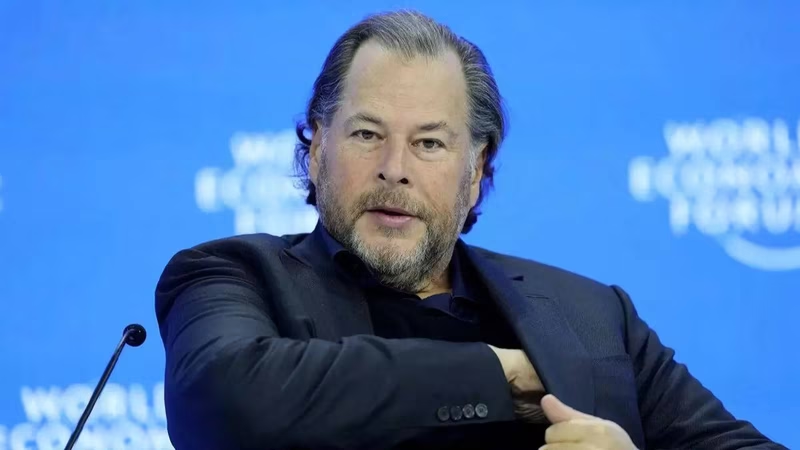
It sounds like something out of a Silicon Valley myth—but it’s true. The $250 billion cloud computing giant Salesforce wasn’t born in a garage or a boardroom. It was conceived in the warm Pacific waters off Hawaii, during a meditative swim with dolphins. That’s the remarkable origin story shared by CEO Marc Benioff, who credits this transcendent experience—and the mentorship of Oracle founder Larry Ellison—as the twin sparks that launched one of the most transformative companies in modern tech history .
Benioff’s journey blends cutting-edge innovation with spiritual introspection, a rare combination that has defined Salesforce’s culture from day one. His vision didn’t just create a new software category—it redefined what a corporation could stand for in the 21st century. At the heart of it all? A dolphin, a billionaire mentor, and a life-changing trip to India.
Table of Contents
- The Dolphin Vision in Hawaii
- Larry Ellison’s Role in the Salesforce Origin Story
- The India Guru and the 1-1-1 Model
- How Spirituality Shaped a Tech Giant
- Why This Origin Story Matters Today
- Conclusion
- Sources
The Dolphin Vision in Hawaii
In the late 1990s, Marc Benioff was a rising star at Oracle, working closely under Larry Ellison. But he felt a growing restlessness—a sense that the future of software lay beyond the clunky, on-premise systems dominating the industry. During a sabbatical in Hawaii, he went swimming with dolphins, seeking clarity.
“I had this vision,” Benioff later recounted. “The internet was going to change everything. Software should be delivered as a service—simple, accessible, and always up to date.” In that moment, the concept of “Software as a Service” (SaaS) crystallized for him—not as a technical spec, but as a mission .
He returned to California not just inspired, but determined. He would leave Oracle and build a company that delivered enterprise software over the internet—something many deemed impossible at the time.
Larry Ellison’s Role in the Salesforce Origin Story
Despite leaving Oracle, Benioff didn’t burn bridges. In fact, his former boss became his first believer. When Benioff pitched his radical idea, Ellison didn’t laugh—he listened. And then he wrote a check.
“I went to Larry Ellison and said, ‘I’m going to start this company called Salesforce,’” Benioff recalled. “He said, ‘Great—how much do you need?’” Ellison became an early investor, providing crucial seed funding and credibility in a skeptical market .
Ironically, Salesforce would go on to become one of Oracle’s fiercest competitors—yet the two maintain mutual respect. Their relationship underscores a key Silicon Valley truth: mentorship and competition can coexist.
The India Guru and the 1-1-1 Model
But Salesforce’s innovation wasn’t just technological—it was philosophical. During a trip to India, Benioff met his spiritual teacher, who gave him a simple but profound directive: “Use your success to give back.”
This advice became the foundation of Salesforce’s revolutionary **1-1-1 model**: the company donates 1% of its equity, 1% of its product, and 1% of its employees’ time to charitable causes. Launched in 1999, this model has since been adopted by thousands of companies worldwide, including Google and Zoom .
For Benioff, profit and purpose were never mutually exclusive. As he often says, “Business is the greatest platform for change.”
How Spirituality Shaped a Tech Giant
From meditation rooms in its offices to mindfulness sessions at Dreamforce, Salesforce’s culture reflects Benioff’s holistic worldview. Critics once dismissed this as “New Age fluff,” but the results speak for themselves:
- Consistently ranked among the world’s most admired companies by Fortune.
- Over $400 million donated to nonprofits through its philanthropy arm.
- A workforce deeply engaged in social impact initiatives.
This blend of empathy and execution has given Salesforce a unique edge in talent retention and brand loyalty—proving that values-driven leadership isn’t just ethical, it’s profitable.
Why This Origin Story Matters Today
In an era of AI hype and cutthroat disruption, Benioff’s story is a powerful reminder that great companies are built on more than code and capital. They’re built on vision, trust, and human connection.
As startups grapple with ethical AI, climate responsibility, and employee well-being, the Salesforce origin story offers a timeless blueprint: innovate boldly, but never lose sight of your humanity. For more on purpose-driven tech, see our feature on [INTERNAL_LINK:ethical-leadership-in-tech].
Even Harvard Business Review has cited Salesforce as a case study in “compassionate capitalism,” noting that its integration of social impact into core operations has driven long-term resilience .
Conclusion
The tale of Salesforce’s birth—a dolphin encounter, a mentor’s faith, and a guru’s wisdom—is far more than a feel-good anecdote. It’s a masterclass in visionary leadership. Marc Benioff didn’t just build a better CRM; he reimagined the soul of the corporation itself. In doing so, he proved that the most disruptive ideas often come not from spreadsheets, but from moments of stillness, connection, and courage. And that’s a lesson every entrepreneur—and every leader—can learn from.
Sources
[1] Times of India. (2026, January). Salesforce CEO Marc Benioff says he got idea of starting the company while swimming with dolphins. https://timesofindia.indiatimes.com/technology/tech-news/salesforce-ceo-marc-benioff-says-he-got-idea-of-starting-the-company-while-swimming-with-dolphins-i-went-to-larry-ellison-and-said/articleshow/126547271.cms
[2] Salesforce.org. (2026). The 1-1-1 Model: 25 Years of Integrated Philanthropy. https://www.salesforce.org
[3] Harvard Business Review. (2025). How Salesforce Built a Values-Driven Empire. https://hbr.org
[4] Benioff, M. (2019). Trailblazer: The Power of Business as the Greatest Platform for Change. Simon & Schuster.