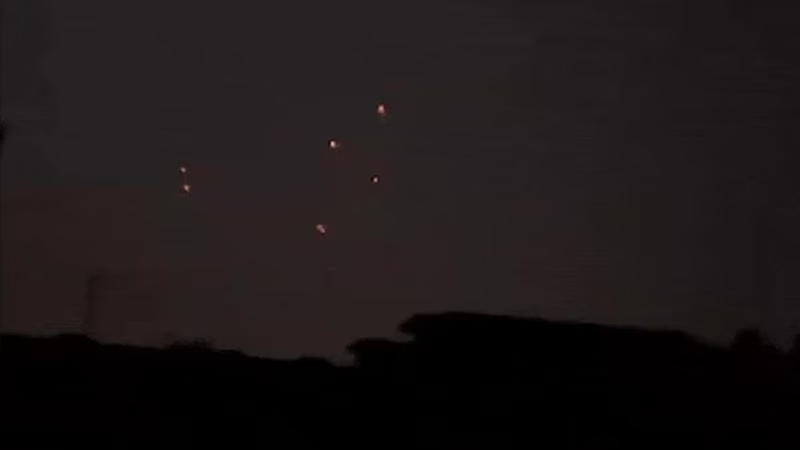
Tension is mounting along India’s western frontier as security forces scramble to respond to a disturbing new pattern: repeated drone incursions in the Jammu region. In the latest incident, a suspected drone was sighted near the International Border (IB), marking the third such occurrence in less than 96 hours. These aren’t random flyovers—they’re calculated intrusions that signal a growing reliance on unmanned aerial systems by hostile elements, likely backed by Pakistan-based networks, to conduct surveillance or smuggle contraband into sensitive Indian territory .
The Border Security Force (BSF), already on high alert, has intensified night patrols and deployed advanced detection systems. But the frequency of these Jammu drone sightings reveals a troubling gap in India’s aerial defense perimeter—one that could have serious implications for national security if not addressed urgently.
Table of Contents
- Timeline of Recent Jammu Drone Sightings
- Why Jammu Is a Hotspot for Drone Activity
- The Threat Beyond Surveillance: Smuggling and Espionage
- How India Is Fighting Back: Anti-Drone Tech
- Pakistan’s Role and Denials
- What Needs to Change: Policy and Technology Gaps
- Conclusion
- Sources
Timeline of Recent Jammu Drone Sightings
According to official BSF sources, the spate of incidents began earlier this week:
- January 13, 2026: First drone spotted near Arnia sector in Jammu; search operations launched but no recovery reported.
- January 15, 2026: Second drone detected in the same general area during night patrol; troops fired warning shots.
- January 16, 2026: Third drone sighting confirmed—this time closer to forward posts, prompting immediate airspace monitoring and ground alerts .
All three incidents occurred within a 15–20 km stretch of the IB, suggesting a coordinated effort rather than isolated attempts.
Why Jammu Is a Hotspot for Drone Activity
Jammu’s geography makes it uniquely vulnerable. Unlike the rugged, mountainous terrain of Kashmir, the Jammu plains offer relatively flat, open corridors that are easier for small drones to navigate under radar cover. Additionally, the region is home to critical military installations, ammunition depots, and major highways connecting Punjab to Ladakh—making it a prime target for reconnaissance.
Moreover, the dense rural landscape provides ample cover for drone operators to launch and retrieve devices without being easily spotted from the Indian side.
The Threat Beyond Surveillance: Smuggling and Espionage
While early drone incursions were primarily for intelligence gathering, recent seizures tell a more alarming story. In 2025 alone, Indian forces recovered over 200 kg of narcotics and dozens of pistols dropped by drones along the Punjab and Jammu borders . These devices are increasingly used as silent mules for cross-border smuggling.
Potential threats include:
- Narcotics trafficking: Fueling addiction and funding terror networks.
- Weapon delivery: Small arms or IED components to sleeper cells.
- Electronic espionage: Drones equipped with signal interceptors or cameras to map troop movements.
For more on how drones are reshaping border warfare, see our analysis on [INTERNAL_LINK:future-of-border-security-drones].
How India Is Fighting Back: Anti-Drone Tech
The Indian government has fast-tracked the deployment of indigenous counter-drone systems. The BSF and Army are now testing a multi-layered defense approach:
- Detection: RF scanners and radar systems like the “Drishti” and “Indrajaal” to spot low-flying, slow-moving objects.
- Neutralization: Drone-jamming guns that disrupt GPS and communication links.
- Hard Kill: Laser-based systems and net-firing drones to physically capture or destroy hostile UAVs.
However, experts warn that current coverage is patchy. A 2025 report by the Ministry of Home Affairs admitted that only 30% of high-risk border sectors have full anti-drone capability .
Pakistan’s Role and Denials
While no group has claimed responsibility, Indian intelligence agencies consistently point to Pakistan’s Inter-Services Intelligence (ISI) and proxy groups like Lashkar-e-Taiba as the masterminds behind these operations. Pakistan routinely denies involvement, calling such allegations “baseless propaganda.” Yet, multiple recovered drones have carried Pakistani serial numbers or SIM cards traceable to Pakistani telecom providers .
This cat-and-mouse game continues despite diplomatic protests, highlighting the limitations of traditional deterrence in the age of asymmetric warfare.
What Needs to Change: Policy and Technology Gaps
To counter this evolving threat, India must act on multiple fronts:
- Accelerate procurement: Fast-track acquisition of anti-drone systems for all border outposts.
- Integrate AI: Use machine learning to predict drone launch patterns based on weather, terrain, and historical data.
- Strengthen laws: Enforce stricter penalties under the updated Drone Rules, 2023, for cross-border misuse.
- Community intelligence: Engage local villagers as “eyes on the ground” through reward-based reporting mechanisms.
As noted by the Stockholm International Peace Research Institute (SIPRI), “Non-state actors and state proxies are increasingly leveraging commercial drone tech to bypass traditional defenses—a trend India must treat with strategic urgency” .
Conclusion
The recent surge in Jammu drone sightings is not a minor border nuisance—it’s a clear signal of a new era in hybrid warfare. With adversaries exploiting the skies as a stealthy corridor for espionage and smuggling, India’s response must be equally innovative and relentless. While the BSF’s vigilance has so far prevented major breaches, the window to close this aerial vulnerability is narrowing. Without a comprehensive, tech-driven strategy, the next drone might not just be watching—it could be delivering something far more dangerous.
Sources
[1] Times of India. (2026, January 16). Jammu: Two incidents of drone spotting near International Borders; third such incident in 4 days. https://timesofindia.indiatimes.com/india/jammu-two-incident-of-drone-spotting-near-international-borders-third-such-incident-in-4-days/articleshow/126549798.cms
[2] Press Trust of India (PTI). (2025, December). Over 200 kg drugs seized from drone drops along Punjab-Jammu border in 2025.
[3] Ministry of Home Affairs, Government of India. (2025). Annual Report on Border Security Infrastructure.
[4] The Hindu. (2025, November). Recovered drones carry Pakistani SIM cards, say security sources.
[5] Stockholm International Peace Research Institute (SIPRI). (2025). Emerging Technologies and Border Security in South Asia. https://www.sipri.org