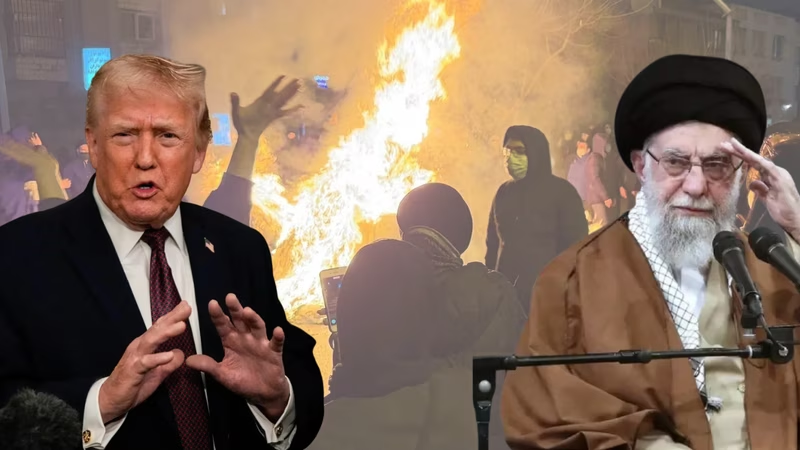
President Donald Trump has reportedly pushed for a “decisive” military strike against Iran—a move that sounds deceptively simple if you’re comparing it to past U.S. interventions in weaker states like Venezuela. But experts across the defense and intelligence communities are sounding the alarm: Iran is not Venezuela. Not even close. Attempting to treat it as such could trigger a catastrophic chain reaction across the Middle East and beyond .
While Venezuela’s military is fragmented and its government isolated, Iran boasts a sophisticated defense network, deep regional alliances, and the capability to retaliate with devastating precision. The idea that a limited strike could be contained or easily executed ignores decades of strategic buildup by Tehran—and the hard lessons of history.
Table of Contents
- Why Trump Wants a ‘Decisive’ Strike
- The US Strike on Iran Reality Check
- Venezuela vs. Iran: A False Comparison
- Iran’s Regional Influence and Retaliation Options
- What the Pentagon and Allies Are Saying
- Historical Precedents and Lessons Ignored
- Conclusion
- Sources
Why Trump Wants a ‘Decisive’ Strike
Trump’s push appears rooted in his long-standing frustration with Iran’s nuclear ambitions, support for proxy militias, and recent crackdowns on domestic protests. He has previously threatened “maximum pressure” and hinted at overwhelming force to deter Tehran . In his view, a swift, powerful strike could reset the balance of power and force Iran back to the negotiating table—much like how economic sanctions have crippled Venezuela’s regime.
But this analogy collapses under scrutiny. Venezuela, despite its oil wealth, has a demoralized military, no significant air defense, and minimal capacity to project power beyond its borders. Iran is a different beast entirely.
The US Strike on Iran Reality Check
A military operation against Iran would face immediate and severe challenges:
- Advanced Air Defenses: Iran operates Russian-made S-300 systems and its own indigenous Bavar-373, capable of tracking and engaging multiple aircraft and missiles simultaneously .
- Asymmetric Warfare Expertise: Through the Islamic Revolutionary Guard Corps (IRGC), Iran has spent decades perfecting guerrilla tactics, drone warfare, and cyber operations.
- Geographic Complexity: Unlike Venezuela’s accessible coastline, Iran’s key targets are often inland, hardened, or buried—requiring sustained bombing campaigns, not just a single strike.
Even a “limited” strike could quickly spiral. As one former Pentagon official noted, “There’s no such thing as a surgical strike on Iran. They will respond—and they have options everywhere.”
Venezuela vs. Iran: A False Comparison
Let’s break down the myth head-on:
| Factor | Venezuela | Iran |
|---|---|---|
| Military Spending (2025 est.) | ~$1.5 billion | ~$25+ billion |
| Active Personnel | ~130,000 | ~600,000+ |
| Ballistic Missiles | None operational | Over 3,000, with ranges up to 2,000 km |
| Regional Allies | Isolated (Cuba, Nicaragua) | Hezbollah, Houthis, Iraqi militias, Syria |
The disparity is staggering. While the U.S. could impose a naval blockade or conduct symbolic flyovers over Venezuela with minimal risk, any similar action against Iran would be met with immediate, coordinated resistance.
Iran’s Regional Influence and Retaliation Options
If struck, Iran wouldn’t just fire missiles at U.S. bases in Qatar or Iraq—it could unleash its vast network of proxies:
- Hezbollah in Lebanon could launch rocket barrages into Israel, dragging the U.S. ally into the conflict.
- Houthi rebels in Yemen might escalate attacks on Red Sea shipping lanes, disrupting global trade.
- Shia militias in Iraq could target U.S. embassies and personnel, forcing a wider ground engagement.
Moreover, Iran controls the Strait of Hormuz—the world’s most critical oil chokepoint. Even a temporary closure could send oil prices soaring above $150 a barrel, triggering a global recession .
What the Pentagon and Allies Are Saying
Behind closed doors, U.S. military leaders have consistently warned against rash action. NATO allies, including the UK and Germany, have urged restraint, fearing a regional conflagration that could destabilize Europe through refugee flows and energy shocks .
Even within the Trump administration, there’s been friction. Former Defense Secretary Mark Esper famously resisted calls for escalation, warning that “one bomb could lead to a thousand.” That caution remains relevant today.
Historical Precedents and Lessons Ignored
The 1980s Tanker War between the U.S. and Iran offers a sobering preview. What began as a limited escort mission for oil tankers escalated into direct naval battles and mine-laying campaigns. The U.S. lost the USS Stark to an Iraqi missile—a friendly fire incident born of chaotic escalation .
More recently, the 2020 assassination of Qasem Soleimani showed how quickly tit-for-tat actions can bring two nations to the brink of all-out war. Iran’s retaliatory missile strike on Al Asad Air Base injured over 100 U.S. troops—proof that Tehran can and will hit back hard.
For more on how past interventions shaped current policy, see our analysis on [INTERNAL_LINK:history-of-us-interventions-in-middle-east].
Conclusion
Calling for a “decisive” US strike on Iran may sound tough in a press briefing, but the geopolitical reality is far more complex and dangerous than any Venezuela-style scenario. Iran’s military capabilities, regional reach, and willingness to absorb short-term pain for long-term gains make it a uniquely formidable adversary. Any military action must account for the near-certainty of massive retaliation—not just from Iran itself, but from its web of allies across the Middle East. In this high-stakes game, miscalculation isn’t just possible; it’s probable. And the cost could be measured in thousands of lives and trillions in global economic damage.
Sources
[1] Times of India. (2026, January). Trump wants a ‘decisive’ strike on Iran: Why it won’t be as easy as Venezuela — explained. https://timesofindia.indiatimes.com/world/us/trump-wants-a-decisive-strike-on-iran-why-it-wont-be-as-easy-as-venezuela-explained/articleshow/126546691.cms
[2] Congressional Research Service. (2025). Iran’s Military Capabilities and Doctrine.
[3] International Institute for Strategic Studies (IISS). (2025). The Military Balance 2025. https://www.iiss.org
[4] Janes Defence Weekly. (2025). Iran’s Integrated Air Defense Network.
[5] U.S. Energy Information Administration (EIA). (2025). Strait of Hormuz: World Oil Transit Chokepoints. https://www.eia.gov
[6] NATO Public Statements. (2026, January). Allied Concerns Over Escalation in the Gulf.
[7] U.S. Naval Institute. (2024). The Tanker War: Lessons from the 1980s Gulf Conflict.