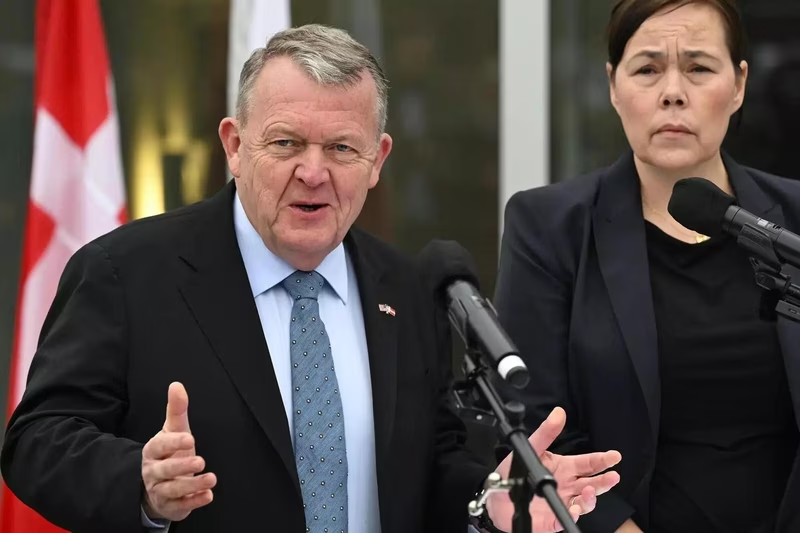
It started as a bizarre headline that many dismissed as a passing whim. Now, Donald Trump’s persistent ambition to “own” Greenland has evolved into a serious geopolitical flashpoint, exposing raw nerves and strategic fractures within the very heart of the Western alliance: NATO. This isn’t just about a vast, icy island; it’s a high-stakes battle over the future of the Arctic, a region rich in resources and critical for global military dominance .
The renewed push from the former president has sent shockwaves through European capitals, with allies openly questioning America’s commitment to the collective security principles that have underpinned the transatlantic partnership for decades. The result? A visible and growing tension that some fear could lead to a monumental fallout .
Table of Contents
- Why Trump Wants Greenland: More Than Just Real Estate
- The NATO Nightmare: Alliance Cracks Under Pressure
- Denmark and Greenland’s Defiant Stance
- The New Cold War in the Arctic
- What This Means for Transatlantic Security
- Conclusion
- Sources
Why Trump Wants Greenland: More Than Just Real Estate
While Trump’s initial 2019 offer to buy Greenland was met with ridicule, his current rationale is rooted in hard-nosed strategic thinking. He frames the autonomous Danish territory as absolutely central to U.S. national security, pointing to the growing influence of rival powers like China and Russia in the Arctic region .
The island is home to the Thule Air Base, a critical U.S. military installation that houses early-warning radar systems and space surveillance assets. Controlling Greenland would grant the U.S. an unparalleled strategic advantage in monitoring activity across the northern hemisphere and securing new shipping lanes that are opening due to climate change.
The Trump Greenland NATO Nightmare: Alliance Cracks Under Pressure
This is where the plan collides with reality. NATO, the cornerstone of Western defense, operates on the principle of collective security among its sovereign members. Denmark is a founding member of NATO, and any unilateral American attempt to seize or pressure a part of its kingdom is seen as a direct assault on the alliance’s integrity .
European leaders have issued stark warnings against such unilateral action, fearing it sets a dangerous precedent that undermines the very trust holding the alliance together . The situation has become so tense that it has been described as a potential catalyst for the end of the NATO military alliance as we know it .
Denmark and Greenland’s Defiant Stance
The people of Greenland and their government have been unequivocal: “Not now, not ever.” They have firmly rejected the notion of a U.S. takeover, asserting that their defense must come through the existing NATO framework, not through a forced acquisition .
Danish Prime Minister Mette Frederiksen has been equally resolute, viewing the U.S. president’s comments as a direct challenge to Danish sovereignty. In response to the heightened rhetoric, Denmark has announced it is boosting its own military presence in the territory, a clear signal of its intent to defend its constitutional realm .
The New Cold War in the Arctic
Beyond the internal NATO drama, Trump’s focus on Greenland is a symptom of a larger global shift. The Arctic is becoming the world’s newest arena for great-power competition. As ice melts, vast reserves of oil, gas, and rare earth minerals are becoming accessible, alongside new, shorter maritime trade routes between Asia and Europe.
Russia has already heavily militarized its Arctic coastline, while China has declared itself a “near-Arctic state” and is investing heavily in icebreakers and research. In this context, Trump’s aggressive posture can be seen as an attempt to secure a dominant U.S. position before it’s too late. However, his transactional approach—viewing alliances as deals to be bargained rather than partnerships to be nurtured—risks alienating the very allies needed to counter these common threats .
What This Means for Transatlantic Security
The Trump Greenland NATO saga reveals a fundamental philosophical divide. On one side is a vision of security based on shared values, mutual respect, and collective defense. On the other is a vision driven by transactional nationalism and the pursuit of unilateral advantage.
This rift has tangible consequences:
- Eroded Trust: Allies are less likely to share intelligence or coordinate military operations if they fear their own territories could become bargaining chips.
- Military Posturing: Instead of a unified front, we see individual nations like Denmark acting alone to protect their interests .
- Strategic Vulnerability: A fractured NATO is a weaker NATO, making it easier for adversaries like Russia and China to exploit divisions in the strategically vital Arctic.
For a deeper dive into the history of U.S.-European relations, see our analysis on [INTERNAL_LINK:history-of-nato-alliance].
Conclusion
Trump’s Greenland obsession is far more than a political sideshow. It’s a stress test for the NATO alliance that has revealed significant structural weaknesses. While the immediate goal may be to counter Russian and Chinese ambitions in the Arctic, the method—bullying a key ally—threatens to achieve the opposite by splintering the Western coalition. The path forward requires diplomacy, respect for sovereignty, and a return to the core principles of collective security that have kept the peace for generations. The future of the Trump Greenland NATO relationship will be a key indicator of whether the transatlantic alliance can survive the challenges of the 21st century.
Sources
[1] Times of India. (2026, January). Greenland Becomes Flashpoint as Trump Presses NATO Allies.
[2] DW News. (2026, January 7). Danish PM: Greenland Takeover Means End of NATO.
[3] Various Media Reports. (2026, January). Greenland ‘SHUTS’ Trump’s Takeover Bid.
[4] Times of India. (2026, January 6). Arctic security or minerals: Why Trump really wants Greenland.
[5] International News Source. (2026, January). Greenland’s government says its defence must come through NATO.
[6] Times of India. (2026, January). Seizing Greenland risks ‘monumental’ fallout, ex-Iceland official warns.
[7] Defense News Wire. (2026, January). NATO allies are moving troops and military assets to Greenland.
[8] Gricius, G. (2024). NATO in the Arctic. Academic Journal on Transatlantic Security.