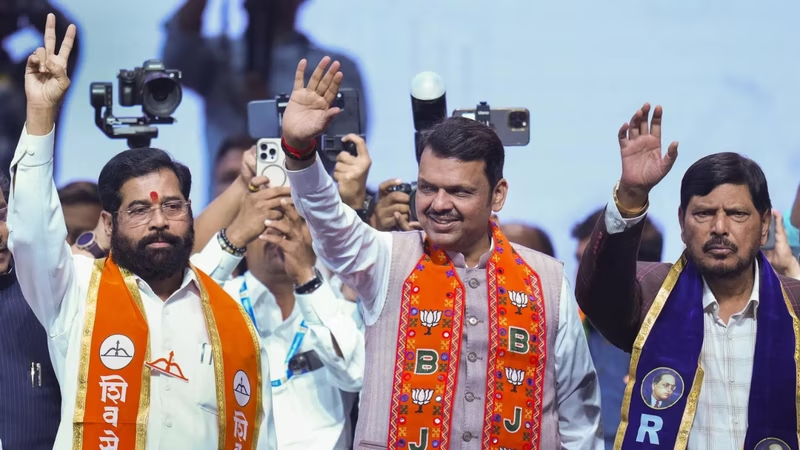
Mumbai’s political landscape may be on the verge of its most dramatic realignment in decades. According to multiple credible exit polls, the BJP-led **Mahayuti alliance**—comprising the BJP, Shiv Sena (Eknath Shinde faction), and NCP (Ajit Pawar group)—is set for a stunning **sweep in the BMC elections**, with projections indicating it will secure well over 130 of the 227 council seats. If these numbers hold, it would mark not just a civic victory but a symbolic conquest of India’s financial capital by the ruling national coalition.
In stark contrast, the opposition alliance of Shiv Sena (Uddhav Thackeray’s UBT) and Raj Thackeray’s MNS is projected to win just over 60 seats—far below the 100+ they had hoped for. This underperformance, coupled with a voter turnout of nearly 50% across Mumbai and 28 other municipal corporations in Maharashtra, suggests a deep erosion of the Thackeray family’s once-unshakable hold on Marathi identity politics in the city.
Table of Contents
- Mahayuti Sweep in BMC: What the Exit Polls Show
- Why the Thackeray–MNS Alliance Fell Short
- BJP’s Strategy: Winning the Urban Heartland
- Turnout and Voter Sentiment in Mumbai
- Broader Implications for Maharashtra Politics
- Conclusion: Is This the End of the Thackeray Era in Mumbai?
- Sources
Mahayuti Sweep in BMC: What the Exit Polls Show
Major polling agencies, including Axis My India and CVoter, have converged on a remarkably consistent forecast: the Mahayuti alliance is on track to win between **130 and 151 seats** in the Brihanmumbai Municipal Corporation (BMC). This would give the coalition not only a clear majority but also the ability to elect the mayor and control all key standing committees—from infrastructure and health to taxation and urban planning.
The BJP alone is projected to emerge as the single largest party, potentially crossing the 90-seat mark—a historic first for the saffron party in Mumbai. Its allies, the Shinde-led Shiv Sena and Ajit Pawar’s NCP, are expected to contribute another 30–40 seats combined, cementing their legitimacy as viable alternatives to their estranged parent factions.
Why the Thackeray–MNS Alliance Fell Short
The much-hyped “Marathi manoos” unity between Uddhav Thackeray’s Shiv Sena (UBT) and Raj Thackeray’s MNS was supposed to counter the Mahayuti juggernaut. Yet, early data suggests it failed to resonate with voters for several reasons:
- Fragmented Identity Appeal: Voters saw the alliance as opportunistic rather than organic, lacking ideological coherence.
- Poor Ground Game: The UBT struggled with booth-level organization, especially in western suburbs where BJP’s machinery dominated.
- Youth Disconnection: Younger voters prioritized development and governance over nostalgic Marathi pride narratives.
- MNS’s Declining Relevance: Once a force in central Mumbai, the MNS has lost significant ground to both BJP and Congress in recent years.
BJP’s Strategy: Winning the Urban Heartland
The BJP’s success in Mumbai isn’t accidental—it’s the result of a decade-long urban strategy that blends national symbolism with hyper-local delivery:
- Infrastructure Focus: Highlighting projects like coastal roads, metro expansions, and slum redevelopment.
- Digital Outreach: Using WhatsApp, Instagram, and local influencers to bypass traditional media.
- Caste & Community Mobilization: Building strongholds among OBCs, Gujaratis, and North Indian migrants.
- Alliance Synergy: Leveraging Shinde’s grassroots Shiv Sena network and Pawar’s rural-urban connect.
This multi-pronged approach has allowed the BJP to reframe itself not as an “outsider” party but as Mumbai’s natural governing force.
Turnout and Voter Sentiment in Mumbai
With a reported **voter turnout of nearly 50%**, participation was slightly higher than in previous BMC elections. Notably, women’s turnout exceeded men’s in several wards—a trend that could signal shifting civic engagement patterns. Exit interviews suggest voters were motivated less by charisma and more by concrete issues: flooding during monsoons, garbage management, property tax reforms, and public transport reliability.
For many, the choice wasn’t about ideology but accountability. “We want someone who will fix the roads, not just shout slogans,” said a voter from Kandivali, echoing a sentiment heard across middle-class neighborhoods.
Broader Implications for Maharashtra Politics
A Mahayuti sweep in Mumbai would reverberate far beyond the BMC headquarters at Mahapalika Marg:
- It would validate Eknath Shinde and Ajit Pawar’s decision to break from their original parties.
- It could accelerate the BJP’s push for full control in the 2029 state assembly elections.
- It may force Uddhav Thackeray to rethink his alliance strategy, possibly seeking closer ties with Congress.
Moreover, control of the BMC—a body with an annual budget exceeding ₹50,000 crore—grants immense patronage power, which can be leveraged for future electoral gains.
Conclusion: Is This the End of the Thackeray Era in Mumbai?
The projected Mahayuti sweep in BMC represents more than a change in civic leadership—it’s a cultural and political inflection point. For over three decades, the Thackeray name was synonymous with Mumbai’s identity. Now, that legacy appears to be fracturing under the weight of internal splits and changing voter priorities. While final results are still pending, the exit polls paint a clear picture: Mumbai is no longer the undisputed fortress of Marathi nativism. It’s becoming a city shaped by performance, pragmatism, and pan-Indian aspirations. For deeper insights into Maharashtra’s evolving political map, explore our feature on [INTERNAL_LINK:maharashtra-political-realignment-2026].