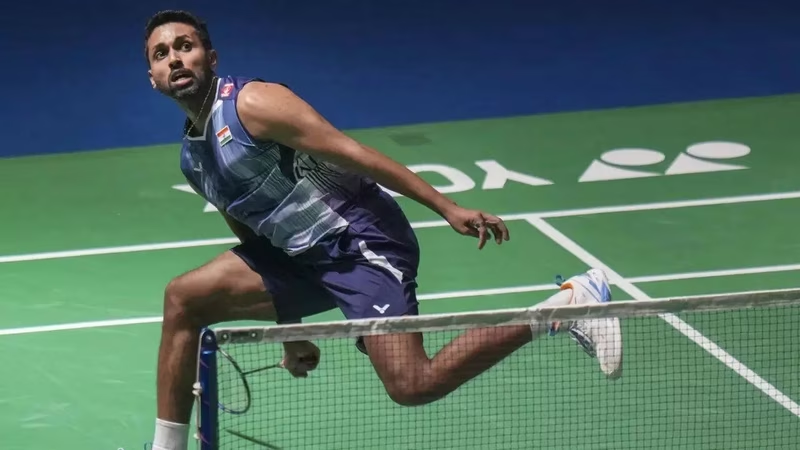
It was supposed to be a showcase of elite badminton—a marquee Super 750 event in the heart of New Delhi, featuring Olympic champions and rising stars. Instead, the India Open has become infamous for something far less glamorous: bird droppings falling from the ceiling onto the court. And it happened not once, but twice in two days—this time halting the high-stakes men’s singles match between India’s own HS Prannoy and Singapore’s Loh Kean Yew.
The incident, which drew gasps and groans from the crowd, directly contradicts repeated claims by the Badminton Association of India (BAI) that the KD Jadhav Indoor Hall at the Indira Gandhi Indoor Stadium is a “clean, world-class arena.” With global players already voicing concerns about venue conditions—including Danish star Anders Antonsen last year—the latest India Open bird poop fiasco has reignited criticism over poor infrastructure planning and lack of basic wildlife mitigation measures.
Table of Contents
- India Open Bird Poop Halts Prannoy vs. Loh Kean Yew
- A Pattern of Neglect: Wildlife and Venue Issues
- BAI Under Fire for Misleading ‘Cleanliness’ Claims
- Global Reactions and Precedents in Sports
- What Needs to Change for Future Tournaments
- Conclusion: When Birds Outshine the Players
- Sources
India Open Bird Poop Halts Prannoy vs. Loh Kean Yew
During the second game of their Round of 16 encounter, play was abruptly stopped when a fresh splatter of bird droppings landed near the center of the court. Umpires immediately called for a cleanup, and staff rushed in with mops and disinfectant—a scene more fitting for a comedy sketch than a professional sporting event. To make matters worse, this wasn’t the first interruption; earlier in the match, a similar incident had already delayed proceedings.
Adding to the surreal atmosphere was a reported monkey sighting near the stadium just hours before the match—an unwelcome reminder that the venue sits adjacent to forested areas of Delhi, making it prone to wildlife intrusion. While players maintained professionalism, social media erupted with memes and sharp criticism, with many asking: “How can India host top-tier tournaments if they can’t keep birds out of the arena?”
A Pattern of Neglect: Wildlife and Venue Issues
This isn’t an isolated glitch. In recent years, the Indira Gandhi Indoor Stadium has faced repeated scrutiny:
- In 2023, Danish players complained about poor air quality and inconsistent lighting.
- Last year, spectators noted visible dust on courts and malfunctioning scoreboards.
- Now, in 2026, the recurring bird issue suggests a systemic failure to address basic environmental controls—like installing netting or sealing roof openings.
For a sport as precise as badminton—where shuttlecocks are affected by the slightest draft or surface irregularity—even minor distractions can alter the outcome of a point. The fact that such disruptions are becoming routine at a Super 750 event is deeply concerning for India’s reputation as a reliable host.
BAI Under Fire for Misleading ‘Cleanliness’ Claims
Just days before the tournament began, BAI officials assured international federations and players that the venue had undergone “extensive sanitization and facility upgrades” to meet BWF (Badminton World Federation) standards. Yet, the reality on the ground tells a different story.
Industry insiders suggest that while cosmetic improvements were made—new paint, branded backdrops—the core structural issues remain unaddressed. “You can’t just sweep the floor and call it world-class,” said a former national coach who wished to remain anonymous. “If you’re hosting elite athletes, you need to think like a global city—not just decorate the problem away.”
Global Reactions and Precedents in Sports
Wildlife intrusions aren’t unheard of in sports, but they’re usually handled proactively. For example:
- The Wimbledon Championships use hawk deterrents and laser systems to keep pigeons away.
- Australian Open tennis courts are fully enclosed with climate-controlled roofs.
- Even smaller tournaments in Southeast Asia install fine mesh netting above courts to prevent bird access.
These solutions aren’t prohibitively expensive—they require foresight and commitment. Unfortunately, the repeated India Open bird poop incidents suggest a reactive rather than proactive approach to venue management.
What Needs to Change for Future Tournaments
To restore credibility, Indian sports authorities must take concrete steps:
- Install permanent bird netting** across the entire indoor hall ceiling.
- Conduct pre-tournament wildlife risk assessments in collaboration with environmental experts.
- Establish a transparent feedback channel for international players to report venue issues without fear of backlash.
- Invest in long-term infrastructure upgrades, not just temporary fixes for photo ops.
Hosting major events is a privilege—and a responsibility. India has the talent, the fans, and the passion. What it lacks is consistent execution at the operational level.
Conclusion: When Birds Outshine the Players
The India Open bird poop saga is more than a funny headline—it’s a symptom of deeper institutional complacency. As HS Prannoy and other Indian athletes fight for glory on the court, they deserve a stage that matches their ambition. Until then, the real stars of the tournament might just be the pigeons nesting overhead. For more on India’s struggle to modernize its sports infrastructure, see our analysis on [INTERNAL_LINK:india-sports-infrastructure-challenges].