Introduction: A State on Edge
West Bengal is witnessing a disturbing new wave of political unrest, with government offices becoming the epicenter of violent protests. The recent BDO office vandalism in Goalpokhar-II, North Dinajpur, is not an isolated incident but the second such attack in a matter of days, directly linked to the ongoing Special Intensive Revision (SIR) of electoral rolls. This isn’t just property damage; it’s a direct assault on the democratic process itself, leaving citizens, officials, and the nation deeply concerned.
Table of Contents
- The Goalpokhar-II Attack: What Happened?
- A Pattern of Violence: The Farakka Connection
- Decoding the SIR: What is this Controversial Process?
- Why the Anger? Public Anxiety and Political Blame
- The Fallout: Law, Order, and Democratic Integrity
- Conclusion: A Fragile Moment for Bengal
- Sources
The Goalpokhar-II Attack: What Happened?
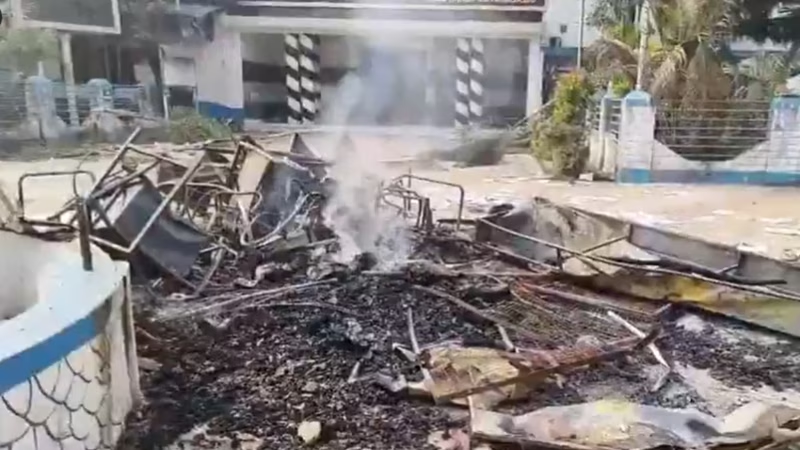
On January 15, 2026, a mob of approximately 300 people descended upon the Block Development Office (BDO) in Goalpokhar-II, North Dinajpur. Their target was a Special Intensive Revision (SIR) hearing that was underway. The situation quickly spiraled out of control, with the agitated crowd vandalizing the office and setting fire to official documents and property .
The damage was extensive, with initial estimates from the FIR pegging the loss at a staggering Rs 20 lakh. The violence wasn’t limited to property; police personnel and office staff were physically assaulted, with reports of an inspector being critically injured [[6], [14]]. This brazen attack on a seat of local governance has sent shockwaves through the district administration.
A Pattern of Violence: The Farakka Connection
This incident in North Dinajpur is alarmingly familiar. It directly follows a near-identical attack on the BDO office in Farakka, Murshidabad, just days prior. In that instance, the office was also ransacked and set ablaze during an SIR hearing, leading to a chaotic scene where election officials were attacked [[11], [17]].
The political finger-pointing has been swift and fierce. The BJP has squarely blamed the ruling Trinamool Congress (TMC), accusing TMC MLA Manirul Islam of leading the mob in the Farakka attack [[4], [13]]. This has escalated tensions between the two major parties, with the BJP now demanding the deployment of central forces to ensure the safe completion of the SIR process across the state .
Decoding the SIR: What is this Controversial Process?
To understand the root of this public fury, one must first understand the Special Intensive Revision (SIR). Mandated by the Election Commission of India (ECI), the SIR is a rigorous exercise designed to clean up and update the electoral rolls before major elections [[20], [21]]. Its goal is to ensure that every eligible citizen is included and that no ineligible names remain.
However, the process in West Bengal has become highly contentious. A key point of friction is the use of the 2002 electoral roll as a benchmark. Citizens are required to link their current identity to their own or their ancestors’ names on that 20-year-old list—a task that is proving impossible for many, especially those from marginalized communities who may lack proper documentation . This has created widespread anxiety and a sense of disenfranchisement, which appears to be boiling over into violent protests .
Why the Anger? Public Anxiety and Political Blame
The public anger seems to stem from a deep-seated fear of being excluded from the voter list, which is seen as a fundamental right and a tool for political representation. Reports have even linked the stress of the SIR process to tragic deaths in the state, further fueling public resentment .
Compounding this is the perception that the process is being weaponized for political gain. The opposition BJP claims the TMC is using its cadres to instigate chaos to either delay the process or manipulate the final voter list in its favor [[11], [13]]. On the other hand, the ruling party and its supporters might argue that the stringent verification process is unfairly targeting specific communities. This toxic mix of bureaucratic complexity and high-stakes politics has created a tinderbox environment.
The Fallout: Law, Order, and Democratic Integrity
The immediate fallout is a severe law and order crisis. With two BDO offices attacked in quick succession, the ability of the state administration to conduct its basic functions is under threat. The safety of government employees and police officers is now a major concern.
More importantly, the very integrity of the democratic process is at stake. When citizens resort to burning down offices to protest a voter registration drive, it signals a catastrophic breakdown of trust in the system. The ECI’s mission to create a fair and accurate electoral roll is being undermined by the very process it has initiated. This situation demands urgent intervention from both the state and central governments to restore peace and ensure the SIR can be completed without fear or intimidation. For more on the political landscape of the region, see our coverage on [INTERNAL_LINK:west-bengal-politics].
Conclusion: A Fragile Moment for Bengal
The BDO office vandalism in Goalpokhar-II is a stark warning sign. It’s not just about damaged property; it’s a symptom of a deeper societal fracture fueled by a controversial bureaucratic process and intense political rivalry. West Bengal stands at a fragile crossroads. The authorities must act swiftly to protect its citizens and its democratic institutions before this cycle of violence becomes the new normal. The world is watching to see if the state can navigate this crisis and uphold the principles of a peaceful and inclusive democracy.
Sources
- Times of India: 2nd BDO office vandalised in Bengal: SIR hearing was underway in Dinajpur; FIR filed
- Election Commission of India: Official Website
- Various news reports on the Farakka and Goalpokhar-II incidents [[1], [4], [5], [6], [10], [11], [13], [14], [17], [23]]