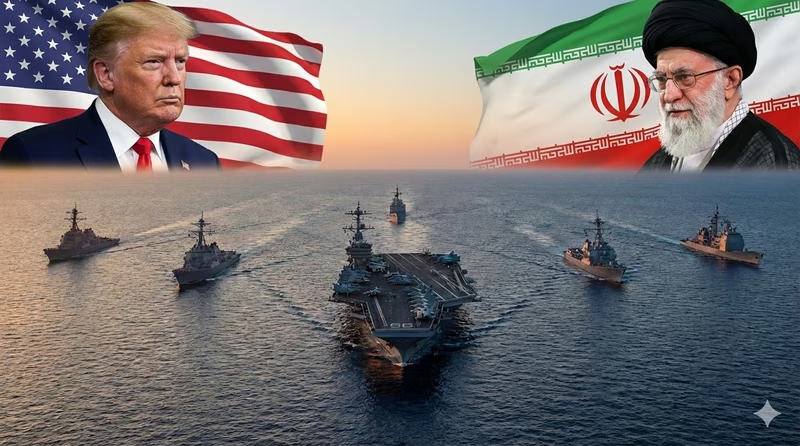
The chessboard of global power just got a lot more dangerous. In a move that has sent shockwaves through diplomatic and defense circles, the United States is redeploying a formidable US carrier strike group from the Pacific directly into the heart of the Middle East. This isn’t a routine rotation—it’s a clear signal of intent at a moment when Iran is already a tinderbox of internal unrest and external hostility.
With Tehran reeling from massive, violent protests and the death toll reportedly climbing into the thousands, the arrival of America’s most potent naval force raises a terrifying question: are we on the brink of a direct military confrontation? The stakes couldn’t be higher, and every nation in the region is holding its breath.
Table of Contents
- Why Is the US Moving a Carrier Strike Group?
- The US Carrier Strike Group Middle East Deployment: Details
- Iran’s Internal Crisis Fueling External Tensions
- Regional Fallout and Global Concerns
- What Are the Pentagon’s Options Against Tehran?
- Conclusion: Navigating a Perilous Moment
- Sources
Why Is the US Moving a Carrier Strike Group?
The official reason from the Pentagon is one of “prudent force posture adjustment” in light of the deteriorating security environment . But let’s be clear: this is a show of overwhelming force. A carrier strike group is not just a ship; it’s a floating city of military power, typically centered around a nuclear-powered aircraft carrier like the USS Gerald R. Ford or USS Nimitz, accompanied by a protective screen of destroyers, cruisers, and submarines.
This single formation can project power across an entire region, with its air wing capable of launching hundreds of sorties per day. Its movement is a deliberate and unmistakable message to adversaries—primarily Iran—that the US has both the capability and the will to respond decisively to any threat against its interests or allies.
The US Carrier Strike Group Middle East Deployment: Details
The specific strike group being moved was previously operating in the contested waters of the South China Sea, a key theater in the US-China strategic rivalry . Its sudden re-tasking to the US Central Command (CENTCOM) area of responsibility—a zone that includes the entire Middle East—is a significant strategic pivot.
This shift accomplishes several things:
- Deterrence: It aims to deter Iran from any aggressive actions, such as attacks on shipping lanes in the Strait of Hormuz or on US bases in the region.
- Reassurance: It reassures nervous allies like Saudi Arabia, Israel, and the UAE that the US remains committed to their security.
- Operational Flexibility: It gives US commanders a wide range of options, from a limited strike on Iranian facilities to a full-scale air campaign, should diplomacy fail.
The timing is critical. This deployment coincides with reports that the US State Department has advised its non-essential personnel in Qatar—a key hub for US military operations—to prepare to leave the country as a precautionary measure . This is a classic indicator that the US government believes the risk of a major incident is real and imminent.
Iran’s Internal Crisis Fueling External Tensions
To understand why the US is acting now, you have to look inside Iran. The country is experiencing its most severe internal crisis in years. What began as a nationwide traders’ strike over economic hardship has exploded into a popular uprising against the regime itself.
Credible international media outlets have reported a brutal crackdown, with estimates of over 2,000 protesters killed in a short span during a near-total internet blackout . The Iranian government has framed this as a foreign-backed “proto-revolution,” a narrative it uses to justify its violence and rally nationalist sentiment. In this context of extreme domestic fragility, the regime may act more aggressively abroad to distract its population or to test the resolve of its enemies, making the situation incredibly volatile.
Regional Fallout and Global Concerns
The ripple effects of this standoff are already being felt. Neighboring countries are deeply concerned about the potential for a wider conflict that could spill over their borders. The last thing the Gulf states need is another war that would disrupt oil flows, send energy prices skyrocketing, and create a new wave of refugees.
For the global economy, the implications are stark. The Strait of Hormuz is a vital chokepoint through which about 20% of the world’s oil passes. Any disruption there would have immediate and severe consequences for markets worldwide. This is why the international community, including traditional US allies in Europe, is likely urging maximum restraint behind closed doors.
What Are the Pentagon’s Options Against Tehran?
While the carrier strike group provides a powerful deterrent, it also represents a menu of potential military actions. Experts at institutions like the Center for Strategic and International Studies (CSIS) often outline a spectrum of options available to the US :
- Diplomatic Pressure & Sanctions: The continued use of economic sanctions to strangle Iran’s economy, though their effectiveness is increasingly debated.
- Covert Action: Cyber operations or support for internal opposition groups, a long-standing but deniable tactic.
- Targeted Military Strikes: Using the carrier’s air wing to hit specific Iranian assets, like drone factories, missile sites, or even nuclear facilities, in a limited “punishment” strike.
- Full-Scale Conflict: An option no rational actor wants, but one that becomes more plausible if a major attack on US forces occurs.
The presence of the carrier strike group makes options two and three far more credible and executable on short notice.
Conclusion: Navigating a Perilous Moment
The deployment of a US carrier strike group Middle East is the clearest possible sign that the US-Iran crisis has entered a new, more dangerous phase. It’s a high-stakes gamble designed to prevent war by showing a willingness to fight one. Yet, in a region already on edge, where miscalculation is a constant risk, the path forward is fraught with peril. The world must now hope that cooler heads prevail, and that the immense destructive power now steaming towards the Persian Gulf serves its ultimate purpose: to keep the peace, not to break it.
Sources
- Times of India: US-Iran tensions: Pentagon shifts carrier strike group to CENTCOM
- Iran International: Reporting on Iran Protests (January 2026)
- Center for Strategic and International Studies (CSIS): Analysis on US Military Posture in the Middle East