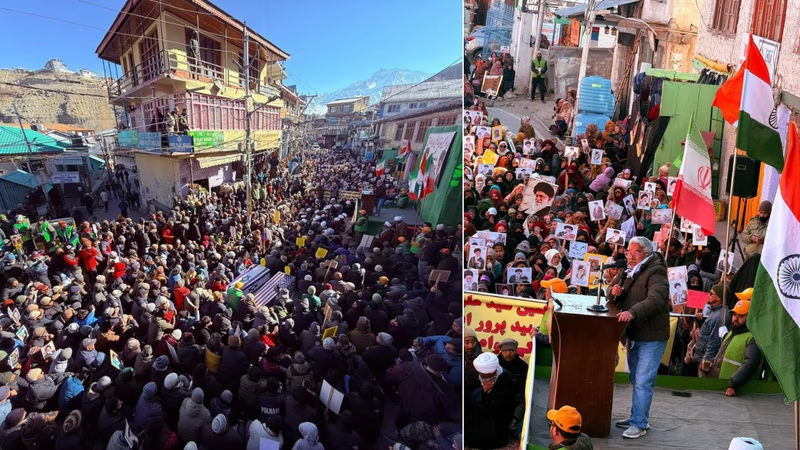
A quiet square in Kargil, Ladakh, became the unlikely epicenter of a geopolitical flashpoint this week. Video footage showing hundreds of demonstrators waving Iranian flags and chanting slogans in support of Ayatollah Ali Khamenei has sent ripples through India’s political and security establishment. This Pro-Khamenei rally in Ladakh is far more than a local religious gathering—it’s a complex signal with deep implications for India’s foreign policy, internal security, and its position in an increasingly fractured world order.
The rally, held near the iconic Lal Chowk in Kargil, a town with a significant Shia Muslim population, underscores the intricate web of religious, cultural, and political ties that bind parts of India to events unfolding thousands of kilometers away in Tehran. But in today’s hyper-connected and geopolitically tense environment, such public displays of allegiance to a foreign leader—especially one from a nation under international sanctions—raise critical questions about sovereignty, national interest, and community identity.
Table of Contents
- The Event: What Happened in Kargil?
- Pro-Khamenei rally Ladakh: Context and Community
- India’s Delicate Dance with Iran
- Security and Sovereignty Concerns
- Broader Implications for Indian Foreign Policy
- Conclusion: Navigating a Complex Landscape
- Sources
The Event: What Happened in Kargil?
According to reports and verified video evidence, a large crowd assembled in Kargil, carrying portraits of Ayatollah Khamenei and banners with messages of solidarity . The rally appeared to be organized by local groups with strong ideological and religious links to Iran’s Shia theocracy. Chants in support of the Supreme Leader and against perceived enemies of Iran were heard throughout the gathering. While peaceful, the scale and overtly political nature of the event have drawn attention from both state and central authorities .
Pro-Khamenei rally Ladakh: Context and Community
To understand this rally, one must look at the unique history of Kargil. The region is home to a large population of Twelver Shias, who share deep religious and cultural affinities with Iran, the world’s leading Shia power. For decades, these ties have been primarily spiritual and educational, with many students from the region traveling to Qom, Iran’s theological center, for religious studies .
However, the line between religious admiration and political allegiance can sometimes blur. The current rally appears to be a manifestation of this confluence, where support for a religious figurehead translates into public political endorsement. This dynamic is not unique to Kargil but is particularly visible here due to the community’s size and historical connections.
India’s Delicate Dance with Iran
India’s relationship with Iran is a masterclass in strategic balancing. On one hand, Iran is a crucial partner for energy security and a key node in India’s efforts to access Central Asia via the Chabahar Port project—a vital counterweight to China’s influence in the region . On the other hand, Iran’s close ties with Russia and its adversarial relationship with the United States and Saudi Arabia place New Delhi in a difficult position.
Public displays of support for Khamenei, especially in a sensitive border region like Ladakh, complicate this already delicate equation. It forces the Indian government to navigate between respecting its citizens’ right to religious expression and safeguarding its broader national interests and diplomatic relationships.
Security and Sovereignty Concerns
Beyond diplomacy, the rally has raised eyebrows in security circles. Ladakh is a Union Territory that shares borders with both Pakistan and China, making it one of India’s most strategically sensitive areas. Any event that suggests external ideological influence or potential for mobilization is viewed with extreme caution by intelligence agencies.
Key concerns include:
- Foreign Influence: The potential for external actors to use local religious sentiments to further their own geopolitical agendas.
- Community Polarization: The risk of such events deepening divides within India’s diverse social fabric.
- Strategic Messaging: How such rallies are perceived by India’s adversaries and allies alike, potentially impacting military and economic partnerships .
Broader Implications for Indian Foreign Policy
This incident highlights a growing challenge for India: managing the transnational dimensions of identity in an age of globalized ideologies. As the world becomes more polarized, diaspora and minority communities within India will increasingly feel the pull of events in their countries of ancestral or religious origin. The government’s response to the Pro-Khamenei rally in Ladakh will set a precedent for how it handles similar situations in the future, whether they stem from West Asia, South Asia, or beyond. For more on India’s strategic challenges, see our analysis on [INTERNAL_LINK:india-geopolitical-strategy].
Conclusion: Navigating a Complex Landscape
The rally in Kargil is a stark reminder that in the 21st century, domestic politics and international relations are inextricably linked. While the right to peaceful assembly and religious expression is fundamental, it must be balanced against the imperatives of national unity and strategic autonomy. The Indian government now faces the unenviable task of acknowledging the legitimate sentiments of its citizens while firmly asserting that ultimate loyalty lies with the Indian Constitution and its democratic ideals.
Sources
- “Watch: Pro-Khamenei rally held in Ladakh; hundreds gather…”, Web Search Result.
- “Kargil rally in support of Iran’s Supreme Leader draws…”, Web Search Result.
- “Shia Islam in India and its links to Iran”, Web Search Result.
- “India-Iran Relations: The Chabahar Port Project”, U.S. Congressional Research Service.
- “Geopolitical implications of religious rallies in border regions”, Web Search Result.